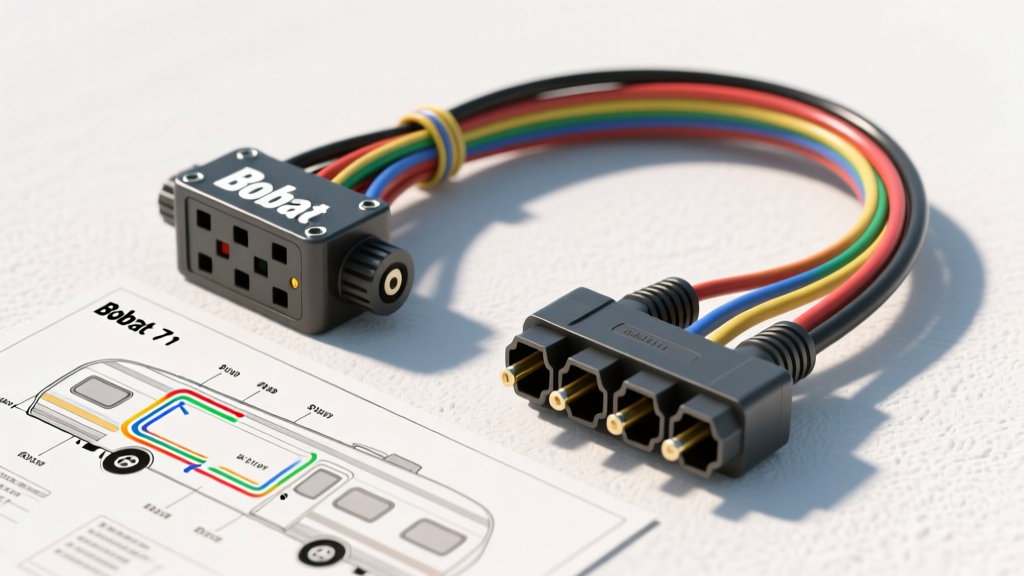
Understanding the Difference: Bobcat 7-Pin vs. Standard RV 7-Way
When outfitting a heavy-duty equipment trailer to haul compact track loaders or skid steers, confusion often arises between standard highway towing connectors and heavy-duty equipment control connectors. Searching for a bobcat 7 pin wiring diagram typically leads to skid steer attachment schematics, which are vastly different from the SAE J286 standard 7-way trailer plug used for highway towing. However, both connectors frequently coexist on custom equipment trailers, hydraulic tilt-deck trailers, and trailers with mounted power packs.
This comprehensive selection and comparison guide breaks down the technical specifications, pinouts, and application environments for both the standard RV 7-way blade connector and the heavy-duty Bobcat-style 7-pin circular connector. Whether you are wiring a custom trailer winch, integrating a hydraulic tilt bed, or simply ensuring your tow vehicle is correctly pinned for electric brakes, understanding these distinct systems is critical for safety and operational reliability.
The Standard SAE J286 Trailer 7-Way Connector
The standard 7-way RV connector, governed by the SAE J286 Standard, is the universal baseline for highway towing in North America. It utilizes a blade-style configuration designed for quick coupling and uncoupling, primarily handling low-to-medium amperage lighting circuits and electric trailer brakes.
SAE J286 Pinout and Wire Gauge Specifications
Adhering to strict AWG (American Wire Gauge) requirements is vital to prevent voltage drop, which can lead to weak electric brake engagement or dim trailer lights. The ground wire must be oversized to handle the cumulative return current of all circuits.
| Pin / Clock Position | Wire Color | Function | Min. AWG | Typical Amperage |
|---|---|---|---|---|
| Pin 1 (7:00) | White | Chassis Ground (Return) | 8 AWG | 20A - 40A (Cumulative) |
| Pin 2 (3:00) | Blue | Electric Trailer Brakes | 12 AWG (10 Preferred) | 12A - 18A |
| Pin 3 (9:00) | Green | Tail / Running / Marker Lights | 16 AWG | 5A - 8A |
| Pin 4 (1:00) | Black | 12V Auxiliary Power / Battery Charge | 10 AWG | 15A - 30A |
| Pin 5 (5:00) | Red | Left Turn Signal / Stop Lamp | 16 AWG | 4A - 8A |
| Pin 6 (11:00) | Brown | Right Turn Signal / Stop Lamp | 16 AWG | 4A - 8A |
| Pin 7 (Center) | Yellow | Backup Lights / Reverse Lockout | 16 AWG | 3A - 5A |
The Bobcat 7-Pin Attachment Connector Explained
The Bobcat 7-pin connector is a heavy-duty, military-style circular connector (often manufactured by Amphenol or Deutsch) used on older and mid-generation skid steers and compact track loaders to control hydraulic and electrical attachments like angle brooms, snow blowers, and trenchers. Unlike the SAE J286 blade connector, this circular connector is designed for high-vibration, high-moisture environments and utilizes robust, solid-pin contacts.
While modern Bobcat machines have largely transitioned to 14-pin connectors to accommodate CAN-bus communication and advanced proportional hydraulics, the 7-pin diagram remains highly relevant for aftermarket attachment wiring, legacy machine repair, and custom trailer-mounted hydraulic power packs.
Bobcat 7-Pin Circular Connector Pinout
When wiring a custom trailer hydraulic system or repairing an attachment harness, refer to this standard 7-pin layout. Wire colors can vary by aftermarket harness manufacturer, but the functional pinout remains standardized.
| Pin Letter | Standard Function | Wire Spec / Gauge | Crimp Type |
|---|---|---|---|
| Pin A | 12V Main Power (From Machine Battery) | 10 AWG (Stranded) | Solid Pin / Solder Cup |
| Pin B | Main Chassis Ground | 10 AWG (Stranded) | Solid Pin / Solder Cup |
| Pin C | Switch 1 (e.g., Forward / Left Control) | 14 AWG | Solid Pin |
| Pin D | Switch 2 (e.g., Reverse / Right Control) | 14 AWG | Solid Pin |
| Pin E | Auxiliary Control 1 | 14 AWG | Solid Pin |
| Pin F | Auxiliary Control 2 | 14 AWG | Solid Pin |
| Pin G | Enable / Aux 3 (Ignition Sense) | 14 AWG | Solid Pin |
Product Comparison: Blade-Style vs. Circular Heavy-Duty Connectors
Selecting the right connector for your equipment trailer depends entirely on the electrical load, environmental exposure, and coupling frequency. Below is a technical comparison to guide your selection.
- Environmental Sealing (IP Rating): The SAE J286 blade connector is generally IP54 rated (splash resistant) but highly susceptible to road salt and standing water corrosion. The Bobcat-style circular connector, when equipped with proper backshells and O-rings, achieves IP67 to IP69K ratings, making it submersible and pressure-wash safe.
- Vibration Resistance: Blade connectors rely on spring-tension friction, which can loosen under the high-frequency vibration of an empty equipment trailer bouncing down a washboard dirt road. Circular connectors utilize threaded coupling rings or bayonet locks, ensuring zero contact fretting under extreme vibration.
- Amperage Capacity: While the SAE J286 auxiliary pin (Black) can handle up to 30A-40A with proper 8 AWG wire, the heavy-duty circular pins (Pins A and B) can safely carry continuous 50A+ loads, making them ideal for powering trailer-mounted hydraulic solenoids, heavy winches, or deck lights.
Selection Guide: Integrating Both Systems on an Equipment Trailer
If you are building or upgrading a custom equipment trailer designed to haul a Bobcat skid steer, you will likely need both connectors. The SAE J286 7-way is legally required for highway towing (brakes and lights), while a heavy-duty 7-pin circular connector can be mounted on the trailer deck to interface with a trailer-mounted hydraulic power pack, a heavy-duty electric winch, or a detachable lighting stanchion.
Step-by-Step Integration Strategy
- Isolate the Circuits: Never splice the SAE J286 12V Auxiliary (Black wire) directly into the heavy-duty circular connector's Pin A without a high-amperage relay or a marine-grade circuit breaker (e.g., Blue Sea Systems 80A). The tow vehicle's alternator cannot safely supply the inrush current of a trailer hydraulic pump.
- Establish a Common Ground Bus: Run a dedicated 4 AWG ground cable from the trailer's main steel frame to a copper ground bus bar. Terminate both the SAE J286 White wire and the Circular Pin B ground to this bus bar using heat-shrink ring terminals. This prevents ground loops that can cause trailer brake controllers to throw 'SH' (Short) or 'OL' (Overload) error codes.
- Use a Breakaway System: For the electric brakes (Blue wire), ensure a dedicated breakaway battery is wired inline. If the trailer separates, the breakaway switch must pull full amperage to lock the brakes. Reference etrailer's wiring guidelines for proper breakaway switch integration.
Common Failure Modes and Troubleshooting
When dealing with heavy machinery trailers, electrical faults are a leading cause of downtime. Use this diagnostic matrix to identify and resolve common issues.
Troubleshooting Matrix
| Symptom | Probable Cause | Technical Fix |
|---|---|---|
| Trailer brakes pulse weakly; controller shows low voltage. | Voltage drop on the Blue (Brake) or White (Ground) wire due to undersized AWG or corrosion. | Upgrade brake circuit to 10 AWG. Clean ground ring terminal to bare metal and apply anti-oxidant paste. |
| Bobcat attachment (or trailer winch) solenoid clicks but won't engage. | High resistance on Pin A (Power) or Pin B (Ground) inside the circular connector due to moisture ingress. | Disassemble connector. Clean pins with electrical contact cleaner. Replace O-rings and pack with Nyogel 760G dielectric grease. |
| Trailer running lights blow fuses when hitting bumps. | Chafing on the 16 AWG Green wire near the trailer tongue pivot point. | Reroute harness through flexible nylon loom. Secure with Adel clamps every 12 inches to prevent fatigue failure. |
Expert Crimping and Termination Standards
The integrity of your bobcat 7 pin wiring diagram implementation relies entirely on the quality of your terminations. For the heavy-duty circular connector, avoid soldering if the equipment will be subjected to extreme flexing, as solder wicks up the wire strands and creates a brittle stress point that will eventually snap. Instead, use precision machined crimp pins and a calibrated ratcheting crimp tool (such as the HDT-48-00 or equivalent Deutsch tool). For the SAE J286 blade connector, use adhesive-lined dual-wall heat shrink terminals to seal out road salt and moisture, ensuring long-term reliability across all your equipment trailer deployments.
For further reading on heavy machinery attachment standards and electrical schematics, consult the official Bobcat attachment documentation to verify specific pinout variations for your exact machine serial number range.