The Fatal Mistake: Confusing Trailer Harnesses with Marine GPS Power
When outfitting a boat trailer, overland rig, or RV, DIYers frequently search for a 4 pin garmin power cable wiring diagram to connect their Garmin GPSMAP or EchoMap units to an auxiliary 12V DC system. However, a catastrophic and incredibly common mistake occurs when installers confuse the Garmin 4-pin circular marine/automotive connector with a standard 4-pin flat trailer lighting connector. Splicing a GPS power cable into a 4-way trailer harness is a guaranteed way to fry your tow vehicle’s Body Control Module (BCM), blow your trailer lighting fuses, and permanently destroy the Garmin unit’s internal logic board.
At Autoflowwire, we see the aftermath of these wiring disasters every week. Modern trucks (such as the 2015+ Ford F-150 and 2013+ Ram 1500) utilize highly sensitive multiplexed CAN bus systems and solid-state BCMs to manage trailer lighting. If you accidentally backfeed 12V+ power from a Garmin auxiliary battery setup into the green (right turn) or yellow (left turn) wires of a 4-pin flat trailer plug, you will send reverse voltage directly into the truck’s BCM. This results in thousands of dollars in dealership repair bills. Below, we break down the correct wiring protocols, AWG requirements, and safety warnings for integrating Garmin 4-pin power systems into trailer and tow vehicle electrical architectures.
Correct 4 Pin Garmin Power Cable Wiring Diagram & Pinout
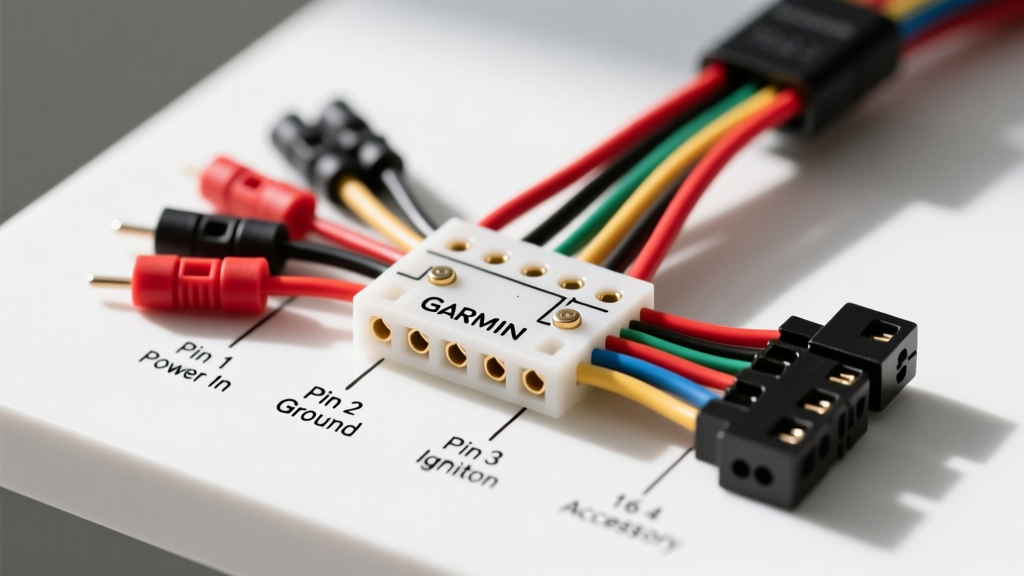
The Garmin 4-pin power and data cable (commonly used on GPSMAP 7x/8x/9x/12x series and EchoMap units) utilizes a waterproof, circular, threaded locking connector. This is entirely unrelated to RV or trailer blade connectors. Understanding the exact pinout is critical for safe power delivery and NMEA data transmission.
| Pin Number | Wire Color | Function | Connection / Safety Warning |
|---|---|---|---|
| Pin 1 | Red | 12V+ DC Power | Connect to a dedicated 12V+ source via an inline fuse. Never connect to a switched trailer light circuit. |
| Pin 2 | Black | Ground (Negative) | Must connect to a clean, bare-metal chassis ground or directly to the auxiliary battery negative terminal. |
| Pin 3 | Blue | NMEA 0183 Tx / CAN High | Data transmission. Requires shielded routing away from high-current trailer winch cables to prevent EMI. |
| Pin 4 | Green / Bare | NMEA 0183 Rx / CAN Low | Data receive. If unused, must be insulated and capped to prevent shorting against the chassis. |
Reference: Always verify your specific unit’s pinout against the official Garmin Support Installation Manuals, as older NMEA 0183 configurations may vary slightly from newer Garmin Marine Network (CAN bus) pinouts.
The 7-Pin RV Blade Auxiliary Pin Confusion
Another severe safety warning involves the 7-pin RV blade connector. Pin 4 on a standard 7-way trailer plug provides 12V+ auxiliary power (often used for charging trailer breakaway batteries or powering trailer-mounted winches). Many DIYers attempt to use this 7-pin auxiliary circuit to power their Garmin GPS units, assuming it provides a clean, stable 12V source. Do not do this.
The wiring running from the tow vehicle’s alternator, through the 7-pin umbilical cord, and back to the trailer tongue is notorious for severe voltage drop. Standard trailer umbilical cords use 10 AWG or 12 AWG wire, but the distance (often 20+ feet) combined with cheap, corrosion-prone blade connectors creates massive resistance. According to Ohm’s Law, under a 3-amp load, a long, degraded 7-pin auxiliary circuit can drop voltage below 10.5V. Garmin units are highly sensitive to under-voltage conditions; operating them below 11V can cause continuous reboot loops, corrupted memory cards, and degraded internal battery health. Always wire your Garmin unit to a dedicated, localized auxiliary deep-cycle battery mounted on the trailer tongue or in the truck bed, completely isolated from the 7-pin trailer charge line.
Wire Gauge (AWG), Fusing, and Extension Specifications
Garmin’s factory-supplied 4-pin power cables are typically 6 to 8 feet long, utilizing 18 AWG wire for data lines and 16 AWG for power. When extending this cable to reach a trailer-mounted battery box or a tow vehicle’s upfitter switch, you must adhere to strict marine and automotive electrical standards.
1. Use Marine-Grade Tinned Copper Wire
Trailer tongues and truck beds are high-corrosion environments. Standard automotive copper wire (untinned) will oxidize and turn black within months when exposed to road salt and moisture, leading to high resistance and voltage drop. You must use stranded, tinned copper wire that meets SAE J1128 or ABYC E-11 standards. Brands like Ancor or Pacer are industry benchmarks.
- Power Extension (Red/Black): Use 12 AWG stranded tinned copper for any extension over 5 feet to eliminate voltage drop.
- Data Extension (Blue/Green): Use 18 AWG shielded marine wire. The shielding must be grounded at one end only to prevent ground loops that corrupt NMEA data packets.
2. Inline Fusing Requirements
Never connect the Garmin Red (12V+) wire directly to a battery terminal without overcurrent protection. A short circuit in a trailer wiring harness can easily ignite the wire insulation, causing a catastrophic fire. Install an inline ATC/ATO waterproof blade fuse holder within 7 inches of the positive battery terminal. For most Garmin GPSMAP and EchoMap units, a 5-amp or 10-amp fuse is required (check your specific unit's manual). Use a high-quality marine fuse holder with an O-ring seal to prevent water ingress.
3. Crimping and Heat Shrink
Soldering is generally discouraged in high-vibration trailer environments because solder wicks into the wire strands, creating a rigid point that will eventually snap under road vibration. Instead, use adhesive-lined, marine-grade heat shrink crimp connectors (such as 3M MDT or Ancor). When you apply heat, the inner adhesive melts and seals the connection completely against moisture and oxygen.
Troubleshooting Common Garmin Power & Data Failures
If your Garmin unit is failing to power on, rebooting randomly, or displaying NMEA data errors after installation on a trailer or tow vehicle setup, consult this expert decision tree:
Symptom: Unit Randomly Reboots When Trailer Hits Bumps
- Cause: Voltage drop or a loose ground connection. Trailer tongues experience extreme harmonic vibration.
- Fix: Check the Black (Ground) wire termination. Do not use self-tapping screws into thin sheet metal. Bolt the ground ring terminal directly to the trailer frame using a star washer to bite through the paint and rust, ensuring a bare-metal-to-bare-metal connection. Apply dielectric grease over the terminal to prevent galvanic corrosion.
Symptom: NMEA Data is Corrupted or GPS Drifts
- Cause: Electromagnetic Interference (EMI) from a trailer winch or ground loop.
- Fix: Ensure the Garmin data cables (Blue/Green) are routed at least 6 inches away from high-current DC cables, such as those powering an electric trailer winch or brake controller. If a ground loop exists, isolate the NMEA ground or use a galvanic isolator on the data lines.
Symptom: Blown Fuse Immediately Upon Connection
- Cause: Reversed polarity or a shorted data pin.
- Fix: Disconnect the unit immediately. Use a multimeter to verify that the Red wire is receiving positive voltage relative to the Black wire. If you are using a custom-built adapter pigtail, verify that the Garmin proprietary circular connector pins are aligned correctly. Pin 1 must always be 12V+. Reversing Pin 1 and Pin 2 will instantly destroy the unit's internal reverse-polarity protection diode, requiring a costly factory repair.
Final Safety Directives for Trailer and Marine Integrations
Integrating sensitive marine electronics like Garmin GPS units into the rugged, high-vibration, and moisture-heavy environment of a trailer setup requires strict adherence to ABYC (American Boat & Yacht Council) standards, specifically ABYC E-11 for DC Electrical Systems. Never take shortcuts by tapping into trailer lighting circuits, brake controller outputs, or 7-pin auxiliary lines. By utilizing dedicated auxiliary batteries, tinned copper wiring, adhesive-lined heat shrink, and proper inline fusing, you ensure your Garmin unit receives clean, stable power, protecting both your expensive electronics and your tow vehicle’s vital electrical modules.