The Crossover: Gaming Floor Surveillance Meets the Road
When security integrators transition from fixed-location architectural projects to mobile Cash-in-Transit (CIT) environments, the stakes are remarkably similar. The principles governing a high-stakes casino security camera installation—zero blind spots, tamper-proof housings, redundant power, and overlapping multi-sensor fields of view—must be rigorously re-engineered for the violent vibrations, thermal cycling, and voltage fluctuations of a commercial van chassis. Upgrading an armored Ford E-Series or Transit Connect to meet these rigorous gaming-floor standards requires a complete departure from standard 12V automotive accessory wiring.
In a traditional casino security camera installation, IP cameras are powered via 802.3bt PoE++ (Power over Ethernet) delivering up to 90W per node through climate-controlled CAT6a plenum cables. In a mobile vault, you are battling a 220-amp commercial alternator generating massive electromagnetic interference (EMI), voltage drops during engine cranking, and physical shock. This guide details the exact wiring schematics, AWG specifications, and isolation protocols required to adapt casino-grade multi-sensor IP cameras to a 12V/24V automotive electrical system without inducing packet loss or hardware failure.
Powering 802.3bt PoE++ Cameras from a Commercial Chassis
Casino-grade panoramic cameras (such as 4x 5MP multi-sensor domes) require consistent 48V DC PoE++ delivery. An automotive charging system nominally outputs 13.8V to 14.4V, but can drop below 10V during diesel cranking cycles. Feeding a standard DC-DC step-up converter directly to the ignition circuit will result in NVR (Network Video Recorder) reboots and camera board damage due to inductive spikes.
To achieve the uptime expected of a casino security camera installation, the mobile power architecture must utilize an isolated auxiliary battery bank paired with a buck-boost DC-DC converter capable of maintaining a steady 48V output even when input voltage sags to 9V. According to SAE J1113 standards for automotive electromagnetic compatibility, all high-current DC-DC conversion must be heavily shielded and grounded directly to the chassis star-point to prevent high-frequency switching noise from bleeding into the data lines.
Table 1: Auxiliary Power & PoE Injector Wiring Matrix
| Circuit Segment | Wire Color (SAE) | AWG Size | Overcurrent Protection | Termination / Torque Spec |
|---|---|---|---|---|
| Aux Battery to DC-DC Converter Input | Red (Primary) / Black (Ground) | 6 AWG | 50A ANL Fuse (within 7 inches of battery) | 3/8" Ring Terminal, 12 Nm torque |
| DC-DC Converter 48V Output to PoE Injector | Orange (48V+) / Yellow (48V-) | 12 AWG | 10A Automotive Blade Fuse | Phoenix Contact MSTB Pluggable |
| Ignition Sense (Delay Trigger) | White (12V Signal) | 18 AWG | 2A Micro Fuse | 1/4" Spade, Heat Shrink Crimp |
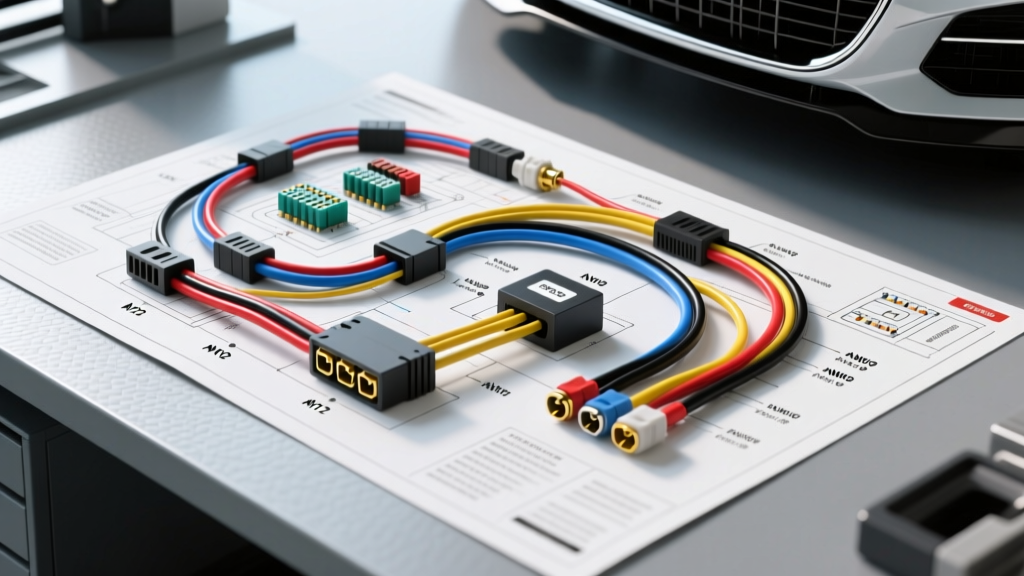
Wiring Diagram: Isolated Relay & Crank-Protection Logic
A critical failure mode in mobile surveillance is the voltage spike generated when the starter solenoid disengages, or when the alternator's voltage regulator overcompensates after a heavy cranking cycle. To protect the sensitive silicon in casino-grade IP cameras, we implement a delayed power-up sequence using a heavy-duty 5-pin Bosch-style isolation relay paired with a time-delay capacitor module.
This ensures the cameras and mobile NVR do not attempt to draw power or negotiate PoE handshakes until the van's alternator has stabilized at a minimum of 13.2V for at least 15 seconds post-crank.
Pinout Configuration: Delay Relay Harness
- Pin 30 (Common Input): 10 AWG Red wire from the 48V DC-DC converter output bus. Protected by a 15A fuse.
- Pin 87 (Normally Open Output): 12 AWG Orange wire routing to the 4-port Industrial PoE++ Injector main power input.
- Pin 86 (Coil Positive): 18 AWG White wire connected to the output of the 15-second delay timer module (triggered by the ignition run circuit).
- Pin 85 (Coil Negative): 18 AWG Black wire grounded to the nearest verified chassis star-ground point. Note: Do not ground to seatbelt bolts or painted surfaces; use a dedicated M6 self-tapping grounding screw into bare frame metal.
- Pin 87a (Normally Closed): Unused and sealed with adhesive-lined heat shrink to prevent moisture ingress.
Data Integrity: Shielding and M12 X-Coded Connectors
In a fixed casino security camera installation, RJ45 connectors are standard. In a mobile vault subjected to 4G of vibration and potential water ingress during pressure washing, RJ45 tabs will fracture and oxidize. The automotive and industrial standard for ruggedized IP video is the M12 X-Coded connector. X-coding allows for 10-Gigabit Ethernet transfer rates while maintaining an IP69K environmental seal.
When adapting CAT6a shielded cable to M12 X-coded pigtails for the exterior camera drops, the shielding drain wire must be managed precisely to avoid creating a ground loop between the camera housing (mounted to the armored steel body) and the NVR chassis.
Table 2: M12 X-Coded to CAT6a Shielded Mapping
| M12 X-Code Pin | Function | CAT6a Pair / Color | Shield Drain Wire Protocol |
|---|---|---|---|
| Pin 1 | TX+ (Transmit) | Pair 1 (White/Orange) | Terminate drain wire at the NVR end ONLY. Leave floating (capped) at the camera M12 end to prevent chassis ground loops. |
| Pin 2 | TX- (Transmit) | Pair 1 (Solid Orange) | |
| Pin 3 | RX+ (Receive) | Pair 2 (White/Green) | |
| Pin 4 | RX- (Receive) | Pair 2 (Solid Green) |
Installation Note: The M12 coupling nut requires exactly 0.6 Nm of torque. Under-torquing compromises the IP69K seal; over-torquing strips the internal PCB solder pads on the camera's logic board.
Defeating EMI and Ground Loops in Mobile NVRs
The most significant barrier to replicating a pristine casino security camera installation inside a commercial van is Electromagnetic Interference (EMI). A modern 220A+ alternator generates severe radiated and conducted noise. If unshielded CAT5e is used, the 1000Base-T data negotiation will fail, resulting in camera dropouts or severe video tearing.
Following guidelines supported by Belden Technical Documentation for industrial Ethernet environments, you must use continuous foil-shielded CAT6a (F/UTP or S/FTP) for all exterior runs. Furthermore, the shield must be bonded to the metal backshell of the M12 connector. Inside the van, all data cables must be routed at least 12 inches away from the main alternator power cables, AC inverter lines, and two-way radio coaxial cables to prevent cross-talk and packet loss.
Troubleshooting Decision Tree: Mobile IP Video Artifacts
When mobile IP streams exhibit artifacts, packet loss, or 'alternator whine' audio interference, use this diagnostic sequence:
- Symptom: Video freezes exactly when the van's engine is revved or the AC compressor clutch engages.
- Cause: Conducted EMI on the 12V input line overwhelming the DC-DC converter's filtering, causing micro-reboots in the PoE injector.
- Fix: Install a 10,000µF automotive-grade electrolytic capacitor across the 12V input terminals of the DC-DC converter to act as a low-pass filter, and verify the 6 AWG ground wire is under 0.05 ohms of resistance to the battery negative terminal.
- Symptom: Intermittent 'Network Cable Disconnected' alerts in the NVR logs, specifically on the rear cargo door cameras.
- Cause: Flex-fatigue on the CAT6a cable passing through the door hinge conduit, breaking the internal foil shield and inducing crosstalk.
- Fix: Replace standard solid-core CAT6a with stranded-core industrial robotics Ethernet cable (rated for continuous flexing) inside the door jambs, maintaining the M12 X-coded termination at both ends.
- Symptom: Night vision IR reflection 'washout' and corroded connector pins after 6 months.
- Cause: Improper M12 torque or missing dielectric grease, allowing capillary action to draw moisture into the camera's PoE negotiation pins.
- Fix: Clean pins with 99% isopropyl alcohol, apply a thin layer of Nyogel dielectric grease to the O-ring, and torque the M12 collar to 0.6 Nm using a calibrated torque screwdriver.
Summary: Bridging the Gap Between Architectural and Automotive
Executing a mobile vault upgrade using the benchmark standards of a casino security camera installation demands a hybrid skill set. Integrators must respect the strict data protocols and PoE power budgets of enterprise IT, while simultaneously applying the ruggedized, high-current, and vibration-resistant wiring practices of heavy-duty automotive engineering. By utilizing isolated buck-boost power architectures, M12 X-coded terminations, and strict single-point shield grounding, security teams can deploy mobile surveillance networks that are just as resilient and uncompromising as the gaming floors they emulate.
For further reading on physical security standards and mobile surveillance integration, refer to the guidelines published by ASIS International regarding cash-in-transit and mobile vault risk assessments.