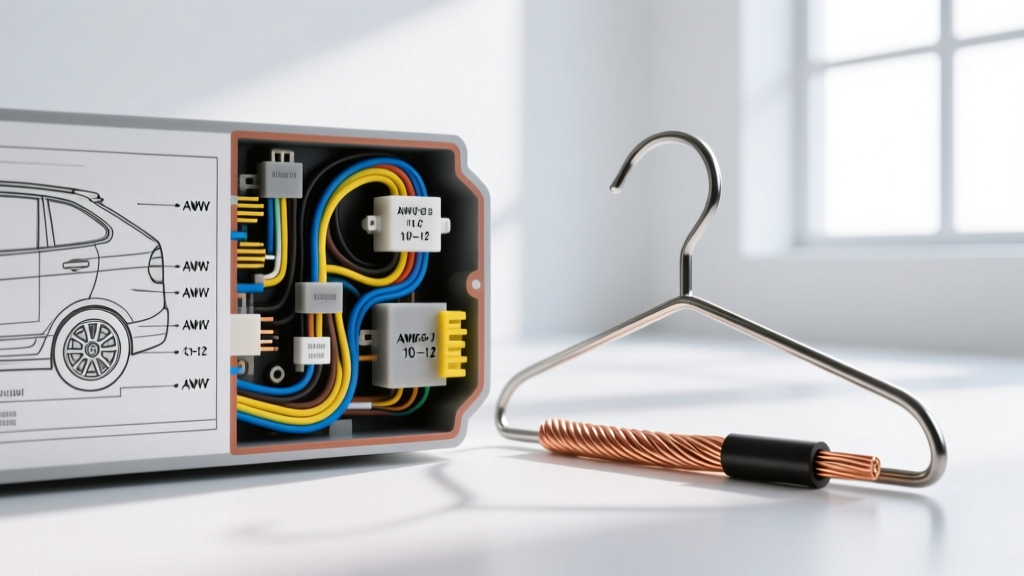
The Direct Answer: What Gauge Wire Is a Coat Hanger?
In the automotive and electrical repair world, the phrase 'shade tree mechanic' often conjures images of creative, albeit dangerous, makeshift repairs. One of the most persistent myths and dangerous practices involves repurposing a standard metal coat hanger as an electrical conductor. To answer the fundamental question: a standard steel wire coat hanger measures between 0.090 and 0.105 inches in diameter, which equates to a physical cross-section of roughly 12 AWG to 10 AWG.
However, in electrical engineering, physical diameter is only half the equation. The American Wire Gauge (AWG) system standardizes the geometry of a wire, but it does not dictate the metallurgy. Assuming a 10 AWG steel coat hanger can safely carry the same current as a 10 AWG copper wire is a catastrophic misunderstanding of resistivity, thermal dynamics, and automotive safety standards. Using a coat hanger in any 12V or 24V DC automotive circuit is a severe fire hazard and a direct violation of basic electrical safety protocols.
The Fatal Flaw: Diameter vs. Conductivity (Steel vs. Copper)
Automotive wiring relies heavily on annealed copper due to its exceptionally low electrical resistance. Standard coat hangers are manufactured from low-carbon steel, often coated with a thin layer of zinc (galvanized) or epoxy paint to prevent rust. Steel is a notoriously poor conductor of electricity compared to copper. In fact, the electrical resistivity of low-carbon steel is approximately 8 to 10 times higher than that of pure copper.
When you push current through a high-resistance material, the energy is converted into heat via I²R (current squared times resistance) heating. Below is a technical comparison demonstrating why a coat hanger fails as a 10 AWG equivalent in real-world applications.
| Material | AWG Equivalent | Diameter (in) | Resistivity (nΩ·m) | Safe Ampacity (Chassis) | Thermal Risk |
|---|---|---|---|---|---|
| Annealed Copper | 10 AWG | 0.1019 | 17.2 | 30 Amps | Low (Properly fused) |
| Low-Carbon Steel (Hanger) | 10 AWG | 0.090 - 0.105 | ~150.0 | < 5 Amps | Extreme (Acts as a heating element) |
| Aluminum | 10 AWG | 0.1019 | 28.2 | 20 Amps | Moderate (Requires specific lugs) |
As documented in standard conductor property references, pushing 20 amps through a steel hanger will cause it to glow red-hot within seconds, functioning more like a Nichrome toaster coil than a wire.
Common 'Shade Tree' Mistakes & Severe Safety Warnings
Understanding the physics is only the first step. In the field, we see coat hangers misused in three specific ways, each carrying distinct risks to the vehicle and its occupants.
Mistake 1: Jumping a Blown Automotive Fuse
The Scenario: A critical circuit, such as the fuel pump relay or ECU main power, blows a 20A or 30A ATC/ATO blade fuse. Instead of diagnosing the short circuit, a user cuts and bends a coat hanger to bridge the fuse slot terminals.
The Failure Mode: Modern automotive fuse boxes are typically molded from PA66-GF30 (Polyamide 66 with 30% glass fiber). While PA66 has a high melting point (~260°C), it begins to soften and structurally deform at temperatures as low as 150°C. Because the steel hanger has massive resistance, it generates intense localized heat at the terminal crimp points. The hanger will melt the plastic fuse box housing, permanently destroying the terminal tension. Worse, because the hanger bypasses the overcurrent protection, if the original short circuit is still present, the hanger will not melt fast enough to break the circuit. It will ignite the surrounding wiring harness loom and under-dash sound deadening materials.
Mistake 2: Using as a Fish Tape in Wire Looms
The Scenario: An installer needs to route new 14 AWG GXL wire through an existing corrugated split loom or a tight firewall grommet. They use a straightened coat hanger as a makeshift fish tape to pull the wire through.
The Failure Mode: Coat hangers are unyielding and feature sharp, sheared ends where they were cut at the factory. When forced through tight PVC or nylon looms, the bare steel easily scrapes and gouges the thin cross-linked polyethylene (XLPE) insulation of the actual automotive wire. This creates a micro-abrasion. Over time, engine bay vibrations and thermal cycling will cause the exposed copper to arc against the chassis or adjacent wires, leading to intermittent CAN-bus faults or dead shorts. Always use dedicated, rounded-tip nylon or flexible steel fish tapes with pulling eyes.
Mistake 3: DIY Ground Straps and Sensor Returns
The Scenario: A technician fabricates a makeshift chassis ground strap for an engine block or uses a hanger to ground an aftermarket accessory.
The Failure Mode: Automotive sensors, particularly narrowband Oxygen (O2) sensors, operate on highly sensitive voltage scales (typically 0.1V to 0.9V). They rely on a pristine ground path. If you use a steel hanger as a ground strap, the high resistance of the steel combined with the galvanic corrosion caused by the zinc coating will introduce a voltage offset. For example, a hanger with just 0.2 ohms of resistance carrying 2 amps of chassis return current will induce a 0.4V offset (V = I × R). The ECU will read this false voltage, interpret it as a severely rich exhaust condition, and drastically lean out the fuel trims, potentially causing engine detonation and throwing P0130 or P0172 diagnostic trouble codes.
Automotive Wiring Standards: What You Should Actually Use
To ensure safety, reliability, and compliance with automotive engineering standards, all repairs must adhere to SAE J1128 (Low Tension Primary Cable) specifications. Never substitute structural steel for electrical conductors.
- Wire Type: Use GXL, TXL, or SXL cross-linked polyethylene insulated copper wire. These offer superior resistance to under-hood heat (up to 150°C) and chemical exposure compared to standard PVC wire.
- Overcurrent Protection: If a fuse blows, diagnose the root cause (e.g., chafed wire near the O2 sensor bung, failing fuel pump drawing locked-rotor amperage). Replace only with an OEM-spec ATC, ATO, or Mini blade fuse of the exact same amperage rating.
- Grounding: Use flat, braided copper ground straps with properly crimped and solder-sealed ring terminals. Ensure the chassis mating surface is sanded down to bare, clean metal and treated with dielectric grease to prevent oxidation.
- Wiring Methods: The NFPA 70 (National Electrical Code) Article 110.8 strictly mandates that only wiring methods and components recognized as safe and approved for the specific environment may be used. This principle applies equally to 12V automotive DC systems.
Summary: The Coat Hanger Rule of Thumb
While a standard coat hanger may physically measure out to 10 or 12 AWG on a micrometer, its metallurgical properties render it entirely useless—and actively dangerous—for electrical conduction. Keep coat hangers in the closet for your dry cleaning, and keep high-strand-count, SAE J1128 compliant copper wire in your toolbox. When dealing with automotive electrical faults, there are no safe shortcuts; proper diagnostics and OEM-specified materials are the only way to ensure the vehicle operates safely and reliably.