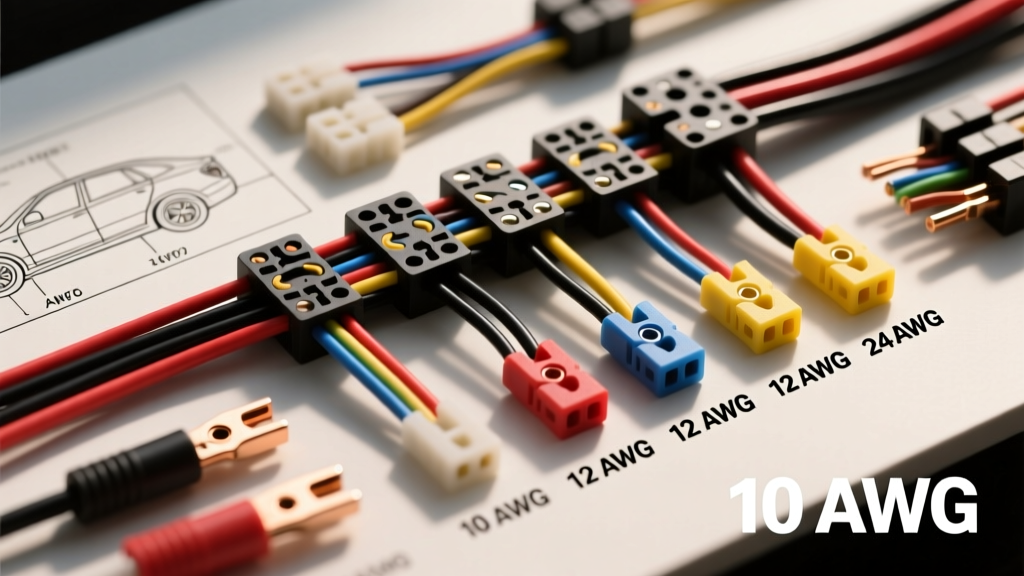
Decoding the AWG American Wire Gauge Table for Automotive Systems
Selecting the correct wire gauge is the most critical decision in any automotive electrical project. Unlike residential 120V AC wiring, a vehicle operates on a 12V to 14.4V DC system, meaning current (amperage) must be significantly higher to deliver the same wattage. This makes the AWG American wire gauge table an indispensable tool for preventing voltage drop, insulation melt-downs, and ECU communication failures. In this product comparison and selection guide, we break down the exact specifications, insulation types, and real-world circuit applications required for modern vehicle wiring.
The Core AWG American Wire Gauge Table (SAE J1128 Automotive Spec)
The table below outlines standard automotive stranded copper wire specifications. These values align with SAE International J1128 standards for low-tension primary cables. Ampacity ratings listed are for 'chassis wiring' (short runs under 15 feet in an engine bay or cabin), which allows for higher current capacity than 'power transmission' wiring.
| AWG Size | Metric (mm²) | Stranding (AWG/No) | Resistance (Ω/1000ft @ 20°C) | Max Amps (Chassis) | Common Automotive Application |
|---|---|---|---|---|---|
| 18 AWG | 0.82 | 16/30 | 6.39 | 6A | ECU Sensors, CAN-Bus, Low-draw LEDs |
| 16 AWG | 1.31 | 26/30 | 4.02 | 10A | Interior Lighting, Horns, Wiper Park |
| 14 AWG | 2.08 | 41/30 | 2.52 | 15A | Headlights (Halogen), Fuel Injectors |
| 12 AWG | 3.31 | 65/30 | 1.59 | 20A | Fuel Pumps, Power Windows, Cigarette Lighter |
| 10 AWG | 5.26 | 105/30 | 1.00 | 30A | High-Current Fuel Pumps, Radiator Fans |
| 8 AWG | 8.37 | 168/30 | 0.63 | 40A | Alternator Output, Amplifier Power (Small) |
| 4 AWG | 21.15 | 420/30 | 0.25 | 70A | Main Battery Feed, High-Output Alternators |
| 1/0 AWG | 53.50 | 1064/30 | 0.10 | 150A | Starter Motor, Competition Audio Grounds |
Insulation Selection: Comparing GPT, TXL, and SGT Wire Types
When consulting an AWG American wire gauge table, gauge size is only half the equation. The insulation jacket dictates the wire's temperature tolerance, flexibility, and chemical resistance. According to TE Connectivity automotive wire specifications, choosing the wrong insulation type can lead to catastrophic harness failures in high-heat zones.
GPT (General Purpose Thermoplastic)
GPT is the industry standard for general automotive wiring. It features a PVC insulation rated for continuous use up to 90°C (105°C for short excursions). It is cost-effective and highly flexible, making it ideal for cabin wiring, taillights, and interior accessory circuits. However, GPT should never be routed directly against exhaust manifolds or turbocharger housings.
TXL (Cross-Linked Thin Wall)
TXL wire utilizes Cross-Linked Polyethylene (XLPE) insulation, which pushes the temperature rating to 125°C. The 'thin wall' design reduces the outer diameter (O.D.) by up to 20% compared to GPT without sacrificing ampacity. This smaller O.D. is critical when packing high-pin-count connectors like the Delphi Metri-Pack 150 or 280 series, where space inside the connector cavity is extremely tight. TXL is the mandatory choice for engine bay sensor harnesses and EFI wiring.
SGT (Starter and General Purpose Heavy Duty)
SGT wire is governed by SAE J1127 and is specifically designed for battery-to-starter and battery-to-ground applications. It features a much thicker PVC jacket to resist physical abrasion, road debris, and battery acid. SGT is only available in larger gauges (6 AWG through 4/0 AWG) and is not suitable for routing through firewall grommets or tight looms.
The CCA Trap: Copper vs. Copper-Clad Aluminum
When purchasing wire based on an AWG American wire gauge table, you must verify the conductor material. Many budget-friendly 'stinger' or audio wires are made from CCA (Copper-Clad Aluminum). Aluminum has roughly 61% of the conductivity of pure copper. Therefore, a 4 AWG CCA wire will exhibit the resistance and voltage drop of a 6 AWG pure copper wire. In high-current EFI or charging system applications, CCA wire will overheat, oxidize at the crimp terminals, and cause severe voltage drop. Always demand 99.9% pure oxygen-free copper (OFC) for critical automotive circuits.
Real-World Selection Guide: Matching AWG to Automotive Circuits
Theoretical ampacity charts do not always account for the harsh realities of automotive voltage drops. Here is how to apply the AWG American wire gauge table to specific, high-stakes vehicle systems.
1. Electronic Fuel Injection (EFI) Sensor Harnesses
Modern ECUs rely on precise 5V reference signals from sensors like the TPS (Throttle Position Sensor) and MAP (Manifold Absolute Pressure).
- Gauge Selection: 18 AWG or 20 AWG TXL.
- Connector Type: Bosch EV1 or EV6 injector clips, Delphi Metri-Pack 150 for MAP sensors.
- Expert Insight: Do not use 16 AWG wire for 5V reference signals. The thicker wire will not seat properly into the tiny terminal cavities of a Metri-Pack 150 connector, leading to backed-out pins and intermittent ECU limp-mode triggers. Furthermore, 20 AWG Tefzel (TE Type E) is preferred for O2 sensor heater circuits due to its extreme heat resistance near the exhaust.
2. High-Flow In-Tank Fuel Pumps
Upgrading to a Walbro 450 or AEM 340lph fuel pump draws significant current, especially at base fuel pressures of 58 PSI or higher.
- Gauge Selection: 10 AWG GPT or TXL.
- Wiring Colors (GM LS Standard): Pin A (Gray) for 12V+, Pin B (Black) for Ground.
- Expert Insight: Factory fuel pump wiring is often 12 AWG or even 14 AWG, which was sufficient for a 9-amp stock pump. A high-flow pump pulling 15-18 amps will cause a massive voltage drop across 15 feet of 12 AWG wire. If the pump receives less than 12.5V, fuel volume drops exponentially. Always run a dedicated 10 AWG feed from a 30A relay directly to the pump hat pigtail.
3. Halogen Headlight Upgrades and Relays
Upgrading to high-wattage H11 or 9005 halogen bulbs (e.g., 85W or 100W) will melt factory 18 AWG headlight wiring and damage the multifunction switch.
- Gauge Selection: 14 AWG GPT for the relay harness.
- Connector Type: Ceramic H11/9005 pigtails (plastic will melt).
- Expert Insight: Use the AWG American wire gauge table to size the ground wire as well. A common mistake is running 14 AWG for the 12V+ feed but relying on the factory 18 AWG ground wire. This creates a bottleneck. Run a dedicated 14 AWG ground directly to a clean, unpainted chassis point using a ring terminal and star washer.
Calculating Voltage Drop in 14V DC Systems
According to Haynes electrical wiring tutorials, a circuit should not experience more than a 3% voltage drop (approx. 0.42V on a 14V system) for critical ECU components. To calculate if your selected gauge is sufficient, use this formula:
Voltage Drop = (2 x Length x Current x Resistance per 1000ft) / 1000
Example: You are wiring a radiator fan drawing 25 amps. The wire run is 12 feet one-way (24 feet total round-trip). You select 12 AWG wire (Resistance = 1.59 Ω/1000ft).
VD = (24 x 25 x 1.59) / 1000 = 0.954V Drop.
A nearly 1-volt drop means the fan is only seeing 13V, which will slow the motor and reduce cooling efficiency. By consulting the table and stepping up to 10 AWG (1.00 Ω/1000ft), the drop reduces to 0.6V. For a 25A load, stepping up to 8 AWG (0.63 Ω/1000ft) brings the drop down to a highly efficient 0.37V.
Expert Troubleshooting: When the Gauge Table Fails You
Even if you strictly follow the AWG American wire gauge table, poor termination practices will ruin a circuit. The most common failure mode in high-current automotive wiring is the 'crimp-and-solder' myth. Soldering large gauge wires (8 AWG and thicker) makes the wire brittle right at the edge of the terminal, leading to strand fatigue and breakage from engine vibration. Always use a high-quality, closed-barrel hydraulic or ratcheting crimper for terminals.
Additionally, beware of 'amp-rated' fuses that do not match the wire. If you run 14 AWG wire (Max 15A) but protect it with a 20A fuse to stop nuisance blowing, you have created a fire hazard. The wire will act as the fuse, melting the GPT insulation and shorting to the chassis before the 20A fuse ever pops. Always size the fuse to protect the wire, not the load.