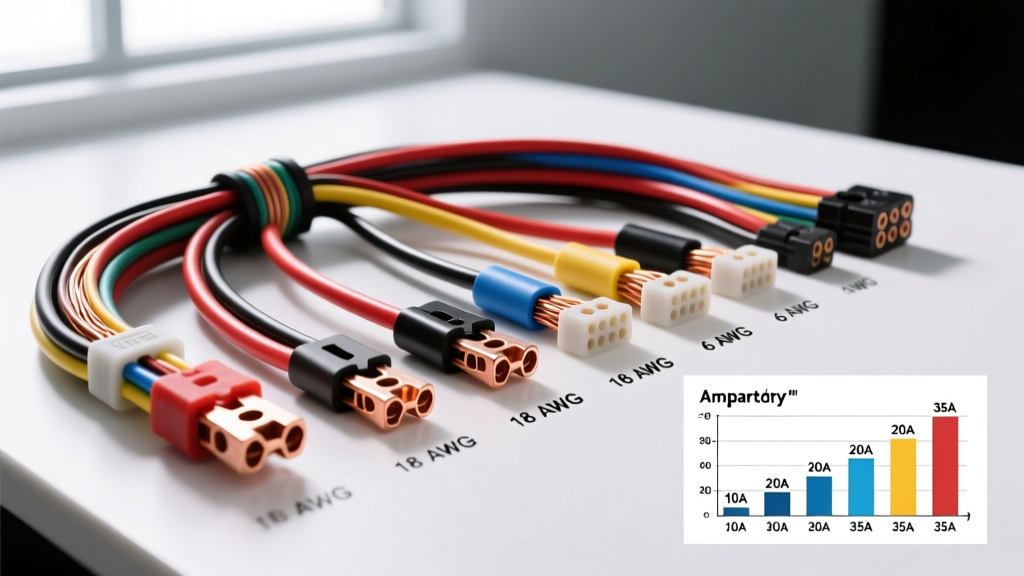
The Critical Role of Wire Gauge Current Rating in Vehicle Electrical Systems
Selecting the correct wire for automotive applications is not merely about physical fitment; it is fundamentally about managing thermal limits and voltage drop. The wire gauge current rating dictates how much electrical current a conductor can safely carry before the insulation degrades or the wire acts as a resistor, starving downstream components of necessary voltage. In modern vehicles, where electronic control units (ECUs), high-pressure fuel pumps, and electric steering racks demand precise voltage tolerances, undersizing your wiring can lead to catastrophic component failure, erratic sensor readings, or electrical fires.
This guide compares wire materials, insulation types, and gauge sizes to help you select the optimal conductor for everything from high-amperage winch circuits to low-current ECU sensor harnesses.
Conductor Material Comparison: OFC vs. CCA
Before evaluating specific wire gauge current ratings, you must select the correct base metal. The automotive aftermarket is flooded with two primary conductor types:
- Oxygen-Free Copper (OFC): The industry standard for automotive wiring. Pure copper offers superior conductivity, high tensile strength, and excellent resistance to vibration-induced fatigue.
- Copper-Clad Aluminum (CCA): An aluminum core with a thin copper coating. While cheaper and lighter, CCA has roughly 40% higher resistance than OFC. More importantly, aluminum is prone to galvanic corrosion when exposed to moisture and dissimilar metals (like brass or tin terminals), leading to high-resistance connections and eventual failure. Never use CCA for critical automotive or marine circuits.
Insulation Types: PVC vs. XLPE vs. Tefzel
The wire gauge current rating is heavily influenced by the insulation material, which determines the maximum operating temperature. According to the SAE J1128 Standard, automotive wire must withstand specific thermal and mechanical stresses.
1. PVC (Polyvinyl Chloride)
Standard primary wire uses PVC insulation, typically rated for 105°C. It is thick, stiff, and difficult to route through tight firewall grommets or modern engine bays where ambient temperatures regularly exceed 90°C.
2. XLPE (Cross-Linked Polyethylene)
Brands like GXL, TXL, and SXL use XLPE insulation. Cross-linking the polymer creates a thermoset material that will not melt when exposed to soldering irons or engine heat. TXL (Thin-wall) and GXL (General) are rated for 125°C, allowing them to carry higher current loads safely while reducing the outer diameter (OD) by up to 25% compared to PVC.
3. Tefzel (PTFE / ETFE)
Reserved for motorsports and aerospace, Tefzel wire operates up to 200°C. It features ultra-thin walls, drastic weight savings, and complete resistance to automotive fluids, but it requires specialized stripping tools to avoid nicking the fine-strand conductors.
Comprehensive Wire Gauge Current Rating Chart
The following chart outlines the maximum continuous wire gauge current rating for chassis wiring (short runs, typical in vehicles) based on OFC conductors with XLPE insulation at an ambient temperature of 40°C (104°F).
| AWG Size | Strand Count | Max Amps (Chassis) | Resistance (Ohms/1000ft) | Typical Automotive Application |
|---|---|---|---|---|
| 18 AWG | 16 | 14A | 6.38 | ECU Sensors, Injectors, Low-amp Lighting |
| 14 AWG | 19 | 32A | 2.52 | Fuel Pumps, Radiator Fans, Horn Relays |
| 12 AWG | 19 | 41A | 1.58 | Power Windows, Seat Heaters, Amplifier Power |
| 10 AWG | 19 | 55A | 1.00 | Ignition Coils, Main ECU Power/Ground |
| 8 AWG | 73 | 73A | 0.62 | Starter Solenoid Control, High-amp Relays |
| 4 AWG | 133 | 130A | 0.25 | High-Output Alternator (up to 180A) |
| 1/0 AWG | 245 | 285A | 0.10 | Alternator (200A+), Battery Relocation |
| 2/0 AWG | 323 | 330A | 0.07 | 12,000lb Winches, EV Battery Cables |
Application-Specific Selection Guide
High-Amperage Accessories: Winches and Hydraulics
A standard 12,000 lb electric winch can draw upwards of 450 amps under peak stall load. Standard stranded battery cable is too rigid and prone to work-hardening and breaking under hood vibration. For these applications, select 2/0 AWG fine-strand welding cable. The thousands of micro-strands provide extreme flexibility. Terminate these using Anderson Powerpole SB175 connectors, utilizing a hex-crimp die to ensure a gas-tight connection that prevents moisture ingress and subsequent galvanic corrosion.
Charging System Upgrades: High-Output Alternators
When upgrading to a 250-amp alternator (e.g., Mechman or Power Bastards) for car audio or off-road lighting, the factory 4 AWG or 8 AWG alternator charge wire will bottleneck the system and create a severe fire hazard. Upgrade the main charge wire to 1/0 AWG XLPE wire. Always route a matching 1/0 AWG ground cable directly from the alternator casing to the engine block, and upgrade the engine-to-chassis ground strap. Protect the main wire within 7 inches of the battery positive terminal using a 250A Class-T or Mega fuse.
Low-Current Sensor and ECU Circuits
For engine management wiring (such as Holley Terminator X or standalone MoTeC systems), signal integrity is paramount. Use 20 AWG to 22 AWG TXL wire for standard sensors like coolant temperature and TPS. However, for critical timing sensors (Crankshaft and Camshaft position sensors), you must use Shielded Twisted Pair (STP) cable. The twisting cancels out electromagnetic interference (EMI) generated by high-voltage ignition coils, while the braided shield (drained to the ECU sensor ground, never chassis ground) prevents signal degradation that can cause timing pull or misfires.
Voltage Drop Calculations and Real-World Failure Modes
A wire's current rating is only half the equation; voltage drop over distance is the other. In a 12V nominal automotive system (often 13.8V - 14.4V at idle), dropping below 11.5V at a component can cause erratic behavior. For example, a drop in voltage to an electric in-tank fuel pump reduces its RPM, lowering fuel pressure and causing dangerous lean air/fuel ratios under wide-open throttle.
Use the following formula to calculate voltage drop:
V_drop = (2 x Length x Current x Resistance per 1000ft) / 1000
Example: Running 15 feet of 12 AWG wire to a 30A cooling fan.
V_drop = (2 x 15 x 30 x 1.58) / 1000 = 1.42 Volts.
With a charging system at 14.0V, the fan only receives 12.58V. Upgrading to 10 AWG reduces the drop to 0.90V, ensuring optimal fan motor speed and thermal management.
Expert Tips for Termination and Crimping
The highest wire gauge current rating is rendered useless by a poor termination. When terminating high-current cables (4 AWG and larger):
- Use the Correct Crimp Profile: Use a nest-style or hexagonal crimp die for ring terminals on battery cables. Indent crimpers (which leave a divot in the barrel) are acceptable for small-gauge Weather-Pack terminals but create stress risers and loose strands on heavy-gauge wire.
- Seal the Connection: Always use adhesive-lined, dual-wall heat shrink (3:1 or 4:1 shrink ratio). The inner meltable adhesive layer flows into the wire strands, creating a waterproof seal that prevents capillary action from wicking moisture under the insulation jacket.
- Tinning is Prohibited: Never solder or 'tin' the ends of crimped automotive wires. Solder wicks up into the strands, creating a rigid section right at the crimp barrel. In high-vibration environments, this rigid-to-flexible transition point will suffer from metal fatigue and snap.
Final Selection Verdict
When planning your next vehicle build, harness fabrication, or electrical upgrade, prioritize ABYC E-11 and SAE J1128 compliant XLPE wiring. Match the wire gauge current rating not just to the fuse size, but to the physical run length and the voltage sensitivity of the downstream component. By avoiding CCA wire, utilizing proper hex-crimp terminations, and respecting voltage drop mathematics, you will build an electrical system that is both inherently safe and exceptionally reliable.