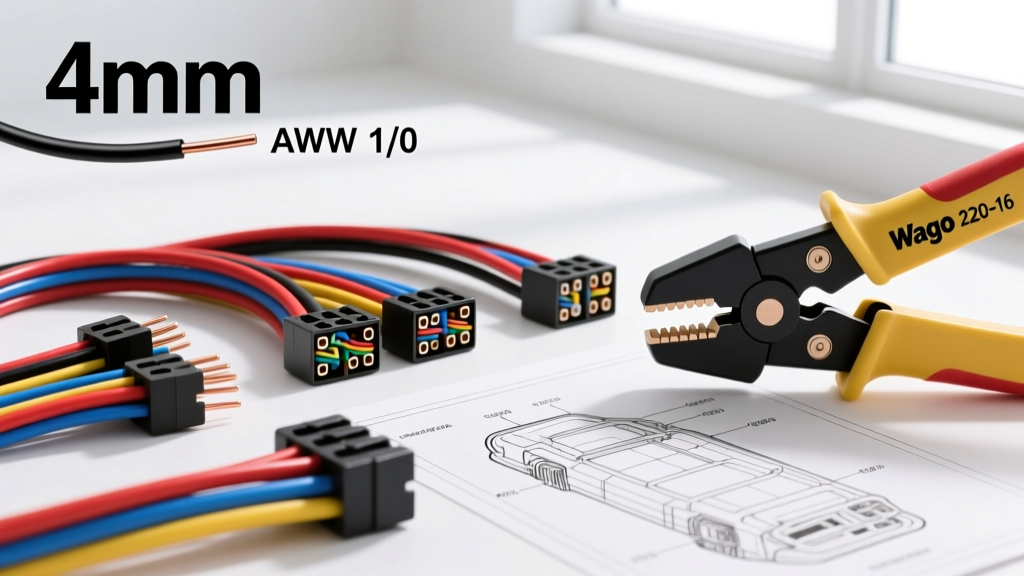
The Direct Answer: What Gauge is 4mm Wire?
When automotive technicians and DIYers ask, "what gauge is 4mm wire," they are almost always referring to the metric cross-sectional area (4mm²) mandated by DIN standards in European and Asian vehicles, rather than a literal 4-millimeter diameter. To answer the question directly: a true 4mm² wire mathematically converts to 11.14 AWG. However, because 11 AWG is not a standard size in the American Wire Gauge system, technicians must navigate a critical substitution dilemma.
In the North American aftermarket, wire is sized by AWG (SAE J1128 standards), where SAE J1128 Standard dictates the insulation thickness, temperature ratings, and copper stranding. The closest standard AWG equivalents to 4mm² are 10 AWG (5.26mm²) and 12 AWG (3.31mm²). Using 12 AWG as a substitute for 4mm² is a severe safety hazard, as it offers 17% less copper cross-section, leading to excessive voltage drop and potential thermal runaway in high-current circuits. Therefore, 10 AWG is the only safe and code-compliant AWG substitute for 4mm² metric wire in automotive applications.
Metric vs. AWG: The Hidden Cost Analysis
Understanding what gauge 4mm wire is only solves half the problem; sourcing it introduces a significant cost variable. European vehicles (BMW, Audi, Volkswagen, Mercedes-Benz) utilize thin-wall metric wire, specifically FLRY-A and FLRY-B (Flexible Low-voltage Road vehicle wire, Type A/B). North American vehicles typically use GXL or TXL AWG wire.
Material and Sourcing Costs
- True 4mm² FLRY-B Wire: Sourced from specialized distributors (e.g., Helukabel, Kabeltron), true metric 4mm² wire costs between $0.85 and $1.30 per foot. The premium is driven by import costs, strict DIN 72551 compliance, and specific PVC or XLPE insulation formulations designed for high-temperature engine bays.
- Standard 10 AWG GXL Wire: Readily available at any automotive parts store or bulk wire supplier, 10 AWG GXL costs roughly $0.40 to $0.65 per foot.
- OEM Dealership Harnesses: If a technician attempts to buy a pre-assembled pigtail harness from a European dealership (e.g., a VAG ABS module connector with 4mm² pigtails), the cost can exceed $85 for a mere 12-inch harness, largely due to the specialized metric terminals and wire.
From a cost-analysis perspective, substituting 10 AWG GXL for 4mm² FLRY-B saves roughly 40% on raw wire costs. However, this introduces a secondary cost: tooling incompatibility.
Tool Requirements: Stripping and Crimping 4mm²
The physical dimensions of 4mm² wire and its corresponding terminals differ just enough from 10 AWG to cause catastrophic crimp failures if the wrong tools are used. A 4mm² wire typically features 56 strands of 0.30mm bare copper, while a 10 AWG wire features 19 to 37 thicker strands. This changes the compression ratio required during crimping.
Wire Stripping Tools
Standard AWG strippers often nick the finer strands of metric FLRY wire. For 4mm² wire, technicians should use adjustable automatic strippers like the Knipex Stripax (12 42 190) or the Jokari 20050, setting the blade depth precisely to 1.1mm to avoid scoring the copper strands, which reduces the wire's ampacity and creates a stress-riser point.
Crimping Dies and Ratchet Tools
This is where the cost and tooling analysis becomes critical. If you are crimping a true 4.0mm² metric open-barrel terminal (such as a TE Connectivity MQS or Junior Power Timer), you cannot use a standard 10 AWG crimp die. An AWG 10 die cavity is designed for 5.26mm² of copper. Using it on a 4.0mm² terminal will result in an under-crimped, loose connection with high electrical resistance. According to TE Connectivity AMP Application Specifications, metric terminals require specific die cavities calibrated to the square millimeter cross-section.
- Professional Metric Crimper: TE Connectivity CERTI-CRIMP II with the 4.0mm² die cavity (Tooling cost: ~$350 - $450).
- Aftermarket Ratchet Crimper: Titan Power Crimper or Glarks Precision Ratchet Crimper with interchangeable metric dies (0.5 - 6.0mm²). (Tooling cost: ~$80 - $120).
- Terminal Cost: True metric 4.0mm² open-barrel terminals cost roughly $0.45 each, compared to $0.15 for generic AWG 10 ring terminals.
Real-World Application: VAG ABS Control Module Pinout
To understand where 4mm² wire is utilized, we look at high-current safety systems. A prime example is the Bosch MK60 / MK70 ABS Control Module found in millions of Volkswagen and Audi vehicles (e.g., Golf Mk5, Audi A3 8P). The main power and ground circuits rely heavily on 4.0mm² wire to handle the massive inrush current of the ABS hydraulic pump motor during emergency braking events.
VAG ABS Module Connector (T47) High-Current Pinout:
| Pin Number | Terminal Type | Wire Size (Metric) | Safe AWG Substitute | DIN Color Code |
|---|---|---|---|---|
| Pin 1 | Terminal 30 (Battery +) | 4.0mm² | 10 AWG | rt/sw (Red w/ Black stripe) |
| Pin 32 | Terminal 31 (Ground) | 4.0mm² | 10 AWG | br (Brown) |
| Pin 47 | Terminal 15 (Ignition +) | 1.5mm² | 14 AWG | sw/ge (Black w/ Yellow stripe) |
Note: DIN 72551-6 color codes use abbreviations like 'rt' (red), 'sw' (black), and 'br' (brown). When repairing these harnesses, using standard SAE color codes can cause severe diagnostic confusion for the next technician.
Substitution Matrix and Ampacity Derating
The following matrix compares the electrical characteristics and costs of true 4mm² wire against its AWG counterparts, based on Bosch Automotive Electronics guidelines and standard copper resistivity at 20°C.
| Specification | True 4mm² (FLRY-B) | 11 AWG (Math Exact) | 10 AWG (GXL Safe Sub) | 12 AWG (Undersized) |
|---|---|---|---|---|
| Cross-Sectional Area | 4.00 mm² | 4.17 mm² | 5.26 mm² | 3.31 mm² |
| Conductor Diameter | 2.25 mm | 2.30 mm | 2.59 mm | 2.05 mm |
| Max Ampacity (60°C) | 30A - 35A | 32A | 40A | 23A |
| Resistance (Ω/ft) | 0.00132 Ω | 0.00126 Ω | 0.00100 Ω | 0.00159 Ω |
| Avg Cost (per foot) | $0.85 - $1.20 | N/A (Rare) | $0.45 - $0.70 | $0.30 - $0.50 |
Expert Troubleshooting: Voltage Drop in Mixed-Gauge Harnesses
A common failure mode occurs when a previous repair technician substitutes 12 AWG wire for a blown 4mm² ABS power feed to save money. Because 12 AWG has 20% higher resistance per foot than 4mm², the wire acts as a resistor under the 30+ amp load of the ABS pump.
The Diagnostic Fix: Do not rely solely on a multimeter's continuity test. Perform a dynamic voltage drop test. Backprobe the ABS module Pin 1 and connect your multimeter to the positive battery post. With the engine running and the ABS pump activated (via a bi-directional scan tool), measure the voltage drop across the power wire. A healthy 4mm² or 10 AWG wire should drop no more than 0.1V to 0.2V under load. If you read a voltage drop exceeding 0.5V, the wire is undersized (likely 12 AWG) or the crimp terminal is failing due to metric/AWG die mismatch. Cut out the offending wire and replace it with true 4.0mm² FLRY or 10 AWG GXL, utilizing the correct ratchet crimper die to ensure a gas-tight, cold-weld connection.