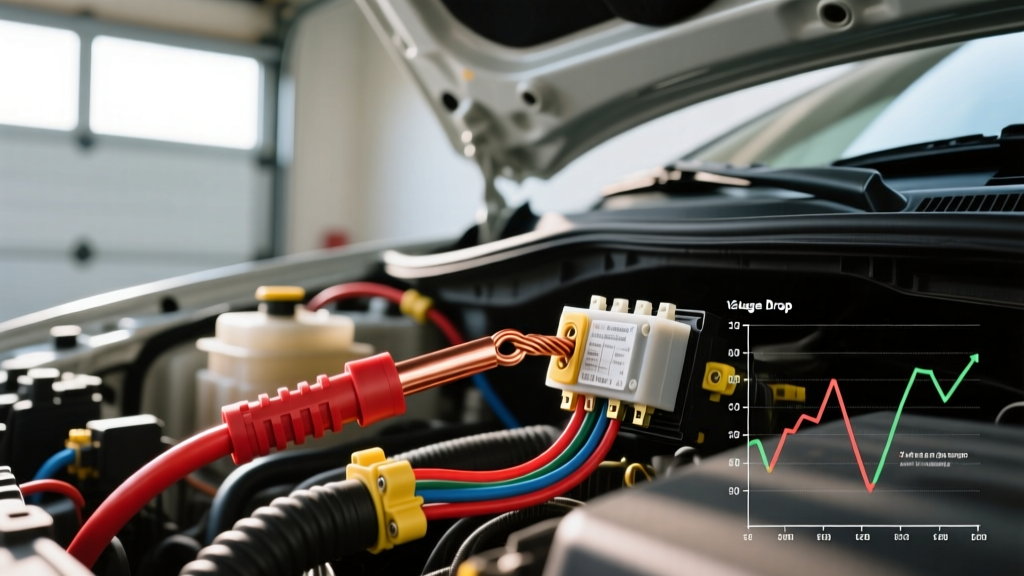
The Short Answer: Is 12 Gauge Wire Good for 15 Amps?
When planning an electrical upgrade, one of the most common questions enthusiasts ask is: is 12 gauge wire good for 15 amps? The short answer is yes, but with critical caveats specific to 12-volt automotive environments. According to the SAE J1128 standard, 12 AWG (American Wire Gauge) copper wire with GXL or TXL insulation is rated for up to 20 amps in a single-wire, open-air chassis application. However, automotive wiring rarely exists in a perfect, open-air vacuum. Bundled harnesses, under-hood ambient heat, and the strict voltage tolerances of modern ECUs and high-output fuel pumps mean that ampacity (the ability to carry current without melting) is only half the equation. The true limiting factor for 12 AWG wire at 15 amps is voltage drop over distance.
Ampacity vs. Voltage Drop: The 12-Volt Reality
In residential AC wiring (governed by the NEC), a 120-volt circuit carrying 15 amps through 12 AWG wire is perfectly safe because a 3% voltage drop still leaves 116 volts—well within the operating tolerance of household appliances. In a 12-volt DC automotive system, a 3% drop on a 12.6V charging system leaves only 12.22V. While that sounds acceptable, high-draw accessories like 255 LPH fuel pumps or heavy-duty winch solenoids experience severe performance degradation when voltage dips below 11.5V.
A 12 AWG wire has a cross-sectional area of 3.31 mm² and a resistance of approximately 1.588 ohms per 1,000 feet at 20°C. When pushing 15 amps of continuous current, heat generation and resistance increase, compounding the voltage drop. Therefore, while 12 AWG wire will not catch fire at 15 amps, it may starve your accessory of the voltage it needs to operate efficiently if the circuit run is too long.
Voltage Drop Chart: 12 AWG vs. 10 AWG at 15 Amps
The following chart illustrates the voltage drop for a complete circuit (positive feed + ground return) carrying a continuous 15-amp load on a standard 12.6V automotive system. Note that total circuit length includes both the power and ground wires.
| Total Circuit Length | 12 AWG Voltage Drop | 12 AWG Drop % | 10 AWG Voltage Drop | Verdict for 15A Load |
|---|---|---|---|---|
| 10 ft | 0.24V | 1.9% | 0.15V (1.1%) | 12 AWG is Excellent |
| 20 ft | 0.48V | 3.8% | 0.30V (2.3%) | 12 AWG is Acceptable |
| 30 ft | 0.71V | 5.6% | 0.45V (3.5%) | Marginal (Use 10 AWG) |
| 40 ft | 0.95V | 7.5% | 0.60V (4.7%) | Poor (Upgrade to 8 AWG) |
Real-World Mod 1: High-Flow Fuel Pump Upgrade (255 LPH)
Upgrading from a stock 110 LPH pump to a high-flow 255 LPH pump (such as a Walbro or DeatschTech DW300c) is a staple modification for forced-induction builds. These pumps draw between 12 and 14 amps continuously at 43 PSI, with inrush current spikes up to 18 amps upon startup. Is 12 gauge wire good for 15 amps in this scenario? Yes, provided the run from the relay to the pump sender hat is under 15 feet.
Fuel Pump Relay Wiring Scheme
To safely deliver power without relying on the factory ECU driver (which is typically only rated for 5-8 amps), you must use a standard Bosch-style ISO mini relay. Here is the professional specification for the harness:
- Pin 30 (Power In): 12 AWG Red wire, routed directly from the battery positive terminal, protected by a 20A MAXI blade fuse located within 18 inches of the battery.
- Pin 87 (Power Out to Pump): 12 AWG Pink or Blue wire, routed through the firewall grommet to the fuel tank sender. Terminate using a TE Connectivity Metri-Pack 280 series female terminal with a silicone weather seal.
- Pin 86 (Trigger In): 18 AWG Violet wire, spliced into the factory fuel pump trigger wire at the ECU or factory relay.
- Pin 85 (Ground): 18 AWG Black wire, terminated with a 1/4-inch ring terminal, bolted to a clean, unpainted chassis ground. Apply dielectric grease to prevent corrosion.
Pro Tip: Never use the factory 12V feed wire that runs through the chassis harness to power the new pump. The factory wire is often 14 or 16 AWG and shares a ground path with the fuel level sender, which will cause erratic gauge readings and severe voltage drop under heavy throttle.
Real-World Mod 2: 50-Inch LED Off-Road Light Bar
A 50-inch dual-row LED light bar typically draws between 14 and 16 amps at 13.8V (engine running). Because this accessory is mounted on the roof rack or front bumper, the wire run from the battery, through the cabin, to the roof can easily exceed 25 feet total circuit length. In this specific modification, 12 AWG wire will result in a voltage drop exceeding 5%, which can cause LED drivers to flicker or overheat.
For roof-mounted 15-amp loads, upgrade the main power feed to 10 AWG. However, 12 AWG is perfectly suited for the secondary side of the circuit, such as the 15-amp dash switch feed, provided you are using a heavy-duty relay to handle the primary amperage. Always use Painless Performance or equivalent waterproof Deutsch DT connectors (12-size contacts) at the roofline to allow for easy removal of the light bar without cutting wires.
Wire Insulation and Stranding: Why Building Wire Fails
A critical mistake made by novice modifiers is purchasing 12 AWG THHN solid-core wire from a local hardware store. THHN is designed for 120V/240V AC residential wiring and is entirely unsuited for automotive use for three reasons:
- Stranding: Automotive wire (SAE J1128) utilizes fine-strand copper (typically 65 strands of 30 AWG wire for a 12 AWG bundle). This allows the wire to flex and absorb high-frequency chassis vibrations without work-hardening and snapping. Solid core wire will fracture within months of driving.
- Insulation Material: Standard PVC insulation melts at lower temperatures and becomes brittle when exposed to under-hood ozone, oil, and transmission fluid. Automotive GXL (General Cross-Linked) or TXL (Thin-wall Cross-Linked) insulation is chemically resistant and rated for continuous operation at 125°C (257°F).
- Outer Diameter: TXL 12 AWG wire has a much thinner outer diameter than THHN, allowing you to pull more circuits through tight factory firewall grommets and loom tubing.
Termination Best Practices for 15-Amp Circuits
Even if you correctly determine that 12 gauge wire is good for 15 amps, a poor termination will introduce localized resistance, generating enough heat to melt the connector cavity. When terminating 12 AWG wire for 15-amp continuous loads:
- Crimping vs. Soldering: Never solder under-hood automotive connections. Solder wicks into the wire strands via capillary action, creating a rigid section of wire that will snap under engine vibration. Use a ratcheting crimp tool specifically calibrated for open-barrel or Weather-Pack terminals. A proper 12 AWG crimp should withstand a minimum pull-force of 70 lbs.
- Heat Shrink: Use adhesive-lined (dual-wall) polyolefin heat shrink. When heated, the inner thermoplastic adhesive melts and flows into the wire strands, creating a 100% waterproof, corrosion-proof seal that blocks oxygen and moisture from creeping up the copper strands.
- Overcurrent Protection: For a continuous 15-amp load on 12 AWG wire, use a 20-amp fuse if the accessory has a high inrush spike (like a motor or compressor). If the load is purely resistive and steady (like heating elements or specific LED arrays), a 15-amp fuse provides tighter protection. Always place the fuse as close to the power source as physically possible.
Final Verdict for Your Build
So, is 12 gauge wire good for 15 amps? For short-to-medium runs (under 20 feet total circuit length) powering fuel pumps, cooling fans, or localized lighting, 12 AWG GXL/TXL wire is the industry standard and performs flawlessly. For runs exceeding 20 feet, or for accessories highly sensitive to voltage variance, step up to 10 AWG to ensure your 15-amp upgrades receive the full 13.8 volts they require to operate at peak efficiency.