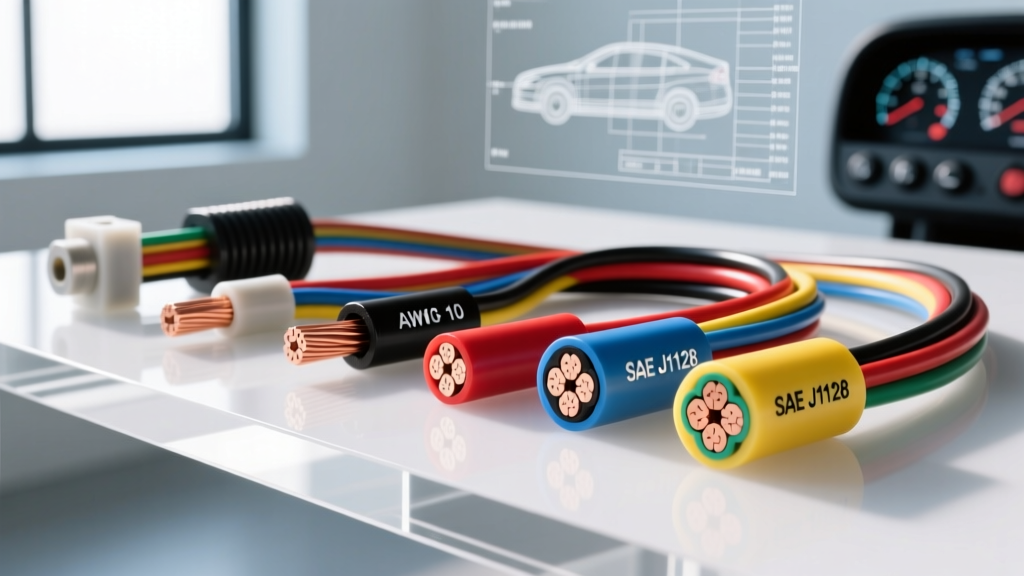
The Foundation: SAE J1128 and Ampacity Standards
When determining the correct wire gauge for amperage in automotive applications, relying on standard household electrical tables is a critical error. Automotive wiring must withstand extreme temperature fluctuations, continuous vibration, and exposure to hydrocarbons. The definitive standard for low-tension primary automotive cable is SAE J1128. This specification dictates not only the copper stranding and American Wire Gauge (AWG) dimensions but also the insulation properties required for vehicular use.
Modern performance vehicles and restomods primarily utilize cross-linked polyethylene (XLPE) insulation types such as TXL, GXL, and SXL. Unlike standard PVC wire, which degrades at 105°C, SXL wire is rated for continuous operation at 125°C to 150°C. This higher thermal threshold allows cross-linked automotive wire to carry slightly higher amperage loads than its PVC counterpart of the exact same AWG, provided the voltage drop remains within acceptable limits.
Master Wire Gauge for Amperage Specification Chart
The following reference chart outlines the physical and electrical properties of standard stranded copper wire (SAE J1128 compliant). 'Chassis Wiring' refers to short runs (under 4 feet) typical in engine bays, while 'Harness Wiring' applies to longer runs routing from the battery or alternator to the rear of the vehicle.
| AWG Size | Stranding (AWG) | Nominal O.D. (inches) | Ohms per 1000 ft (@ 20°C) | Max Amps (Chassis < 4ft) | Max Amps (Harness > 4ft) |
|---|---|---|---|---|---|
| 18 | 16/30 | 0.069 | 6.39 | 16A | 6A |
| 16 | 26/30 | 0.078 | 4.02 | 22A | 10A |
| 14 | 41/30 | 0.090 | 2.52 | 32A | 15A |
| 12 | 65/30 | 0.106 | 1.59 | 41A | 20A |
| 10 | 105/30 | 0.130 | 1.00 | 55A | 30A |
| 8 | 168/30 | 0.164 | 0.63 | 73A | 45A |
| 6 | 266/30 | 0.204 | 0.40 | 101A | 60A |
| 4 | 420/30 | 0.257 | 0.25 | 130A | 85A |
| 2 | 665/30 | 0.324 | 0.16 | 170A | 115A |
| 1/0 | 1064/30 | 0.411 | 0.10 | 210A | 150A |
| 2/0 | 1330/30 | 0.460 | 0.08 | 245A | 175A |
| 4/0 | 2107/30 | 0.580 | 0.05 | 360A | 260A |
Calculating Voltage Drop in 12V and 14V Automotive Systems
Selecting the proper wire gauge for amperage is not solely about preventing the wire from melting; it is primarily about mitigating voltage drop. In a 12-volt nominal system (which operates at 13.8V to 14.4V when the alternator is charging), even a small loss of voltage can severely impact component performance. The Society of Automotive Engineers (SAE) recommends a maximum voltage drop of 3% (approximately 0.42V) for sensitive electronics and EFI systems, and up to 5% for general lighting.
The Voltage Drop Formula
To calculate voltage drop (VD), use the following formula based on the one-way length of the wire (L) in feet, the current draw (I) in amps, and the resistance (R) per 1000 feet from the chart above:
VD = (2 × L × I × R) / 1000
Note: We multiply by 2 to account for the complete circuit loop (power and ground).
Real-World EFI Fuel Pump Example
Consider an aftermarket in-tank EFI fuel pump drawing 15 Amps, located 12 feet from the relay in the engine bay. If you use 14 AWG wire (2.52 ohms/1000ft):
- VD = (2 × 12 × 15 × 2.52) / 1000 = 0.91V drop.
- If the alternator is outputting 14.0V, the pump receives 13.09V. This is generally acceptable.
However, if the fuel pump is mounted in a rear sump cell 20 feet away:
- VD = (2 × 20 × 15 × 2.52) / 1000 = 1.51V drop.
- The pump now receives only 12.49V. At this reduced voltage, the pump motor spins slower, dropping fuel rail pressure. Under high RPM or boost, this lean condition will cause engine knock and catastrophic detonation. Upgrading to 12 AWG wire (1.59 ohms/1000ft) reduces the drop to 0.95V, restoring safe operating voltage.
Terminal and Connector Current Limits
Your wire gauge for amperage calculation is useless if the connector terminal cannot handle the thermal load. High resistance at a poorly crimped or undersized terminal will cause localized melting. When building custom harnesses using OEM-style connectors, adhere to these terminal current limits:
- Aptiv Metri-Pack 150 Series: Rated up to 14A. Ideal for 18-16 AWG wire (ECU sensors, injector triggers, relay coils).
- Aptiv Metri-Pack 280 Series: Rated up to 20A. Ideal for 14-10 AWG wire (fuel injectors, idle air control, fan relays).
- Aptiv Metri-Pack 630 Series: Rated up to 46A. Ideal for 10-6 AWG wire (main power feeds, high-amperage cooling fans).
- Delphi Weather-Pack: Generally rated up to 20A per cavity. Best suited for 14-10 AWG exterior lighting and accessory circuits.
Always use the correct ratcheting crimp tool specific to the terminal series (e.g., Delphi 12094430 or equivalent) to ensure a gas-tight crimp that prevents oxidation and subsequent resistance spikes.
High-Current Applications: Alternators and the Big Three
Modern vehicles with electric power steering, advanced cooling fans, and high-wattage audio systems frequently require alternator upgrades ranging from 150A to 250A+ (such as the GM AD244 or Powermaster Denso-style units). The factory 4 AWG or 6 AWG alternator charge wire will bottleneck the system and cause severe voltage drop.
Sizing the Charge Wire
For a 200A alternator, the minimum wire gauge for amperage is 1/0 AWG (one-aught) stranded copper. If the battery is relocated to the trunk, 2/0 AWG or 4/0 AWG is mandatory to compensate for the 15+ foot run. Use pure copper welding cable (SAE J1127) rather than standard primary wire for its superior flexibility and higher strand count.
Termination and Crimping Specs
High-current lugs must be tinned copper. Use a 5/16-inch ring terminal for the alternator B+ post and a 3/8-inch terminal for the battery post. Do not use hammer crimpers or pliers. A proper high-amperage connection requires a 12-ton hydraulic crimper with hexagonal dies to cold-weld the copper strands to the lug. Finish the termination with dual-wall, adhesive-lined heat shrink (such as 3M FP-301) to seal out moisture and prevent green corrosion (copper oxide), which acts as a semiconductor and increases circuit resistance.
Car Audio: OFC vs. CCA Wire Gauge Adjustments
When sizing wire gauge for amperage in car audio applications, the conductor material dictates the sizing chart. Oxygen-Free Copper (OFC) offers 100% IACS (International Annealed Copper Standard) conductivity. Conversely, Copper-Clad Aluminum (CCA) wire, which is frequently sold in budget amplifier kits, only offers about 61% conductivity.
The CCA Rule: If you are forced to use CCA wire, you must increase the wire size by one full AWG step to achieve the same amperage capacity and voltage drop characteristics as OFC. For example, if your amplifier draws 120A and requires 4 AWG OFC, you must step up to 2 AWG if using CCA. Furthermore, CCA is highly susceptible to galvanic corrosion when exposed to moisture at the termination points, leading to brittle wire strands and eventual open-circuit failures.
Real-World Failure Modes from Incorrect Sizing
Miscalculating the wire gauge for amperage manifests in several distinct, often misdiagnosed automotive failure modes:
- Thermal Runaway at Crimps: An undersized wire operating near its maximum ampacity generates heat. If the crimp is marginal, the heat increases the electrical resistance of the joint. Higher resistance generates more heat, creating a thermal runaway loop that eventually melts the connector housing and causes a short to ground.
- O2 Sensor Skew: Wideband O2 sensors require precise heater circuit voltages and stable ground references. If 18 AWG wire is used for a heater circuit drawing 8A over a long distance, the voltage drop will cause the sensor to operate below optimal temperature, resulting in false lean readings and causing the ECU to dump excess fuel into the cylinders.
- Headlight Dimming and Relay Chatter: Voltage drop across undersized headlight power wires causes halogen bulbs to emit a yellow, dim light. Worse, if the ground circuit for a headlight relay shares a thin factory ground wire with other accessories, the voltage differential can cause the relay coil to chatter, rapidly destroying the relay contacts.
For comprehensive wiring schematics and advanced harness routing techniques, consult the technical documentation provided by Painless Performance Products, which offers extensive guides on circuit protection and relay integration. Furthermore, verifying terminal specifications via the Aptiv Connection Systems catalog ensures your physical connectors match your calculated wire gauge for amperage.