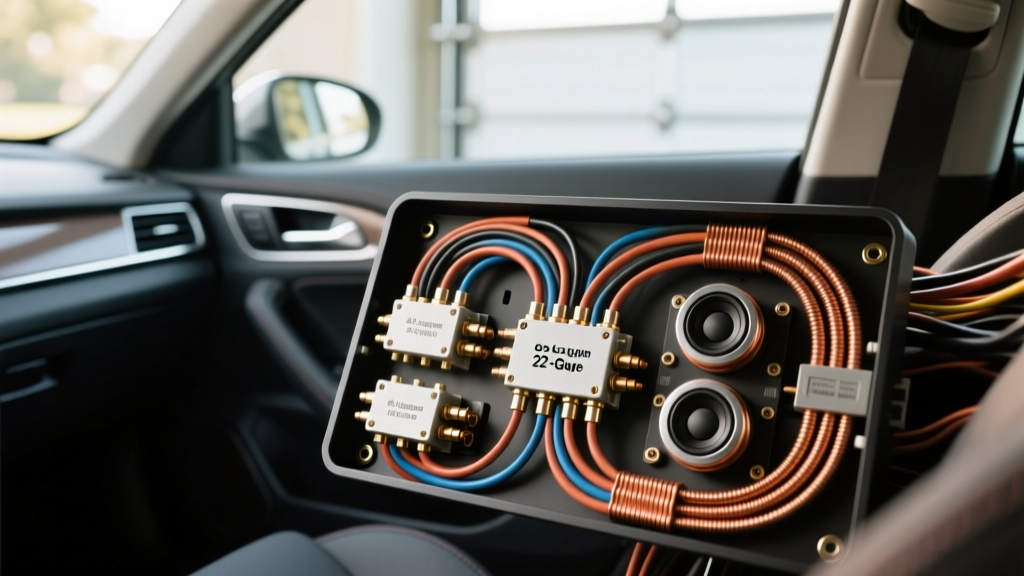
The Reality of 22 AWG in Automotive Audio Upgrades
When executing a custom car audio modification, fabricators and installers are constantly battling the physics of wire routing versus electrical performance. You want the thickest copper possible to minimize resistance, but you also need to snake those wires through impossibly tight dashboard crevices, A-pillar sail panels, and crowded door hinge grommets. This is where 22 gauge speaker wire enters the conversation. While mainstream car audio dogma dictates that 16 AWG or 18 AWG is the absolute minimum for any speaker run, treating 22 AWG as a universal taboo is a fundamental misunderstanding of electrical engineering and impedance curves.
As an automotive electrical specialist, I frequently see enthusiasts ruin perfectly good custom A-pillar tweeter pods by attempting to jam stiff 16 AWG zip-cord into tight dash looms, ultimately tearing the weather seals or causing mechanical fatigue at the solder joints. Conversely, I have seen novices use 22 AWG to wire 6x9-inch woofers, resulting in severe damping factor degradation and muddy bass response. The secret to a flawless upgrade project is understanding exactly where 22 AWG excels, where it fails, and how to terminate it properly for long-term reliability in a high-vibration automotive environment.
Technical Specifications and Metallurgical Realities
Before cutting your first spool, you must understand the physical properties of 22 American Wire Gauge (AWG) conductors. According to the SAE J1128 Low Tension Primary Cable Standard, which governs automotive wiring, the physical diameter and stranding of a wire dictate its flexibility, current carrying capacity, and resistance to mechanical vibration.
A standard 22 AWG wire has a cross-sectional area of approximately 0.326 mm² and a diameter of 0.643 mm. However, in car audio applications, the metallurgical composition is far more critical than the gauge itself. You must exclusively use Oxygen-Free Copper (OFC) featuring a high-strand count (typically 19 strands of 34 AWG wire). Never use Copper-Clad Aluminum (CCA) in 22 AWG for automotive modifications. CCA strands at this microscopic thickness are incredibly brittle; the constant low-frequency mechanical vibrations transmitted through a vehicle's chassis will cause CCA strands to work-harden, snap, and oxidize inside the jacket within months.
Resistance and Voltage Drop Comparison
To understand the electrical footprint of your upgrade, review the resistance characteristics of common speaker wire gauges over a standard 10-foot total loop (5 feet of positive, 5 feet of negative). Data adapted from Belden Electronic Wire Specifications and standard OFC conductivity charts is outlined below:
| Wire Gauge (AWG) | Cross-Section (mm²) | Ohms per 1,000 ft (OFC) | Resistance (10 ft Loop) | Optimal Automotive Application |
|---|---|---|---|---|
| 16 AWG | 1.31 mm² | 4.02 Ω | 0.040 Ω | Mid-bass door woofers, subwoofers |
| 18 AWG | 0.82 mm² | 6.39 Ω | 0.064 Ω | Coaxial rear deck speakers, OEM replacements |
| 22 AWG | 0.33 mm² | 16.14 Ω | 0.161 Ω | Tweeters, crossover jumpers, piezo arrays |
As the table illustrates, a 10-foot loop of 22 AWG OFC introduces 0.161 ohms of resistance into the circuit. If you are driving a 4-ohm tweeter, this represents a mere 4% increase in total impedance. Because high-frequency drivers draw significantly less RMS current than woofers, the resulting voltage drop and thermal compression are entirely negligible.
Ideal Upgrade Applications for 22 Gauge Speaker Wire
When planning your modification project, 22 gauge speaker wire should be strategically deployed in the following high-precision, low-current scenarios.
1. Custom A-Pillar and Sail Panel Tweeter Pods
When fabricating custom A-pillar pods using fiberglass, Bondo, and suede, routing the wiring down through the dashboard and into the main cabin harness is a notorious bottleneck. The rubber weather loom connecting the door hinge or the tight crevice behind the dash trim often cannot accommodate the thick, stiff PVC jacket of 16 AWG wire. 22 AWG wire, particularly when jacketed in flexible silicone or thin-wall Teflon (PTFE), can easily slip through these tight OEM grommets without compromising the factory weather seal or causing water intrusion.
2. Passive Crossover Network Jumper Wires
If you are building or modifying custom passive crossovers for an active-to-passive conversion project, the internal point-to-point wiring on the PCB or terminal strip does not require heavy gauge wire. The physical distance is usually less than six inches. Using 22 AWG OFC for these internal jumper wires makes soldering to small capacitor leads and inductor terminals significantly easier, reducing the risk of thermal damage to sensitive crossover components from prolonged soldering iron contact.
3. Super-Tweeter and Piezo Arrays
For competition SPL vehicles or custom show cars utilizing arrays of piezo-electric tweeters or bullet super-tweeters, 22 AWG is the industry standard. Piezo drivers exhibit extremely high impedance (often 20 to 50 ohms) and draw virtually zero continuous current. Using heavy gauge wire on a piezo array is a waste of copper and adds unnecessary weight and stiffness to the wiring harness.
Where 22 AWG Fails: The Damping Factor Danger
It is critical to understand where 22 gauge speaker wire must never be used. Do not use 22 AWG for mid-bass drivers, woofers, or subwoofers, regardless of the physical distance. This is not about power handling; it is about the damping factor.
The damping factor is the amplifier's ability to control the mechanical movement of the speaker cone, specifically stopping it from oscillating after a transient bass note. A high damping factor requires an extremely low-impedance path between the amplifier's output terminals and the speaker's voice coil. If you run 15 feet of 22 AWG wire to a 6.5-inch mid-bass door speaker, the 0.48 ohms of wire resistance acts as a virtual resistor in series with the voice coil. This drastically lowers the damping factor, resulting in 'boomy', uncontrolled, and muddy bass response. As noted in Crutchfield's Speaker Wire Guide, maintaining a low-resistance path is essential for preserving the transient response of low-frequency drivers.
Step-by-Step: Wiring Custom A-Pillar Tweeters with 22 AWG
Follow this professional installation protocol to ensure your 22 AWG tweeter upgrade survives the harsh automotive environment.
- Prep the Conductor: Strip exactly 1/4-inch of insulation from the 22 AWG OFC wire. Use a precision micro-stripper to avoid nicking the delicate 34 AWG sub-strands. A nicked strand will create a localized stress point that will eventually snap under chassis vibration.
- Twist and Tin: Tightly twist the exposed strands to prevent fraying. Apply a minimal amount of 63/37 rosin-core eutectic solder to 'tin' the wire. Do not over-apply; the solder should wick into the strands via capillary action, leaving the very tip slightly flexible.
- Terminate with Micro-Spades: Most 1-inch dome tweeters utilize 2.8mm (0.110-inch) female spade terminals. Crimp a high-quality, nylon-insulated 2.8mm disconnect onto the 22 AWG wire using a precision micro-crimp tool. For ribbon tweeters with fragile binding posts, direct soldering is preferred.
- Seal and Protect: Slide a piece of 3:1 shrink-ratio, adhesive-lined dual-wall polyolefin heat shrink over the connection. Apply heat until the adhesive oozes from the ends, creating a waterproof, vibration-proof seal that prevents oxidation of the microscopic copper strands.
- Route and Secure: Route the wire behind the dash, avoiding the steering column shaft and sharp metal brackets. Secure the 22 AWG wire to the main factory wiring harness using Tesa tape (fleece automotive harness tape) every 6 inches to prevent acoustic rattling against the plastic dash panels.
Troubleshooting Common 22 AWG Installation Issues
Even with proper gauge selection, installation errors can degrade audio performance. Use this diagnostic matrix to troubleshoot issues specific to thin-gauge tweeter wiring.
| Symptom | Root Cause | Expert Fix |
|---|---|---|
| High-frequency roll-off or 'muffled' tweeters | Using CCA wire instead of OFC; micro-strands oxidizing and increasing resistance over time. | Cut back the wire, verify copper color in the cross-section. Replace entire run with 99.9% OFC 22 AWG. |
| Intermittent tweeter drop-out over bumps | Mechanical fatigue at the solder joint due to stiff wire pulling on the tweeter terminal. | Create a 'service loop' (slack) near the tweeter. Secure the wire to the A-pillar with a foam-backed zip tie base to absorb shock. |
| Alternator whine bleeding into the tweeter | 22 AWG unshielded wire routed parallel to factory ECU or high-current alternator harnesses. | Reroute the speaker wire perpendicular to the noise source, or use a twisted-pair 22 AWG configuration to reject common-mode EMI interference. |
Final Verdict on 22 Gauge Speaker Wire
In the context of automotive audio upgrades, 22 gauge speaker wire is a highly specialized tool, not a universal solution. When applied correctly to high-impedance tweeters, custom A-pillar fabrications, and internal crossover networks, its flexibility and low-profile jacket make it an invaluable asset for achieving clean, professional wire routing. However, respecting its electrical limitations regarding current capacity and damping factor is the hallmark of a true automotive electrical expert. Always prioritize high-strand OFC copper, utilize adhesive-lined heat shrink, and reserve the heavier 16 and 18 AWG gauges for the woofers where they belong.