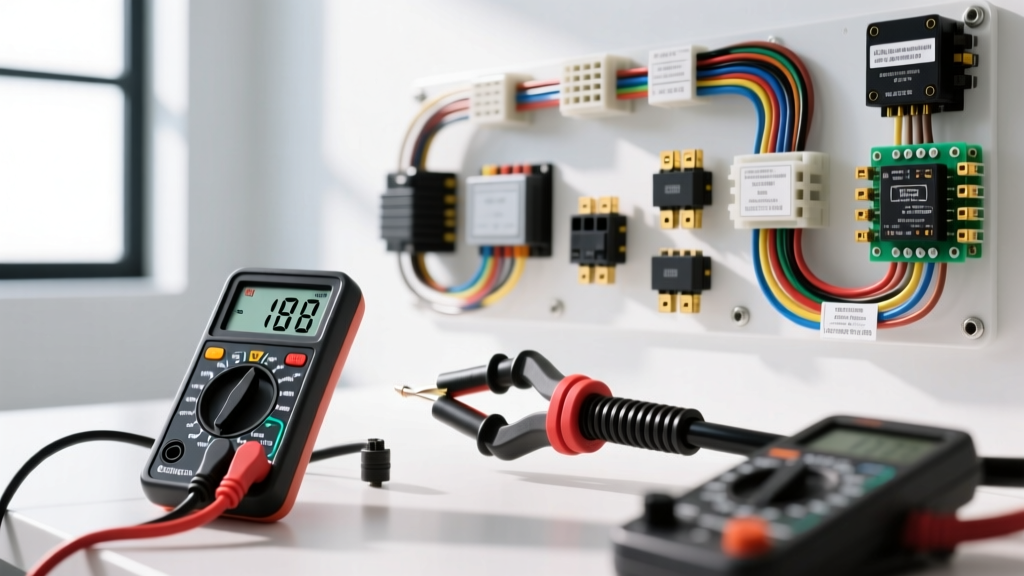
The Evolution of Electric Golf Cart Diagnostics
Modern electric golf carts have transitioned from simple 36V series-wound DC motor setups to complex 48V and 72V AC induction systems managed by sophisticated motor controllers. When troubleshooting electric golf cart problems, relying on a basic test light or an outdated analog meter is no longer sufficient. The high-amperage draws, regenerative braking feedback, and sensitive logic circuits in carts like the Club Car Precedent, EZ-GO TXT/Express, and Yamaha Drive require precision diagnostic equipment.
This selection guide compares the essential diagnostic tools required to accurately isolate faults in battery packs, solenoids, Forward/Reverse (F/R) microswitches, and motor controllers. We evaluate digital multimeters (DMMs), DC current clamps, and conductance testers based on safety ratings, DC accuracy, and real-world automotive application.
Digital Multimeters (DMM) for 48V to 72V Systems
A fully charged 72V lithium or lead-acid golf cart battery pack can peak at nearly 87V DC. When testing controller logic circuits or regenerative braking spikes, your DMM must be rated for these transient voltages. According to Fluke's safety guidelines on measurement categories, working on EV battery packs and inverters requires a minimum of CAT III 600V or CAT IV 1000V ratings to protect against arc flashes and transient spikes.
Product Comparison: Top DMMs for Cart Diagnostics
- Fluke 87V Industrial Multimeter: The gold standard. Features a true-RMS AC/DC measurement, millivolt DC resolution for testing shunt-style current sensors, and a low-pass filter for accurate readings on AC motor controllers (like the Curtis 1238 or Sevcon Gen4). Verdict: Best for professional fleet technicians.
- Klein Tools MM600: A robust, budget-friendly alternative. Rated CAT III 1000V / CAT IV 600V. It handles basic solenoid coil resistance testing and pack voltage checks perfectly, but lacks the millisecond min/max recording needed to catch intermittent voltage drops during hard acceleration. Verdict: Best for DIY owners and occasional repairs.
- Power Probe IV: Excellent for testing 12V accessory circuits (lights, USB chargers, horn) powered by DC-DC converters. However, its high-impedance logic circuits can sometimes trigger false readings on high-voltage 48V+ controller logic pins. Verdict: Best for accessory wiring, not main drivetrain diagnostics.
Inductive DC Current Clamps for Solenoid and Motor Draws
When troubleshooting electric golf cart problems related to sluggish acceleration or sudden power cutoffs, measuring voltage is only half the battle. You must measure amperage under load. A 48V Club Car pulling up a grade can draw 350A to 500A peak through the 2 AWG main battery cables. Standard AC-only clamp meters are useless here; you need a Hall-effect DC current clamp.
Hall-Effect Clamp Selection
- Fluke 376 FC True-RMS Clamp Meter: Measures up to 1000A AC/DC. Includes an iFlex flexible current probe, which is incredibly useful for clamping around tightly bundled 2 AWG battery cables inside cramped controller compartments. The 1000A DC range easily captures solenoid inrush current without maxing out the sensor.
- UNI-T UT210E Mini Clamp: A compact, affordable option that maxes out at 100A DC. While insufficient for main motor draws, it is perfect for testing the 12V DC-DC converter output and the low-amperage solenoid activation coil circuits (typically 2A to 5A).
Diagnostic Tool Comparison Matrix
| Tool Category | Recommended Model | Max DC Voltage | DC Amp Range | Best Application |
|---|---|---|---|---|
| Premium DMM | Fluke 87V | 1000V (CAT III) | N/A (mV Shunt) | Controller logic, AC motor phase testing |
| Budget DMM | Klein MM600 | 1000V (CAT IV) | N/A | Pack voltage, solenoid coil resistance |
| Heavy-Duty Clamp | Fluke 376 FC | 600V | 1000A DC | Motor inrush, 2 AWG main cable draw |
| Light-Duty Clamp | UNI-T UT210E | 600V | 100A DC | DC-DC converter output, coil activation |
| Load Tester | Foxwell BT100 Pro | 12V (per battery) | N/A (CCA Rating) | Individual 6V/8V/12V battery cell health |
Applying Your Tools: Real-World Diagnostic Trees
Selecting the right tool is only the first step. Below are expert-level diagnostic procedures for the two most common faults encountered when troubleshooting electric golf cart problems.
Fault 1: Solenoid Clicks, But Cart Will Not Move
The solenoid acts as the primary high-amperage relay, connecting the battery pack to the motor controller. A 'click' indicates the low-amperage activation coil is engaging, but the heavy-duty internal contacts may be pitted or failing to pass current.
- Safety First: Jack up the rear wheels. Chock the front wheels. Set the F/R switch to Neutral and engage the tow/run switch to 'Tow' (if equipped) before connecting meters.
- Measure Pack Voltage: Using your DMM, measure DC voltage across the main controller B+ (Red) and B- (Black) terminals. On a 48V EZ-GO TXT, this should read between 48.0V and 50.8V depending on state of charge.
- Activation Voltage Test: Turn the key to 'ON' and press the accelerator. Measure the voltage across the solenoid's two small activation terminals. On a Club Car Precedent, you should see pack voltage (e.g., 48V) on the small Yellow and Black wires. If voltage is present but the solenoid doesn't click, the internal coil is open (infinite resistance).
- Voltage Drop Test (The Definitive Check): Leave the DMM in DC Volts. Place the red probe on the large battery-side stud of the solenoid and the black probe on the large controller-side stud. Press the accelerator. A healthy solenoid will show a voltage drop of less than 0.15V. If you read 2V, 10V, or full pack voltage, the internal copper contacts are burned, and the solenoid must be replaced.
Fault 2: Intermittent Power Loss Under Load
This is almost always a high-resistance connection in the main power cables. As noted in the SAE J1127 standard for battery cable performance, high-amperage EV systems require precise crimping and torque specifications to prevent thermal runaway and voltage drop.
- Wire Gauge Check: Ensure all main battery interconnects and controller feeds are utilizing 2 AWG or 4 AWG fine-strand copper wire. Never use solid copper or undersized 6 AWG wire for 400A+ circuits.
- Connector Inspection: Most modern carts use Anderson Powerpole SB connectors (like the Anderson SB175). Inspect the SB175 housing for melted plastic. Use your DC Clamp meter to measure current draw while simultaneously using a thermal camera or infrared thermometer to check the connector. If the connector exceeds 140°F (60°C) at 150A draw, the internal roll-pin contacts are oxidized and must be replaced.
- Torque Specifications: Re-torque all 3/8-inch and 5/16-inch battery and controller lug nuts to exactly 10-12 ft-lbs. Over-torquing can strip the soft copper lugs, while under-torquing creates micro-arcing that destroys controller capacitors.
Wiring & Controller Pinout Reference
When probing controller harnesses, avoid piercing wires with test probes, which introduces corrosion. Always back-probe the Deutsch or Molex connectors. Below is a quick reference for common 48V controller logic pins:
- EZ-GO PDS Controller (48V): Pin 1 (Red/White) is the Key Switch input (48V). Pin 5 (Blue) is the Solenoid activation output. Pin 8 (Yellow) is the Tow/Run switch input.
- Club Car IQ / Excel System: The MCOR (Motor Controller Output Regulator) replaces the old V-Glide. Pin 1 (Red) is 48V input. Pin 2 (White) is the wiper signal (0.8V to 3.6V variable). Pin 3 (Black) is ground. If your DMM reads outside the 0.8V-3.6V range while pressing the pedal, the MCOR potentiometer has failed, triggering the controller's safety rollback.
Expert Verdict
Successfully troubleshooting electric golf cart problems requires moving beyond basic continuity checks. Investing in a CAT-rated True-RMS multimeter and a 1000A Hall-effect DC clamp will immediately elevate your diagnostic accuracy. By combining these tools with systematic voltage drop testing and adherence to SAE wiring standards, you can reliably isolate faults in solenoids, battery packs, and high-voltage motor controllers without resorting to unnecessary parts swapping.