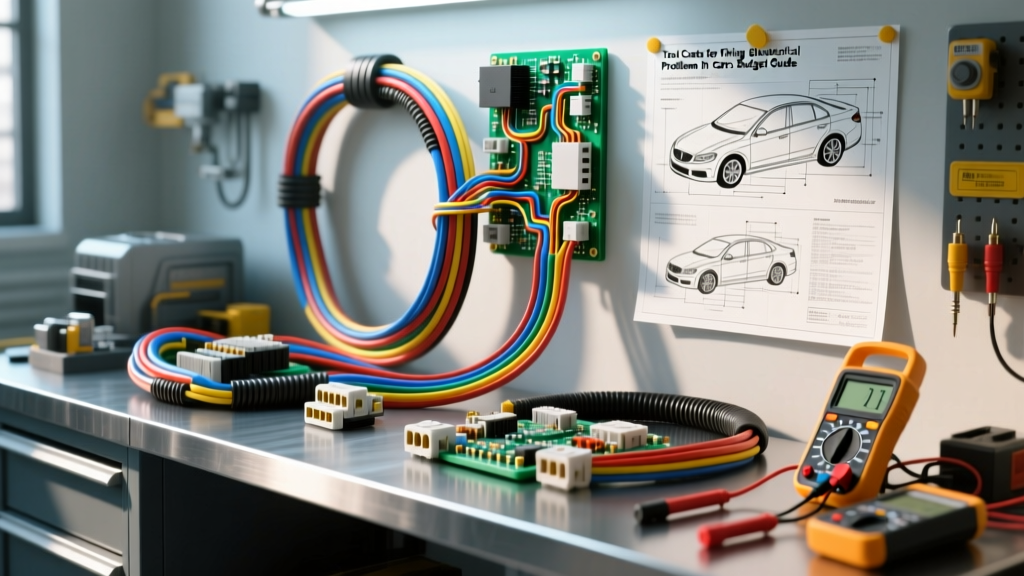
The Financial Reality of Automotive Electrical Diagnostics
When fixing electrical problems in cars, the most expensive mistake a technician or DIYer can make is guessing. Modern vehicles rely on complex multiplexed networks (CAN, LIN, FlexRay) and pulse-width modulated (PWM) power circuits. Throwing replacement parts at a P0600 (Serial Communication Link) code or a parasitic battery drain will quickly drain your wallet. True electrical diagnostics requires isolating the fault layer: power supply, ground integrity, signal communication, or module failure.
However, professional-grade diagnostic equipment carries a steep premium. This cost analysis breaks down the tool requirements for automotive electrical troubleshooting into three distinct budget tiers, evaluating the return on investment (ROI) and technical capabilities of each setup.
Tier 1: The Essential DIY Diagnostic Toolkit ($50 - $150)
For basic circuit validation, voltage drop testing, and continuity checks, a high-quality Digital Multimeter (DMM) is non-negotiable. While a $15 hardware store meter can measure basic DC voltage, automotive circuits require specific features like duty cycle measurement, RPM sensing, and high-impedance inputs to prevent damaging sensitive 5V reference circuits.
High-Impedance DMM & Test Accessories
An automotive-specific DMM, such as the Fluke 88V or Innova 3340, costs between $60 and $120. These meters feature 10-megohm input impedance, ensuring they do not draw enough current to alter the voltage of low-current sensor circuits. For example, when testing the 5V reference circuit (Pin 1) on a GM LS Throttle Position Sensor (TPS), a low-impedance meter might pull the voltage down to 3.2V, leading to a false diagnosis of a failed Powertrain Control Module (PCM).
Essential Accessories ($30):
- Back-Probe Pins: Required for testing sealed connectors like the Delphi Weather-Pack or Aptiv Metri-Pack 280 series without piercing the wire insulation. Piercing wires with T-pins introduces moisture ingress and subsequent copper oxidation, creating high-resistance faults down the road.
- Fused Jumper Wires: 14 AWG TXL wire with inline 5A and 10A AGC glass fuses for safely bypassing switches and relays.
Tier 2: The Advanced Enthusiast & Prosumer Setup ($250 - $600)
Once you move beyond basic voltage checks, diagnosing intermittent faults, actuator failures, and parasitic draws requires active testing equipment. This tier bridges the gap between basic DIY and professional bay diagnostics.
Power Probe and Circuit Testers ($180 - $250)
Tools like the Power Probe Hook Master allow technicians to apply 12V power or ground directly to a component while monitoring the circuit's amperage draw. This is invaluable for testing fuel injectors, cooling fan relays, and solenoid valves. However, extreme caution is required: applying 12V to a 5V logic circuit or a CAN bus line will instantly destroy the driver transistor inside the PCM. Power probes should be strictly limited to high-current actuator circuits (e.g., Terminal 30 to 87 on a standard ISO mini relay).
Parasitic Draw Test Equipment ($50 - $100)
Modern vehicles require up to 45 minutes to enter 'sleep mode,' where module quiescent current drops below 50mA. Breaking the battery connection to insert a standard DMM ammeter will wake the vehicle up, resetting the sleep timer. The professional solution is a 100A inductive current clamp or a precision millivolt shunt. By measuring the millivolt drop across a calibrated 100A shunt installed between the negative battery post and the chassis ground cable, you can monitor the vehicle's sleep cycle without breaking the physical circuit connection.
Tier 3: Professional Dealer-Level Diagnostics ($800 - $2,500+)
Diagnosing network communication faults, variable valve timing (VVT) solenoid PWM signals, and crankshaft/camshaft correlation errors requires visualizing the voltage over time. A multimeter's refresh rate of 4 samples per second is entirely blind to microsecond network glitches.
Automotive Oscilloscopes ($500 - $1,500)
The industry standard for fixing complex electrical problems in cars is the PicoScope 4225A or 4425A. These 20MHz, 20MS/s oscilloscopes allow you to graph voltage signatures. For instance, when diagnosing a CAN bus fault, you can connect Channel A to OBD2 Pin 6 (CAN High) and Channel B to Pin 14 (CAN Low). A healthy network will show CAN High swinging from 2.5V to 3.5V, and CAN Low swinging from 2.5V to 1.5V simultaneously, creating a precise 2V differential signal. If the signals mirror each other or flatline at 2.5V, the scope instantly reveals a short-to-ground or a failed terminating resistor.
Breakout Boxes & OEM Scan Tools ($300 - $1,000+)
Breakout boxes (BOBs) plug inline between the PCM and the engine wiring harness, providing safe, numbered test ports for every pin on the ECM connector. This prevents terminal fretting and damage to the fragile 0.64mm female terminals found in modern TE Connectivity (formerly Tyco) ECU connectors.
Hidden Costs: Consumables and Wiring Repair Materials
Fixing the problem is only half the battle; repairing the wiring to OEM standards requires specialized consumables. According to the Aptiv Connection Systems Catalog, using improper terminals or crimpers leads to terminal push-out and high-resistance melting.
| Material / Tool | Specification / Type | Estimated Cost | Application Notes |
|---|---|---|---|
| Ratcheting Terminal Crimper | Delphi Weather-Pack / Metri-Pack 150/280 | $85 - $140 | Ensures proper bellmouth crimp and insulation grip. Mandatory for pulling 15A+ continuous loads. |
| Automotive Primary Wire | TXL / GXL (Cross-linked Polyethylene) | $0.40 - $0.80 / ft | Handles higher under-hood temperatures (up to 125°C) compared to standard PVC THHN wire. |
| Adhesive-Lined Heat Shrink | Dual-Wall Polyolefin (3:1 or 4:1 ratio) | $25 / spool | Melting inner adhesive seals out moisture and prevents capillary wicking of water into the copper strands. |
| Deutsch DT Crimper | 4-way indent crimp for 16-20 AWG | $120 - $180 | Required for heavy-duty, off-road, or marine sensor connections to ensure IP68 waterproof sealing. |
Cost vs. ROI: When to Buy vs. When to Hire a Pro
Dealerships and specialized electrical shops typically charge between $150 and $220 per hour for diagnostic time. The Pico Technology Automotive Oscilloscope Library provides extensive case studies showing how network faults can take 3 to 5 hours of dealer labor to isolate using only scan tools and guesswork. Below is a breakdown of common scenarios to help you decide if the tool investment is justified.
| Diagnostic Scenario | Required Tool Tier | Tool Investment | Estimated Dealer Cost | Break-Even Point |
|---|---|---|---|---|
| Parasitic Battery Drain | Tier 2 (Shunt / Clamp) | $60 | $300 - $450 (2-3 hrs) | 1st Use |
| Blower Motor Voltage Drop | Tier 1 (DMM) | $90 | $150 - $200 (1 hr) | 1st Use |
| CAN Bus Network Short | Tier 3 (Oscilloscope) | $650 | $600 - $1,000 (3-5 hrs) | 1st to 2nd Use |
| Cam/Crank Sensor Sync | Tier 3 (Oscilloscope) | $650 | $400 - $600 (2-3 hrs) | 2nd Use |
Conclusion: Investing in Diagnostics Over Parts
The cost of fixing electrical problems in cars is heavily skewed toward labor and diagnostic time, not the replacement parts themselves. A $12,000 dealership diagnostic bay is ultimately just utilizing Tier 3 tools combined with OEM wiring diagrams. By understanding the SAE International standards for automotive electrical testing and strategically investing in Tier 1 and Tier 2 tools, a knowledgeable DIYer or independent mechanic can recoup their tool investment on the very first successful diagnosis. Always prioritize high-impedance meters, proper terminal crimping tools, and network-safe testing methodologies to ensure long-term reliability of the vehicle's electrical architecture.