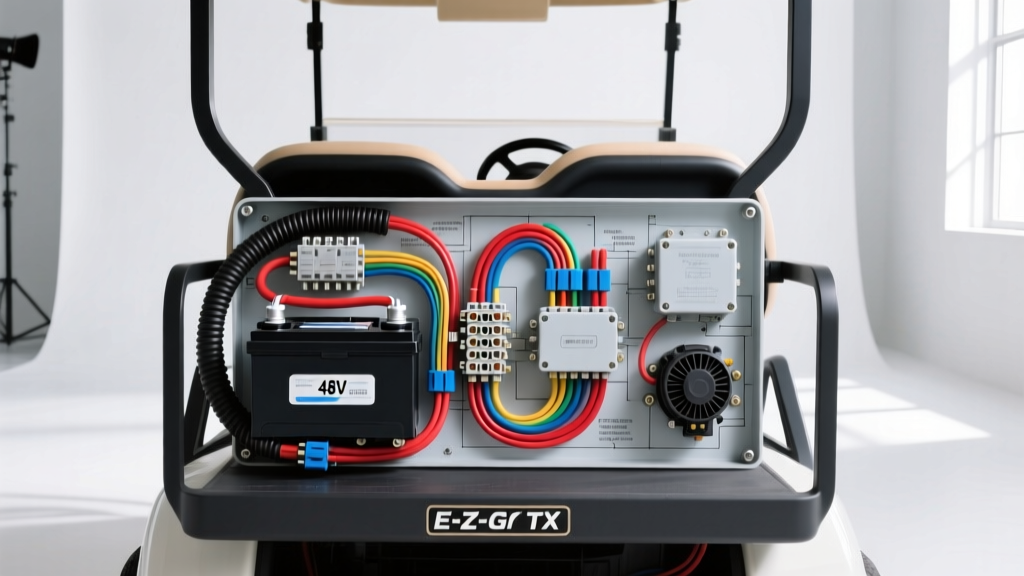
Decoding the E-Z-GO TXT Wiring Diagram: What You Actually Need
Upgrading, troubleshooting, or completely rewiring an E-Z-GO TXT requires more than just a basic understanding of electrical circuits; it demands a precise budget and professional-grade tooling. Whether you are working on a classic 36V Series system, a DCS (Drive Control System), or a modern PDS (Precision Drive System), consulting an accurate ezgo txt wiring diagram is only the first step. The real challenge lies in translating that schematic into a physical, reliable harness capable of handling 300+ amp peak draws without thermal degradation.
Many DIYers and entry-level fleet mechanics underestimate the cost of high-current terminations and the specialized tools required to crimp 2 AWG battery cables safely. A poorly executed connection on the main motor leads will result in severe voltage drop, melted ring terminals, and potentially a welded-shut solenoid. This comprehensive cost and tool analysis breaks down the exact financial and equipment requirements to execute a flawless E-Z-GO TXT rewiring project, ensuring your cart performs reliably on the course or the trail.
Essential Diagnostic & Wiring Tools: The True Cost of Quality
When dealing with the high-amperage DC environments of golf cart motor speed controllers, standard automotive tools often fall short. You cannot safely crimp 2 AWG or 4 AWG Class K copper wire with a standard hand-crimper; the compression ratio will be insufficient, leading to micro-gaps that generate intense heat under load.
The "Must-Have" vs. "Nice-to-Have" Tool Matrix
| Tool Category | Specific Recommendation | Estimated Cost | Application in TXT Rewiring |
|---|---|---|---|
| Digital Multimeter | Fluke 87V (True RMS) or Innova 3340 | $45 - $250 | Testing PWM duty cycles, solenoid coil resistance (12-15Ω), and voltage drop across the F/R switch. |
| Hydraulic Crimper | Knoweasy or Ton HSC8 (16-ton manual) | $60 - $110 | Crimping 2 AWG to 4 AWG heavy-duty ring terminals for the motor and controller B+ leads. |
| Heat Gun | Wagner HT1000 or Milwaukee M18 | $30 - $150 | Shrinking marine-grade adhesive heat shrink over high-current lugs to prevent acid corrosion. |
| Torque Wrench | 3/8" Drive (10-80 in-lbs range) | $40 - $80 | Precision tightening of motor studs and controller busbars to prevent thread stripping. |
| Wire Stripper | Knipex TwinForce or Ancor Marine | $35 - $90 | Stripping thick EPDM insulation from 2 AWG battery cable without nicking copper strands. |
Pro Tip: Never use solder on high-current golf cart battery cables. Solder has a lower melting point and higher electrical resistance than copper. Under the 300A peak loads generated during hill climbs or heavy towing, soldered joints can melt and fail catastrophically. Always use mechanical hydraulic crimps sealed with adhesive heat shrink.
Component Cost Breakdown: Series vs. PDS Systems
The financial scope of your rewiring project depends heavily on whether your E-Z-GO TXT utilizes a Series motor configuration or a Separately Excited (SepEx) PDS/DCS setup. The ezgo txt wiring diagram for a Series cart is relatively simple, routing all high current through the Forward/Reverse switch. In contrast, PDS systems use low-current microswitches and rely entirely on the motor speed controller to manage direction and speed.
1. The Solenoid: The Heart of the High-Current Circuit
Do not compromise on the main contactor. Cheap, unbranded solenoids found on generic marketplaces often suffer from weak internal return springs and poor contact metallurgy, leading to the contacts welding together in the 'ON' position—a massive safety hazard.
- Albright SW180 (OEM Style Replacement): $65 - $85. Features silver-alloy contacts designed for 48V systems and continuous high-amperage cycling.
- White-Rodgers 586-902: $45 - $60. A robust alternative, but requires careful attention to the coil suppression diode placement to prevent frying the controller's logic board.
2. Motor Speed Controller Upgrades
If you are rewiring to support larger tires, lift kits, or increased payload, the stock controller will likely trigger thermal rollback. Upgrading to an aftermarket controller requires specific wiring harness adapters and heavy-duty capacitor banks.
- Alltrax SR48-400 (Series): ~$450. Excellent for basic torque improvements. Requires upgrading the stock 10 AWG solenoid activation wire to handle the increased pre-charge current.
- Alltrax XCT-400 (PDS/DCS): ~$650. Features Bluetooth tuning and regenerative braking. Requires careful mapping of the J5 and J6 logic pins according to the manufacturer's Alltrax Controller Manuals.
3. High-Current Cabling & Terminals
According to the SAE J1127 Standard for battery cables, high-strand count Class K copper is mandatory for flexibility and vibration resistance. Standard solid-core automotive wire will fracture under the constant chassis vibration of a golf cart.
- 2 AWG Class K Battery Cable: $3.50 - $5.00 per foot. You will need approximately 12-15 feet for a complete TXT high-current loop.
- Heavy-Duty 3/8" Ring Terminals (Tinned Copper): $1.50 each. Always buy tinned copper to resist galvanic corrosion from battery off-gassing.
- Marine-Grade Adhesive Heat Shrink (3:1 ratio): $25 for a multi-size box.
Wire Gauge, Routing, and Terminal Specifications
A critical aspect of reading any ezgo txt wiring diagram is distinguishing between the high-current propulsion circuit and the low-current logic circuit. Mixing these up, or using undersized wire for the logic circuits, will result in erratic controller behavior and micro-switch burnout.
E-Z-GO TXT High-Current vs. Low-Current Circuit Specs
| Circuit Function | AWG Size | Standard Color Code | Terminal Type | Torque Specification |
|---|---|---|---|---|
| Battery Pack to Solenoid (B+) | 2 AWG | Red | 3/8" Ring (5/16" on older models) | 9 - 11 ft-lbs |
| Solenoid to Controller (B+) | 2 AWG | Red | 3/8" Ring | 120 in-lbs (Busbar) |
| Controller to Motor (M-, F1, F2) | 2 AWG or 4 AWG | Blue / Yellow / Green | 5/16" Ring | 8 - 10 ft-lbs (Motor Studs) |
| Solenoid Activation (Coil +) | 10 AWG | White or Red (with inline fuse) | 1/4" Spade or #10 Ring | Hand Tight + 1/4 turn |
| F/R Switch Logic (PDS) | 14 AWG | Blue / White | 1/4" Insulated Spade | N/A (Push-on) |
| Throttle Box (MCOR / V-Glide) | 16 AWG | Red / Black / White | Deutsch DT or Molex | N/A (Click-lock) |
Crucial Torque Warning: The motor studs on older GE and AMD motors are brass or soft copper. If you apply standard automotive torque (e.g., 25 ft-lbs) to a 5/16" motor stud, you will strip the threads instantly, requiring a costly motor rebuild or helicoil insertion. Always use an inch-pound torque wrench for controller and motor connections.
Hidden Costs & Common Failure Modes to Avoid
When budgeting for a rewiring project based on an ezgo txt wiring diagram, fleet managers and DIYers frequently overlook the hidden costs associated with aging infrastructure and improper diagnostic techniques.
1. The Voltage Drop Trap
A cart that feels 'sluggish' or triggers the controller's low-voltage cutoff is often misdiagnosed as having bad batteries. In reality, a corroded battery interconnect cable or a loose solenoid terminal can create a 2-volt drop under load. Cost to fix: $40 for a new 6 AWG interconnect cable and a wire brush. Cost of misdiagnosis: $800+ for a new battery bank that doesn't solve the problem.
2. Microswitch Burnout in Series Carts
In older Series E-Z-GO TXT models, the Forward/Reverse switch physically carries the high-current activation signal for the solenoid. If the internal contacts pit and corrode, resistance increases, generating enough heat to melt the switch housing. Upgrading to a heavy-duty microswitch assembly with a dedicated relay harness costs about $65 and prevents the $150 replacement of the entire F/R lever assembly.
3. MCOR vs. Inductive Throttle Sensors
Modern PDS and RXV carts use inductive throttle sensors, but older TXTs use the MCOR (Motor Controller Optical Regulator) or V-Glide potentiometers. These mechanical units are prone to dust ingress and wiper-track wear, causing sudden acceleration or 'tow mode' faults. Budget an extra $85 for a replacement ITS (Inductive Throttle Sensor) and the necessary wiring pigtail if your diagnostic multimeter shows erratic voltage sweeps between 0.8V and 3.2V.
Expert Sourcing & Reference Materials
To ensure your rewiring project meets OEM safety standards, always cross-reference your physical harness with updated service manuals. The Buggies Gone Wild E-Z-GO Archive remains one of the most comprehensive community-driven repositories for legacy TXT schematics, including the elusive 1994-1995 DCS transition diagrams. Furthermore, when sourcing 2 AWG cable, avoid big-box hardware stores; instead, purchase from dedicated marine or EV suppliers who stock genuine SAE J1127 compliant, ultra-flexible Class K copper wire. By investing in the correct tools and premium materials upfront, you eliminate the risk of thermal runaway and ensure your E-Z-GO TXT operates safely for years to come.