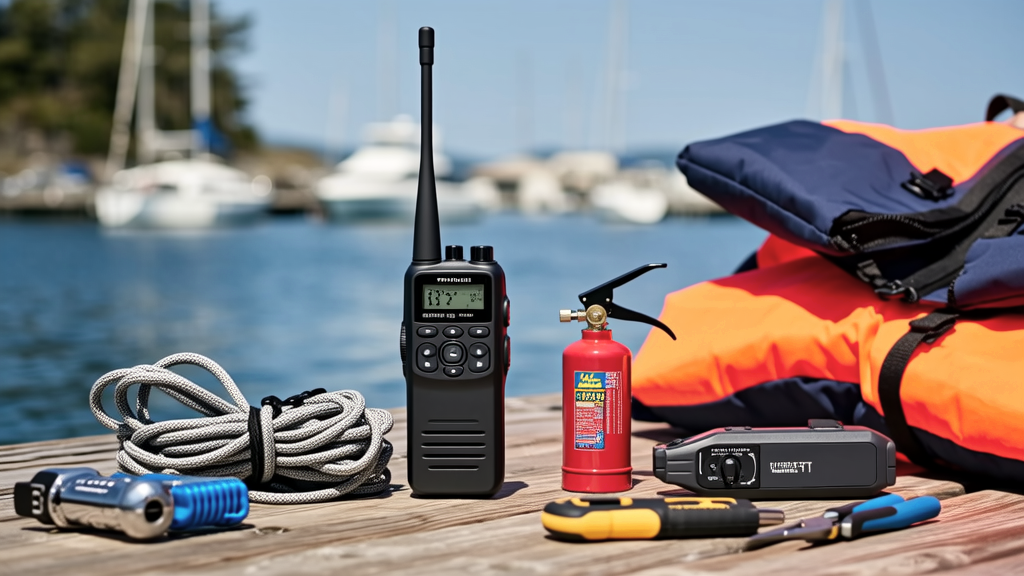
Starting out on the water is thrilling — but without the right essentials, it’s also risky and stressful. This guide cuts through the noise to deliver what every new boat owner actually needs: U.S. Coast Guard–required safety gear (including exact flotation device ratings and fire extinguisher classes), essential maintenance tools with real model numbers and torque specs, navigation aids that work even when GPS fails, and proven storage solutions tested aboard 14–26-foot center consoles and bowriders. We cover specific brands like West Marine’s Pro Series VHF radios, Attwood’s 5-gallon portable fuel tanks (UL-listed, 12.5" × 18.5" × 10.75" dimensions), and Hella LED anchor lights rated for 12V DC at 0.32A draw. No fluff — just field-verified gear, compliance deadlines, and setup steps you can execute before your first launch.
USCG-Mandated Safety Gear: Non-Negotiables
The U.S. Coast Guard doesn’t negotiate — and neither should you. Every vessel operating on navigable U.S. waters must meet strict equipment requirements under Title 33 CFR Part 175. Failure to comply isn’t just a fine; it’s a liability multiplier in the event of an incident. For boats under 16 feet, you need one wearable Type I, II, III, or V PFD per person aboard — and they must be U.S. Coast Guard–approved, not just 'marine-grade.' As of 2024, inflatable PFDs like the Stearns Inflatable Belt Pack (Model #27022) are approved only for persons aged 16+, weighing 80+ lbs, and operating in calm, inland waters. They carry a 22-lb buoyancy rating and deploy via 23g CO₂ cartridge (part #27005).
Fire extinguishers are another hard requirement. Boats under 26 feet with closed compartments (e.g., bilge, engine room, or cabin lockers) must carry at least one B-I rated extinguisher — meaning it discharges at least 2A:10B:C rating, contains minimum 2 lbs dry chemical, and is UL 1518 certified. Kidde’s Firex FAD-10 (1.5 lb ABC powder, 8.5" tall, 3.25" diameter) meets this spec and weighs just 2.1 lbs — critical for small craft where weight distribution matters. It must be mounted within arm’s reach of the helm and inspected monthly for pressure gauge integrity (needle must remain in green zone).
Visual Distress Signals (VDS)
VDS requirements differ by day vs. night and by water type. All vessels operating on coastal waters, the Great Lakes, territorial seas, or federally controlled inland waters must carry USCG-approved signals. Day signals include three handheld orange smoke flares (e.g., Orion Safety Products’ SOS-200, burns 60 seconds, visible up to 6 miles). Night signals require three red parachute flares (Orion’s SOS-300, 1,000-ft ascent, 30-second burn, 12-mile visibility) OR one electric distress light (e.g., Aqua Signal Model 41, 12V DC, strobes at 50–60 cpm, 360° visibility, 3+ hours runtime on 2 AA batteries). Note: Pyrotechnic VDS expire 42 months from manufacture date — check the stamp on the flare’s base, not the box.
Sound-Producing Devices
Boats under 39.4 feet (12 meters) must carry a sound-signaling device audible for at least 0.5 nautical mile. Whistles are acceptable — but only if they meet ISO 14582:2015 standards and produce ≥112 dB at 1 meter. The Fox 40 Classic CMG whistle (model #F40CMG) delivers 118 dB and fits on a lanyard or belt clip. Horns are preferred for reliability: the Standard Horizon HX300E (12V DC, 115 dB at 1m, 4.5" x 3.25" x 2.75") mounts easily and draws just 0.6A.
Navigation & Communication Must-Haves
GPS alone won’t save you — especially when satellite signals drop near cliffs, bridges, or during heavy rain. A layered navigation strategy is essential. At minimum, every beginner needs: (1) a fixed-mount VHF radio with DSC (Digital Selective Calling), (2) paper charts compliant with NOAA Chart No. 1, and (3) a magnetic compass calibrated to within ±3° of true heading.
Fixed-mount VHFs provide far greater range and reliability than handhelds. The Standard Horizon GX2200 (Class D DSC, 25W output, built-in GPS, AIS receiver-ready) offers 6.5-mile range in open water and integrates with chartplotters via NMEA 2000. Its waterproof mic (IPX7 rated) survives full submersion for 30 minutes. Pair it with a properly tuned 8-ft Shakespeare 5206-8 antenna (gain: 6 dB, VSWR <1.5:1) mounted at least 12 ft above waterline for optimal line-of-sight transmission. Handheld backups like the ICOM M25 (6W, IPX8, 10-hour battery life) are vital for man-overboard scenarios — but never sole reliance.
Chartplotter & Backup Systems
A chartplotter simplifies route planning, depth tracking, and hazard avoidance. The Garmin echoMAP UHD 64cv (6.2" sunlight-readable display, CHIRP sonar, built-in Garmin QuickDraw Contours mapping) includes preloaded Navionics+ charts for U.S. coastal and inland waters. But electronics fail — so always carry NOAA paper charts. For the Florida Intracoastal Waterway, use Chart 11449 (scale 1:40,000); for Puget Sound, Chart 18445 (1:25,000). Store them in a waterproof case like the Orca 1200 Dry Bag (20L capacity, RF-welded seams, 100% submersion proof).
Magnetic Compass Accuracy Matters
Even with GPS, a compass remains critical during electrical failure or fog. Mount a Ritchie C-2500 (2.5" diameter, liquid-damped, 0–360° card, ±2° accuracy) on the helm pedestal using non-magnetic stainless steel screws. Calibrate using the ‘swinging the ship’ method: align the boat to known headings (N, NE, E, etc.) using visual landmarks or GPS course-over-ground, then adjust the compensator magnets until deviation is ≤3° across all quadrants. Record deviations in a logbook — many beginners overlook this step and end up 15° off-course in low visibility.
Fuel, Fluids & Engine Maintenance Tools
Engine longevity starts with proper fluids and routine checks — not annual ‘tune-ups.’ Outboards and sterndrives demand specific oil grades, coolant ratios, and propeller inspection protocols. Mercury Marine’s OptiMax 2-stroke engines require XD100 synthetic oil (100:1 mix ratio), while Yamaha’s 4-stroke F90B requires Yamalube 4M 10W-30 API SN/FC rated oil — not automotive oil, which lacks marine-specific anti-foam and corrosion inhibitors.
Carry these core tools onboard: a digital multimeter (Fluke 87V, CAT III 1000V rated), 12V battery load tester (Solar BA30, tests up to 1200 CCA), propeller pitch gauge (Tachyon TP-100, measures ±0.1" accuracy), and a torque wrench calibrated for marine fasteners (Snap-on TM125C, 25–250 in-lbs, ±3% accuracy). Tightening a lower-unit drain plug to 18 in-lbs (Yamaha spec) instead of 35 prevents stripped threads — a $420 repair.
- Oil change intervals: Every 100 hours or annually (whichever comes first) for 4-strokes; every 50 hours for 2-strokes
- Coolant replacement: Every 3 years or 300 hours for closed-loop systems (e.g., Volvo Penta SX drive)
- Zinc anode replacement: Every 6–12 months depending on salinity — replace when >50% eroded
- Spark plug gap: 0.035" for most 4-strokes (e.g., Evinrude E-Tec G2 150)
For fuel handling, avoid ethanol-blended gasoline above E10. Use STA-BIL 360 Marine (1 oz treats 10 gallons) added before every fill-up — it stabilizes fuel for 12 months, prevents phase separation, and contains corrosion inhibitors proven effective in saltwater environments (per ASTM D7547 testing). Store fuel in UL-listed portable tanks only: the Attwood 5-Gallon Portable Fuel Tank (Model #25151-2) measures 12.5" × 18.5" × 10.75", weighs 7.2 lbs empty, and features a self-venting cap and integrated fuel gauge.
Anchoring, Docking & Line Management
Proper anchoring isn’t about brute force — it’s about scope, bottom composition, and rode material. For a 22-foot bowrider, use a 15-lb Danforth-style anchor (e.g., Mantus M1-15) with 3/8" nylon rode (5:1 scope minimum in protected waters; 7:1 in exposed areas). Nylon stretches 15–25% under load — absorbing shock better than chain or polyester. Never use hardware-store rope: Samson XLS (1/2" 3-strand, 4,200-lb breaking strength) meets ABYC A-23 standards and resists UV degradation for 3+ years.
| Rode Type | Diameter | Breaking Strength (lbs) | Recommended Scope | Max Boat Length |
|---|---|---|---|---|
| Nylon 3-strand | 3/8" | 3,200 | 5:1–7:1 | 26' |
| Nylon double-braid | 7/16" | 4,900 | 6:1–8:1 | 32' |
| Galvanized chain | 1/4" | 3,800 | 3:1–5:1 (with nylon snubber) | 28' |
| Stainless steel cable | 3/16" | 2,100 | Not recommended — poor shock absorption | N/A |
Use a 3-ft length of 1/2" nylon snubber between chain and anchor to reduce chafe and absorb shock. Secure dock lines with cam cleats rated for working loads: Harken 150mm Cam-Matic Cleat (rated 2,200 lbs SWL) handles spring lines on 24' cruisers. Avoid cleats with plastic cams — they fail under sustained UV exposure.
Spring Lines & Fender Placement
Four fenders are minimum: two 8" round fenders (e.g., Taylor Made 80100, 8" dia × 4" thick, 12 PSI inflation pressure) amidships on each side, plus two 6" cylindrical fenders (Taylor Made 60100) at bow and stern. Hang fenders at the widest beam point — not at the gunwale — to prevent hull scuffing. Spring lines control fore-aft motion: lead the forward spring from midship cleat to dock piling at a 45° angle aft; the after spring from midship cleat to piling at 45° forward. Use 3/8" braided nylon dock lines — 25 ft for bow/stern, 35 ft for springs on 22' boats.
Wind & Current Considerations
In winds over 15 knots, increase scope to 10:1 and add a second anchor (e.g., Fortress FX-7 set at 45° off primary). Current affects holding power more than wind: a 2-knot current exerts ~3× the lateral force of a 15-knot wind on the same hull. Monitor tide tables (NOAA Tides & Currents website) — slack tide occurs 30 minutes before/after high/low tide and is the safest window for docking in narrow marinas like Newport Harbor’s Channel Islands Blvd slip.
Electrical Systems & Battery Management
Marine electrical systems operate in harsher conditions than automotive ones — salt, vibration, and moisture demand specialized components. Your starter battery must be Group 24 or 27 (12V, 75–100 Ah), AGM (Absorbent Glass Mat) for vibration resistance and zero maintenance. The Odyssey PC680 (12V, 75 Ah, 800 CCA, 4-year warranty) weighs 42.5 lbs and delivers 200+ cycles at 80% depth of discharge — ideal for repeated cranking.
House loads (lights, livewell pumps, fishfinder) require a deep-cycle battery. The Lifeline GPL-31T (12V, 105 Ah, 1,100 CCA, 5-year warranty) uses pure lead plates and lasts 8–10 years with proper charging. Never mix battery chemistries or ages on the same bank — voltage mismatches cause premature failure.
- Install an automatic charging relay (ACR) like the Blue Sea Systems ML-ACR 7610 (120A continuous, 320A surge) to combine batteries while charging and isolate them when off
- Use tinned-copper wire only: 8 AWG for starter circuits (max 10-ft run), 6 AWG for house banks
- Protect all circuits with ABYC-compliant breakers — not automotive fuses
- Ground all DC negative returns to a common bus bar (Blue Sea 5025 Dual BusBar), not the engine block
- Verify alternator output: Mercury Verado 250 produces 70A at 12.8V; insufficient for dual-battery setups without a DC-DC charger
For solar supplementation, the Renogy 100W Eclipse Monocrystalline Panel (12V, 5.87A, 17.5V VOC) pairs with a Victron SmartSolar MPPT 75/15 (15A max, Bluetooth monitoring) to maintain house banks during multi-day trips. It delivers 30–45 Ah/day in full sun — enough to run a 12V refrigerator (Engel MT45, 2.1 cu ft, draws 2.3A avg) and LED cabin lights (4 × 3W bulbs = 0.8A total).
Storage, Organization & Onboard Hygiene
Clutter kills safety. Every item must have a dedicated, secured location — especially on smaller boats where movement is restricted. Use 3M Dual Lock SJ3541 (1" wide, 20-lb shear strength per sq in) to mount tool rolls, first-aid kits, and flashlight holders. Avoid suction cups — they detach in chop.
Mount a 12V freshwater washdown system using a Shurflo 2088-342 (3.0 GPM, 45 PSI, 7.5-amp draw) with a 12-gallon poly tank (SeaLand 12000-12) and 3/8" reinforced PVC hose. Install a dedicated deck plate (Perko 0001241P) with stainless strainer to prevent debris ingestion. For waste management, the Dometic 310 Portable Toilet (1.6-gallon holding tank, 12V macerator, 3.5" marine discharge port) complies with Clean Vessel Act standards and fits under most leaning posts.
First-Aid & Emergency Medical Prep
Standard first-aid kits fail on boats. Upgrade to the Adventure Medical Kits Marine 300 (265 pieces, waterproof case, includes SAM splint, QuikClot gauze, marine-grade antiseptic wipes). Add prescription meds in waterproof pill bottles (Nalgene Wide Mouth, 4 oz, -40°F to 212°F rated) and store insulin (if needed) in a Yeti Hopper M30 soft cooler with frozen gel packs — maintains 36–46°F for 28 hours.
Tool Roll & Spare Parts Kit
Every boat needs a sealed, labeled spare parts kit: (1) 3 spark plugs (NGK BR6HS for Yamaha F150), (2) 2 fuel filters (Racor R10T-02), (3) 1 impeller kit (Johnson/Evinrude 38-10250T), (4) 4 zinc anodes (Sierra 18-2252), (5) 10 ft of 14 AWG tinned wire, (6) 12 heat-shrink butt connectors (Ancor 207230), and (7) marine-grade silicone (Dow Corning 795, 30-day cure, saltwater-rated adhesion). Store in a Pelican 1040 Micro Case (4.2" × 2.7" × 1.9", IP67 rated).
Finally, document everything. Keep a physical logbook (West Marine Logbook #10001) recording oil changes, anode replacements, VDS expiration dates, and compass deviations. Digital backups alone aren’t reliable — saltwater damage, battery loss, and software corruption happen. Update entries after every trip — consistency builds discipline, and discipline keeps you safe. Remember: gear doesn’t replace judgment, but the right gear makes good judgment possible. Equip wisely, inspect weekly, and never launch without verifying your PFDs, fire extinguisher pressure, and VHF battery charge. The water rewards preparation — and punishes assumptions.