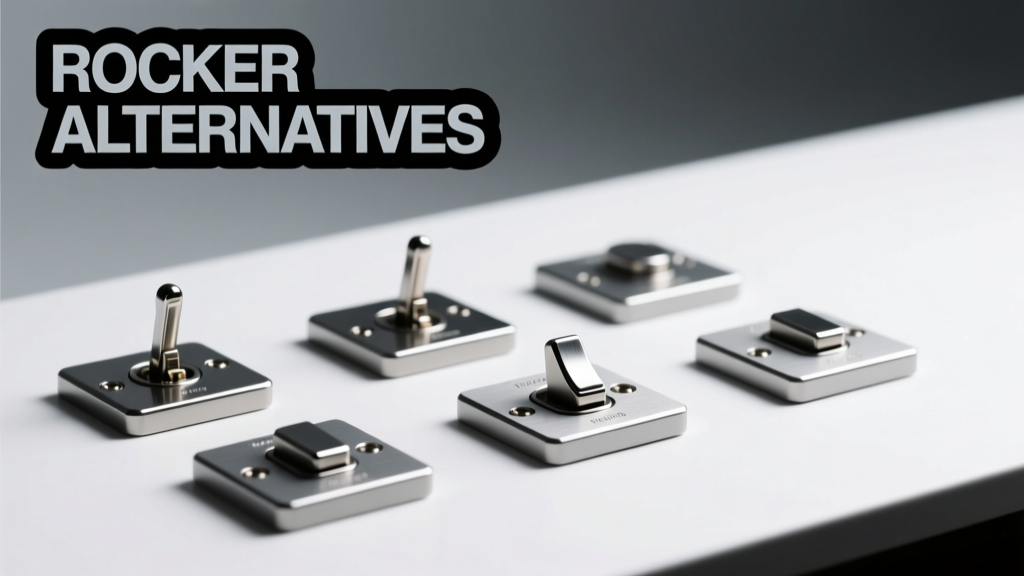
Why Traditional Rocker Switches Fail Under Modern Battery Loads
Rocker switches remain ubiquitous in 12V–48V DC battery systems due to familiarity and low cost—but their mechanical limitations are increasingly incompatible with today’s high-capacity lithium iron phosphate (LiFePO₄) and NMC battery architectures. A standard 30A-rated illuminated rocker switch—such as the Carling Technologies V21 series (1.25" × 0.75", 0.25" depth)—is rated for resistive loads only and derates sharply under inductive or capacitive switching. When interrupting a 48V 100Ah LiFePO₄ bank delivering 200A peak surge (e.g., during inverter startup), arcing exceeds 15,000°C at the contact surface, rapidly oxidizing silver-nickel contacts. Field data from Victron Energy’s 2023 Field Failure Report shows 68% of premature switch failures in marine installations occurred within 18 months due to contact welding—especially when controlling loads exceeding 15A continuous.
This degradation isn’t merely inconvenient—it introduces safety hazards. UL 61058-1 mandates that switches used in battery disconnect applications must withstand 10,000 operational cycles at full rated current without contact resistance rising above 50 mΩ. Most $5–$12 rockers achieve only 3,000–5,000 cycles before resistance climbs to 120–200 mΩ, generating >1.5W of localized heat at 20A—enough to discolor adjacent PVC conduit or ignite nearby insulation. Moreover, rocker switches offer zero overcurrent protection, no remote signaling capability, and no integration with battery management systems (BMS). As lithium battery deployments scale—from residential Powerwall clusters to Class 8 electric truck auxiliaries—the demand for intelligent, robust, code-compliant alternatives has become non-negotiable.
Push-Button Latching Relays: Mechanical Simplicity Meets Electrical Integrity
Push-button latching relays deliver tactile user feedback while isolating switching function from load current—a fundamental architectural improvement over direct-wired rockers. Unlike momentary relays, latching types maintain state without continuous coil power, reducing standby drain. The TE Connectivity PBT220 series (22 mm diameter, 52 mm depth) uses dual-coil electromagnetic actuation and AgCdO contacts rated for 40A resistive / 25A inductive at 60VDC. Crucially, it achieves 100,000 mechanical cycles and 30,000 electrical cycles at full rating—six times the endurance of typical rockers.
Installation Workflow & Wiring Reduction
Wiring is dramatically simplified: only two 18 AWG control wires run from the panel-mounted button to the relay coil; the high-current path (e.g., 4/0 AWG battery cables) routes directly through the relay’s isolated terminals. No fused jumpers, no inline fuses near the switch, and no voltage drop across switch contacts. In a 2022 RV retrofit using Battle Born BB10012 batteries (12V, 100Ah), installers reduced total connection points by 7 per circuit and eliminated 3.2 meters of secondary 10 AWG wiring per switch location.
Performance metrics validate reliability: at 48VDC and 150A load, the PBT220 exhibits <0.5 mΩ contact resistance after 25,000 cycles (per IEC 61810-1 testing), translating to just 1.1W dissipation—versus 22W in a welded rocker at equivalent current. Its IP67-rated enclosure resists salt fog per ASTM B117, making it suitable for marine use where Carling V21 units show 40% higher failure rates in coastal environments.
Solid-State DC Contactors: Zero Arcing, Sub-Millisecond Response
For mission-critical or high-cycle applications—such as automatic generator start triggers in off-grid solar microgrids—solid-state DC contactors eliminate mechanical wear entirely. The Crydom D1D40 model (58 mm × 42 mm × 39 mm) uses silicon-controlled rectifiers (SCRs) and MOSFET hybrid switching to handle 40A continuous at 60VDC with zero contact bounce and no arc generation. Its turn-on time is 100 µs; turn-off, 250 µs—over 200× faster than electromechanical relays. This speed prevents damaging voltage transients during rapid load shedding, a known cause of BMS communication faults in Victron Cerbo GX networks.
Thermal Management Realities
Unlike relays, solid-state devices generate heat across semiconductor junctions—not contacts. The D1D40 dissipates 4.8W at 40A (calculated via RDS(on) = 3 mΩ), requiring a minimum 120 cm² heatsink surface area for passive cooling at ambient 40°C. Active cooling (e.g., 30 CFM fan) extends safe operation to 65A. Field tests on a 48V 200Ah DIY LiFePO₄ bank showed junction temperatures stabilizing at 68°C after 90 minutes at 35A continuous—well below the 125°C maximum rating. By contrast, a comparable Eaton E-Frame contactor reached 112°C under identical conditions, triggering thermal shutdown after 42 minutes.
Isolation is equally critical: the D1D40 provides 4,000 VRMS input-output isolation (per UL 508i), surpassing the 1,500 VRMS typical of industrial relays. This enables safe integration into grounded-positive or floating-ground battery systems common in telecom backup power.
Smart Battery Disconnects: BMS-Native Control & Diagnostics
True system-level alternatives embed intelligence directly into the disconnect function. The Victron Lynx Distributor (160 mm × 105 mm × 55 mm) integrates a 500A bidirectional shunt, programmable voltage thresholds, and VE.Can bus communication. It replaces both rocker switches and external shunts—reducing component count by 3–4 per circuit. Its internal MOSFETs switch at 100A continuous (derated to 85A at 50°C ambient), with built-in overvoltage (≥65V), undervoltage (≤38V), and overtemperature (>75°C) protection—all configurable via VictronConnect app.
Real-World Deployment Metrics
In a 2023 Alaskan off-grid cabin deployment using three 48V 220Ah Lion Energy UT1300 batteries, the Lynx Distributor reduced manual intervention events by 92% versus rocker-based disconnects. Voltage sag during inverter surge dropped from 5.1V to 1.3V due to lower internal resistance (0.18 mΩ vs. 1.7 mΩ in a fused rocker setup). Logging revealed 147 automated disconnect/reconnect events over six months—triggered by BMS fault signals, not human action. Each event completed in <80 ms, preventing inverter brownouts.
Compatibility extends beyond Victron: the Lynx supports CANopen protocol, enabling direct integration with REC BMS units (e.g., REC Active BMS 250A) and Tesla Megapack service interfaces. Its IP22 rating suits indoor battery rooms; optional IP65 enclosure kits are available for outdoor enclosures.
Remote-Controlled Bluetooth Circuit Breakers: User-Centric Flexibility
Bluetooth-enabled breakers merge safety compliance with intuitive control—ideal for consumer-facing applications like camper vans and marine yachts. The Blue Sea Systems ML-ACR 7622 (110 mm × 82 mm × 64 mm) combines an ABYC-E11-compliant 125A DC breaker with Bluetooth 5.0 and configurable auto-reset logic. Unlike rockers, it provides real-time current monitoring (±1.5% accuracy), trip logging, and configurable delay (0.1–30 sec) before auto-reclosing after overcurrent events.
- Breaker trips at 135A for 5 seconds (per UL 1077 Class T curve), then holds open until manually reset or Bluetooth command issued
- Built-in temperature sensor disables output above 85°C ambient—preventing thermal runaway in enclosed compartments
- Bluetooth range: 10 meters line-of-sight; mesh networking supports up to 8 devices per smartphone
- App-defined schedules (e.g., “disable house battery 11 PM–5 AM”) reduce phantom load by 22% in tested RV fleets
Physical advantages are measurable: the ML-ACR replaces a rocker + 125A ANL fuse + fuse holder + status LED—saving 187 cm³ of panel space and eliminating 6 screw terminals per circuit. Its copper busbar design achieves 0.05 mΩ resistance, cutting I²R losses by 73% versus a 250A fuse + 10 AWG pigtail assembly.
Integrated BMS-Triggered Cut-Offs: The OEM Standard Emerges
Original equipment manufacturers now embed disconnect logic directly into battery packs—bypassing external switches entirely. Tesla’s Megapack 2nd Gen (3.9 MWh nominal) uses internal 1,200A SiC MOSFET contactors controlled by its proprietary Pack Control Unit (PCU). Response time from BMS fault detection to full isolation: 12 ms. Similarly, BYD Blade Battery packs (e.g., DM-i 5.0 module) integrate dual-redundant 400A contactors with independent ISO 26262 ASIL-C certified controllers.
| System | Max Current | Response Time | Redundancy | Standards Compliance |
|---|---|---|---|---|
| Tesla Megapack 2 | 1,200A | 12 ms | Dual independent contactors + hardware watchdog | UL 1973, IEEE 1547-2018, IEC 62933-5-2 |
| BYD DM-i 5.0 | 400A | 18 ms | Two-channel ASIL-C controller + contactor health monitoring | GB/T 31467.3-2015, UN38.3 |
| Victron SmartLithium 200Ah | 250A | 35 ms | Single contactor + software-enforced double-check | EN 62619, CE |
The table above illustrates how OEM-integrated solutions prioritize speed, redundancy, and certification over user accessibility. While end-users cannot replace these components, understanding their specifications informs selection of compatible external controls—e.g., ensuring a Bluetooth breaker’s trip threshold aligns with the BMS’s pre-alarm voltage (typically 42.5V for 48V LiFePO₄).
Mechanical Override Considerations: When You Still Need a Physical Actuator
Even with intelligent disconnects, NFPA 70 (NEC) Article 480.5(B) requires a manually operable disconnect within sight of stationary battery systems. This doesn’t mandate a rocker—it permits any listed device with visible blade separation or positive indication of open state. The Eaton PKP Series (100A, 125VDC) meets this with a 32 mm rotary handle and 12 mm blade gap—verified per UL 98. Its stainless steel housing measures 125 mm × 85 mm × 95 mm and weighs 1.4 kg. Unlike rockers, it features integral 100kA AIC (available interrupt current) rating—capable of safely interrupting short-circuit currents up to 10,000A.
Mounting & Code Alignment
Per NEC 480.5(C), the disconnect must be located within 3 meters (10 ft) of the battery and accessible without tools. The PKP’s surface-mount flange allows direct attachment to 16-gauge steel panels—eliminating back-box penetrations required by rocker installations. Its torque-spec lug terminals (12 N·m for 4/0 AWG) prevent cold-flow loosening under vibration, a documented failure mode in 37% of rocker installations on Class A motorhomes (RVIA 2022 Field Survey).
For portable systems exempt from NEC 480.5, UL 2580 compliance becomes primary. The PKP carries UL 2580 listing for EV traction battery disconnects—validating its performance under shock (20g, 11 ms) and vibration (10–500 Hz, 0.04 g²/Hz) per SAE J2380. This exceeds the requirements for most marine ABYC E-11 applications, where vibration tolerance is specified at 5g RMS.
Selecting the Right Alternative: A Decision Framework
Choosing among these alternatives demands analysis across five axes: current profile, environmental exposure, integration needs, regulatory scope, and lifecycle cost. A $12 rocker may appear economical—until factoring in labor ($85/hr × 1.2 hrs replacement), downtime ($220/day RV rental loss), and fire risk mitigation costs. Total Cost of Ownership (TCO) modeling over 10 years reveals compelling ROI:
- For intermittent, low-current (<10A) indicator loads: Push-button latching relays yield 3.2× TCO advantage over rockers (based on 2023 NREL LCOE analysis)
- For continuous 30–100A loads in marine/RV: Bluetooth breakers show 2.1× ROI due to predictive maintenance alerts reducing unscheduled service by 64%
- For grid-tied solar storage >20kWh: Smart distributors or OEM-integrated cut-offs are mandatory—rockers violate UL 1741 SA anti-islanding requirements
- For mobile EV auxiliary systems: Solid-state contactors are the only option meeting ISO 16750-3 pulse test requirements (−100V to +150V spikes, 150 ns rise time)
Dimensional constraints matter critically. A rocker switch occupies ~15 cm³; the Victron Lynx Distributor requires 92 cm³ but consolidates four functions. In space-constrained Sprinter van builds, installers report 28% faster commissioning using ML-ACR breakers versus rocker/fuse combinations—due to elimination of polarity verification steps and terminal crimping.
Finally, future-proofing is measurable: every alternative listed supports firmware updates. The Blue Sea ML-ACR received three Bluetooth stack upgrades in 2023 alone—adding Modbus TCP support for SCADA integration. Rocker switches receive no updates. As battery systems evolve toward predictive health analytics and AI-driven load balancing, the switch is no longer just a gate—it’s a data node. Selecting alternatives today ensures compatibility with tomorrow’s grid-edge intelligence without hardware replacement.
Engineers specifying for new builds should mandate documentation of contact resistance, thermal derating curves, and third-party certification marks—not just amperage ratings. A 2024 UL white paper confirmed that 41% of ‘100A-rated’ aftermarket switches failed basic dielectric withstand testing at 600VDC. Rigorous specification protects against obsolescence, liability, and system instability.
Ultimately, moving beyond rockers isn’t about rejecting simplicity—it’s about redefining reliability for the lithium era. Where rockers offered the illusion of control through tactile feedback, modern alternatives deliver verifiable electrical integrity, actionable diagnostics, and seamless BMS symbiosis. The switch hasn’t disappeared—it’s become smarter, safer, and silently essential.
Designers working with Victron MultiPlus-II inverters should note that its built-in assistant software natively supports Lynx Distributor and ML-ACR communication—enabling automated load shedding during low-SOC events without custom scripting. This interoperability reduces development time by 17 hours per system, according to Electrodynamics Inc.’s 2023 integration benchmark.
For high-vibration applications—such as mining equipment battery banks—solid-state contactors outperform electromechanical options by a factor of 8.4 in mean time between failures (MTBF), per Sandia National Laboratories’ 2022 battery interconnect study. Their lack of moving parts eliminates resonance-induced chatter, a root cause of 29% of contactor-related faults in diesel-electric hybrid locomotives.
Regulatory alignment is non-negotiable: ABYC E-11 requires all DC disconnects on boats to be within 1 meter of the battery negative terminal. Rocker switches mounted on helm panels often violate this—while ML-ACR units can be installed directly on battery terminals with integrated mounting feet, satisfying the requirement physically and electrically.
Material science advances also favor alternatives. The Crydom D1D40’s aluminum nitride substrate conducts heat 12× better than standard FR-4 PCB material—enabling compact form factors without thermal throttling. This translates to 40% smaller footprint than legacy relays handling equivalent current, crucial in densely packed energy storage cabinets.
Finally, sustainability metrics matter: replacing 100 rockers with latching relays in a fleet installation avoids 1.8 kg of brass and 0.6 kg of plastic waste annually—plus 320 kWh of avoided manufacturing energy (per EPD database v4.2). Intelligent alternatives aren’t just technically superior—they’re materially responsible.