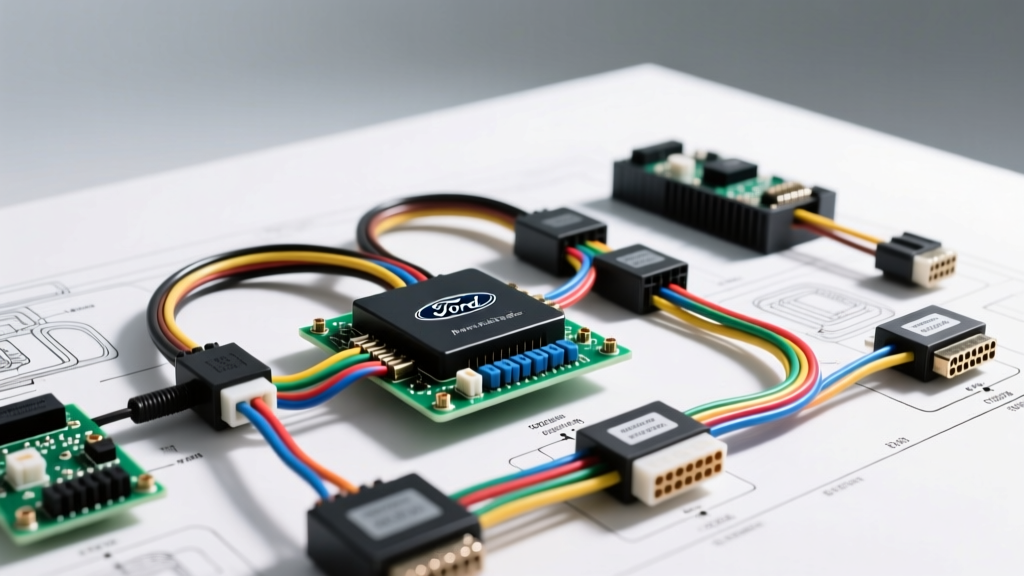
The Economics of Mustang Electrical Diagnostics
When tackling electrical gremlins in a Ford Mustang, from the classic 5.0L Fox Body to the modern S650 Coyote platforms, a visual map is only the first step. Interpreting a Ford Mustang wiring diagram effectively requires a specialized diagnostic arsenal and an understanding of material costs. Electrical diagnostics are rarely a simple matter of swapping a fuse; they involve tracing CAN bus networks, verifying pulse-width modulation (PWM) signals, and sourcing OEM-grade terminals. This comprehensive cost and tool analysis breaks down exactly what it takes to professionally diagnose, trace, and repair Mustang wiring systems, ensuring you invest in the right equipment and materials for the job.
Diagram Acquisition: Free Forums vs. OEM Documentation
The foundation of any successful electrical repair is an accurate, high-resolution schematic. While enthusiast forums often share scanned, low-resolution diagrams, these are frequently missing critical splice locations, ground distribution charts (the legendary Ford G100 through G400 series grounds), and connector cavity views.
Cost Breakdown of Wiring Resources
- Enthusiast Forums & Free PDFs: $0. High risk of misinterpreting faded wire color codes (e.g., confusing a Red/Light Green stripe with a solid Red wire).
- AlldataDIY / Mitchell1 DIY: $30 to $40 per year. Provides factory-equivalent wiring diagrams, connector pinout charts, and component location guides. Ideal for weekend warriors tackling SN95 or S197 models.
- Helm Incorporated Factory Service Manuals (FSM): $150 to $250 per volume. Helm is the official publisher for Ford Motor Company documentation. Purchasing the specific Electrical and Vacuum Troubleshooting Manual (EVTM) for your exact model year is the gold standard for restorers and professional technicians.
- Ford PTS (Professional Technician System): $45 per day or $150 per month. Required for late-model S550 and S650 Mustangs where wiring diagrams are integrated into module configuration and programmable module installation (PMI) routines.
Essential Diagnostic Toolchain & Cost Analysis
You cannot accurately trace a Mustang circuit using a basic test light. Modern Ford Powertrain Control Modules (PCMs) operate on 5-volt reference logic and high-speed data networks that require precision instrumentation.
Digital Multimeters (DMM) and Oscilloscopes
For checking the 5V reference on a Mustang Coyote Manifold Absolute Pressure (MAP) sensor or testing the duty cycle of a fuel injector, an automotive-specific DMM is mandatory. The Fluke 88V Automotive Multimeter (approx. $450) is the industry standard, offering high impedance to prevent back-feeding sensitive Ford PCM drivers. For deeper analysis, such as viewing the square wave pattern of a Ford Integrated Vehicle Speed (IVS) sensor or decoding CAN bus faults, a PicoScope 4225A (approx. $550) is required. Cheap multimeters often average out PWM signals, leading to false diagnoses of failed Ford fuel pump driver modules (FPDM).
Breakout Boxes and Back-Probes
For Fox Body (1987-1993) and early SN95 Mustangs equipped with the EEC-IV and EEC-V systems, a 60-pin or 104-pin breakout box ($150 to $250) is essential. Back-probing the PCM connector while the engine is running allows you to monitor the VPWR (Vehicle Power) and VREF (Reference Voltage) circuits without piercing the wire insulation. Wire piercing probes should be avoided on modern Mustangs, as they compromise the TXL wire insulation and invite corrosion into the high-density connectors.
Generational Wiring Architectures & Material Costs
The cost of repairing a Mustang wiring harness varies drastically depending on the generation, primarily due to the shift from simple analog circuits to complex multiplexed networks.
Fox Body EEC-IV (1987-1993)
The Fox Body 5.0L relies on the 60-pin EEC-IV connector. The wiring insulation from this era is notoriously brittle. A common failure is the chafing of the oxygen sensor harness against the bellhousing. Repairing this requires stripping back the loom and splicing in new 18 AWG TXL (Thin-wall Cross-linked) wire. Sourcing a complete Motorcraft replacement pigtail for the O2 sensor costs around $35, whereas buying bulk 18 AWG TXL wire and Molex MLX terminals costs less than $10 per repair, provided you own the correct ratcheting crimper.
S550 Coyote CAN Bus Networks (2015-2023)
Modern S550 Mustangs utilize High-Speed CAN (HS-CAN) and Medium-Speed CAN (MS-CAN) networks. The HS-CAN bus (OBD2 Pins 6 and 14) operates at 500 kbps and uses twisted pair 18 AWG wiring to prevent electromagnetic interference (EMI). Diagnosing a CAN bus fault requires measuring the termination resistors. A healthy Ford HS-CAN network should read exactly 60 ohms across Pins 6 and 14 (two 120-ohm resistors in parallel, typically located in the PCM and the Instrument Cluster). If your multimeter reads 120 ohms, you have an open circuit in the CAN_H or CAN_L trace, requiring meticulous pin-to-pin continuity testing.
Technical Breakdown: Tool & Application Matrix
| Diagnostic Tool | Estimated Cost | Primary Mustang Application | Technical Requirement |
|---|---|---|---|
| Fluke 88V DMM | $450 | EEC-V / Coyote PCM 5V Ref, PWM Fuel Pump testing | High Impedance (10 Megohm), Duty Cycle |
| PicoScope 4225A | $550+ | CAN Bus decoding, Crank/Cam correlation | 4-Channel, 20MHz Bandwidth |
| Power Probe III | $250 | Testing S197 Window Motors, Fuel Pumps | Do NOT use on PCM logic circuits |
| Delphi Crimper | $85 | Weather-Pack / Metri-Pack terminal repairs | Proper ratcheting crimp for 14-20 AWG |
| 60-Pin Breakout Box | $180 | Fox Body EEC-IV live data tracing | Must match Ford 60-pin footprint |
Real-World Repair Costs: Harness Repair vs. Replacement
When a Mustang wiring diagram reveals a catastrophic harness failure—such as a melted alternator charge wire or a rodent-damaged engine control harness—technicians must weigh the cost of repair against full replacement.
Wire Gauge and Connector Sourcing
Adhering to SAE J1128 specifications for low-tension primary cable is critical for under-hood Mustang repairs. Standard PVC wire from a hardware store will melt near the Coyote exhaust manifolds. You must source GXL or TXL cross-linked polyethylene wire. A 100-foot spool of 10 AWG TXL (for main battery feeds and alternator outputs) costs approximately $45, while a spool of 20 AWG TXL (for sensor grounds and signal wires) costs around $25.
For connectors, never splice a bare wire into a factory Ford harness without using the correct sealed terminals. For SN95 and New Edge models, Ford heavily utilized Weather-Pack and Metri-Pack 150/280 series connectors. A kit of OEM-style sealed terminals and silicone plugs costs about $40. For late-model S550 sensors, Ford uses Deutsch DT or specialized TE Automotive connectors, which require specific insertion tools and cost upwards of $8 per cavity to repair properly.
The Pigtail vs. Splice Debate
While splicing is acceptable in the middle of a harness run using adhesive-lined marine heat shrink (approx. $15 for a box), connector repairs must be done using OEM Motorcraft pigtails. A Motorcraft WPT-1234 style pigtail (including 6 inches of pre-crimped wire and the sealed connector housing) typically ranges from $25 to $65. This ensures the terminal tension and weather seals match the factory specifications, preventing the infamous 'green crust' corrosion that plagues poorly repaired Mustang sensor circuits.
Expert Sourcing and Reference Links
To master the Ford Mustang wiring diagram, professionals rely on verified data and precision materials. Always cross-reference your physical wire colors with the EVTM, as mid-year production changes can alter stripe colors. For advanced diagnostic training and tool calibration standards, refer to Fluke Automotive Testing Guidelines. Investing in the correct breakout boxes, high-impedance multimeters, and SAE-compliant TXL wire will ultimately save thousands of dollars in misdiagnosed PCM replacements and recurring electrical faults.