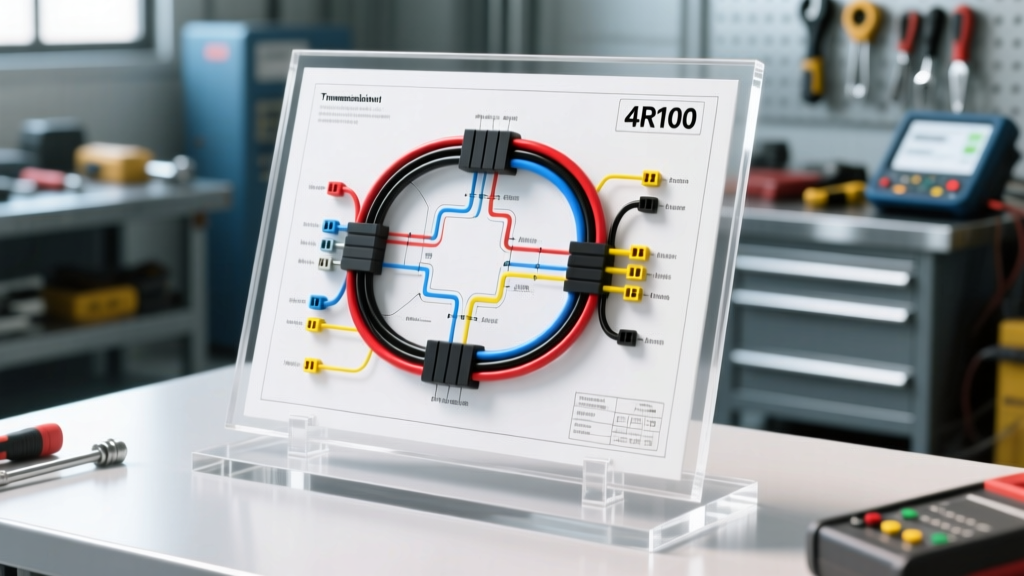
Decoding the 4R100 Transmission Wiring Harness Diagram
The Ford 4R100 automatic transmission, deployed heavily in Super Duty trucks, Excursions, and Expeditions from 1998 through 2004, relies on a complex network of solenoids and sensors to manage line pressure and shift timing. When diagnosing shift flares, limp mode, or torque converter clutch (TCC) slip, a factory-accurate 4R100 transmission wiring harness diagram is your most critical asset. Unlike earlier hydraulic-heavy transmissions, the 4R100 utilizes a Powertrain Control Module (PCM) to pulse-width modulate (PWM) the Electronic Pressure Control (EPC) solenoid and fire discrete shift solenoids based on input from the Transmission Fluid Temperature (TFT) and Output Speed Sensor (OSS).
Selecting the correct replacement harness—whether you are dropping the valve body for an internal harness replacement or chasing a chafed external pigtail—requires understanding the exact circuit architecture. This guide breaks down the 4R100 wiring schematics, compares OEM and aftermarket harness options, and provides a diagnostic selection matrix to ensure you buy the exact component required for your specific failure mode.
4R100 12-Pin Bulkhead Connector Pinout & Wire Codes
The internal harness connects to the external chassis harness via a 12-pin rectangular bulkhead pass-through connector located on the driver’s side of the transmission case. Corrosion, pin push-out, and internal chafing against the valve body casting are the most common failure points. Below is the definitive pinout reference based on Ford OEM wiring schematics.
| Pin | Function | Wire Color (Ford Std) | AWG | Circuit Type |
|---|---|---|---|---|
| 1 | Shift Solenoid A (SSA) | Violet/White (VT/WT) | 18 | Switched Ground |
| 2 | Shift Solenoid B (SSB) | Yellow/Black (YE/BK) | 18 | Switched Ground |
| 3 | Shift Solenoid C (SSC) | White/Yellow (WT/YE) | 18 | Switched Ground |
| 4 | Torque Converter Clutch (TCC) | Light Green/Red (LG/RD) | 18 | Switched Ground |
| 5 | Electronic Pressure Control (EPC) | White/Light Green (WT/LG) | 18 | PWM Signal |
| 6 | Trans Fluid Temp Sensor (TFT) | Red/Yellow (RD/YE) | 20 | Analog Sensor |
| 7 | Signal Return (SIG RTN) | Black/White (BK/WT) | 20 | Sensor Ground |
| 8 | Output Speed Sensor (OSS) | Gray/Red (GY/RD) | 20 | Hall Effect Signal |
| 9 | OSS Shield / Secondary | Gray/Yellow (GY/YE) | 20 | Twisted Pair Shield |
| 10 | Vehicle Power (VPWR) | Red (RD) | 16 | 12V Solenoid Feed |
| 11 | Power Ground | Black (BK) | 16 | Solenoid Ground |
| 12 | Overdrive Cancel Switch (OCS) | Light Blue/Red (LB/RD) | 18 | Switch Input |
Note: Wire colors may vary slightly by model year and chassis integration, but the pin functions remain constant across the 4R100 production run. Always verify against the vehicle-specific Ford wiring manual.
Product Comparison: Selecting the Right 4R100 Harness
When the 4R100 transmission wiring harness diagram confirms a hard electrical fault, you must choose between a complete internal assembly, an external pigtail, or an aftermarket alternative. Here is how the market options compare.
1. Genuine Motorcraft OEM Internal Harness
Best For: Complete internal chafing, multiple solenoid codes, and fleet/longevity builds.
Specifications: Utilizes cross-linked polyethylene (XLPE) insulation meeting SAE J1128 standards for high-temperature ATF immersion. The molded bulkhead connector features positive-lock terminal retention to prevent pin push-out during case vibration.
Pros: Exact factory routing clips; high-temperature loom prevents melting near the exhaust side of the bellhousing; guaranteed PCM compatibility.
Cons: Highest price point; often requires dealer backorder.
2. Premium Aftermarket Assemblies (Standard Motor Products / Dorman)
Best For: Budget-conscious repairs and standard daily drivers.
Specifications: Typically uses 18 AWG PVC-insulated wire. While functional, PVC insulation can become brittle after years of cycling between -20°F and 250°F ATF temperatures.
Pros: Readily available at local auto parts stores; cost-effective.
Cons: Bulkhead connector seals may not match OEM durometer ratings, leading to moisture ingress and green corrosion on the EPC and TFT pins over time.
3. Targeted Pigtail Repair Kits (e.g., Motorcraft WPT-Series)
Best For: Isolated sensor failures (TFT, OSS) or damaged external bulkhead connectors.
Specifications: Pre-terminated with OEM-style Metri-Pack or Weather-Pack terminals. Includes butt-splice seals for moisture-proof crimping.
Pros: Eliminates the need to drop the transmission pan and valve body if the fault is strictly external.
Cons: Requires advanced crimping skills; improper splicing can introduce resistance that alters the TFT sensor voltage curve, causing erratic shift scheduling.
External Harness & MLPS Connector Selection
The 4R100 wiring ecosystem extends beyond the internal 12-pin bulkhead. The Manual Lever Position Sensor (MLPS), located on the exterior driver-side case, is notorious for harness failure. The MLPS dictates the PCM’s understanding of gear selection (Park, Reverse, Neutral, Overdrive). If your truck cranks in Drive or exhibits reverse lights while in Park, the MLPS or its external pigtail is the culprit.
Selection Advice: Never reuse an MLPS connector if the terminals show signs of arcing or widening. The MLPS carries low-amperage 5V reference signals. Even a 0.2-volt drop caused by a loose aftermarket terminal will cause the PCM to default to a fail-safe shift map. Always opt for the OEM Motorcraft MLPS pigtail (typically WPT-1194 or equivalent depending on year) featuring integrated weather seals.
Diagnostic Decision Tree: When to Replace vs. Repair
Use this diagnostic matrix alongside your 4R100 transmission wiring harness diagram to determine the correct part to order.
- Symptom: P0743 (TCC Circuit Electrical) + P0750 (Shift Solenoid A).
Diagnosis: Shared 12V VPWR feed (Pin 10) is compromised, or internal harness is chafed against the valve body separator plate.
Action: Replace complete internal OEM harness. - Symptom: Erratic shifting only when cold; P0715 (Turbine Shaft Speed Sensor) or P0720 (Output Speed Sensor).
Diagnosis: Twisted pair wiring for the OSS/ISS is degraded, or external connector is corroded.
Action: Inspect external bulkhead. If internal, replace internal harness. If external, use an OSS/ISS pigtail kit. - Symptom: Harsh 1-2 shifts, EPC solenoid clicking, P1747 (EPC Solenoid Short).
Diagnosis: The EPC circuit (Pin 5, WT/LG) is shorting to ground. The 4R100 EPC is a Variable Force Solenoid (VFS); it requires a clean PWM signal.
Action: Perform a continuity test from the PCM to the bulkhead. If the external chassis harness is intact, the internal harness insulation has melted. Replace internal assembly.
Expert Installation & Torque Specifications
Installing a new 4R100 harness requires precision. The internal harness routes tightly between the valve body and the transmission case. According to Sonnax transmission rebuilding guidelines, improper routing is the leading cause of repeat harness failures.
- Routing & Looming: Ensure the factory convoluted loom is perfectly positioned over the sharp edges of the aluminum valve body casting. Use high-temp nylon zip-ties to secure the harness to the designated retaining tabs before torquing the valve body bolts.
- Bulkhead Seating: The 12-pin pass-through connector must be seated completely flush. Apply a thin layer of Motorcraft XC-10 dielectric grease to the terminals to prevent ATF-induced corrosion and ensure optimal conductivity for the analog TFT sensor.
- Torque Specs:
- Valve Body to Case Bolts: 8-11 Nm (71-97 lb-in).
- Bulkhead Connector Retaining Bolts: 5-7 Nm (45-62 lb-in). Do not overtighten, as the plastic housing will crack, leading to fluid leaks and terminal misalignment.
- External MLPS Retaining Bolts: 8-10 Nm (71-88 lb-in).
- External Chafing Check: Inspect the external harness where it crosses the transmission crossmember and near the exhaust Y-pipe. Ford issued technical service bulletins (TSBs) regarding harness melt-downs in this area; wrap external sections in reflective heat-sheathing if routing near high-flow exhaust manifolds.
By leveraging the precise 4R100 transmission wiring harness diagram and selecting the correct component tier for your specific diagnostic trouble codes, you eliminate guesswork and ensure the longevity of Ford’s most robust heavy-duty automatic transmission.