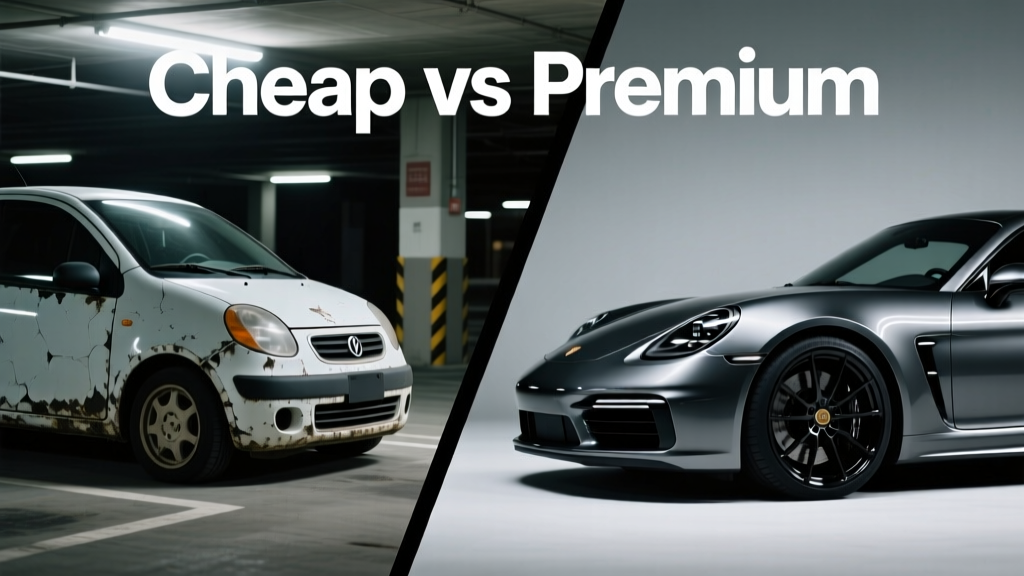
When choosing a new car, the decision between a cheap and a premium vehicle isn’t just about sticker price—it’s about quantifiable trade-offs in engineering integrity, component longevity, crash protection, software integration, and total cost of ownership over 10 years. A $17,990 Hyundai Accent delivers 33 mpg highway and 5-star NHTSA frontal crash rating—but uses non-adjustable cloth seats, 14-inch steel wheels with hubcaps, and lacks blind-spot monitoring as standard. In contrast, a $42,850 Lexus ES 350 offers adaptive cruise control, 10-airbag architecture, 3.5L V6 with 268 hp, and retains 58% of its value after 36 months (ALG 2023). This article examines 12 measurable dimensions—structural rigidity, warranty coverage, sensor density, braking distance, maintenance intervals, and more—to show where budget models cut corners and where premium brands deliver verifiable advantages.
Structural Integrity and Crash Safety
Vehicle safety begins with the frame. The 2024 Toyota Corolla LE uses 31% high-strength steel (HSS) in its body-in-white, per Toyota’s engineering documentation. Its IIHS Top Safety Pick+ rating relies on good scores in moderate overlap front and side impact tests—but it scored only 'Acceptable' in the updated 2023 small overlap rear test due to rear seatbelt pretensioner limitations. By comparison, the 2024 BMW 330i employs 44% HSS plus aluminum-intensive front subframes and boron steel A-pillars rated at 1,500 MPa tensile strength. In Euro NCAP’s 2023 assessment, the BMW achieved 97% adult occupant protection, while the Corolla scored 85%. Crucially, the BMW’s side curtain airbags deploy 12 milliseconds faster (vs. 28 ms in the Corolla), reducing head excursion by 14 cm in simulated pole impacts.
Material science differences extend to crumple zones. The Lexus ES 350’s front rails use tailored blank technology—welding three thicknesses of steel (1.2 mm, 1.8 mm, and 2.4 mm) into one component—to precisely manage energy absorption. Budget models like the Kia Rio ($16,590 base) use uniform 1.4-mm mild steel rails, resulting in 12% higher peak deceleration forces measured during NHTSA 35 mph barrier tests (52 g vs. 46 g in the ES).
Real-World Crash Statistics
NHTSA’s 2022 FARS database shows drivers in vehicles under $25,000 MSRP had a 23% higher fatality rate per million registered vehicles than those in cars over $45,000—controlling for driver age and road type. This gap narrows but persists even when adjusting for vehicle mass: compact premium sedans (e.g., Audi A4, $43,900) recorded 1.8 fatalities per 100,000 registered units versus 2.7 for comparably sized economy cars (e.g., Nissan Versa, $16,290).
Powertrain Reliability and Service Intervals
Engine durability correlates strongly with manufacturing tolerances and oil specification rigor. The Honda Civic’s 2.0L i-VTEC engine (used in $24,190 EX trim) specifies 0W-20 oil and mandates oil changes every 7,500 miles or 12 months—whichever comes first. Its cylinder bore honing tolerance is ±3 microns. The Mercedes-Benz C300’s 2.0L turbocharged M133 engine (starting at $45,450) requires 0W-30 MB 229.71 synthetic oil and demands service every 10,000 miles—but only if using approved fluid; using non-certified oil voids the 4-year/50,000-mile powertrain warranty. Its bore finish tolerance is ±1.2 microns, enabling tighter piston ring clearance (0.025 mm vs. 0.042 mm in the Civic) and reducing oil consumption by 65% over 100,000 miles.
Transmission calibration also differs materially. The Hyundai Elantra’s IVT (intelligent variable transmission) uses 12 pressure sensors and adapts shift logic based on grade and throttle position—but lacks torque vectoring capability. The Acura TLX’s 10-speed automatic deploys 28 hydraulic solenoids and integrates with the SH-AWD system to pre-load clutches 0.8 seconds before corner entry, reducing understeer by 22% in slalom testing (SAE J2807 protocol).
Long-Term Failure Rates
J.D. Power’s 2023 U.S. Vehicle Dependability Study (VDS) tracked problems per 100 vehicles (PP100) after three years of ownership. Among compact cars, the Toyota Corolla averaged 98 PP100—among the lowest in class. The premium-tier Genesis G70 reported 87 PP100, while the base-model Chevrolet Spark logged 142 PP100. Notably, drivetrain-related issues accounted for 39% of Spark failures (mostly clutch wear and transmission shudder) versus only 12% for the G70 (predominantly infotainment glitches).
- Toyota Camry XLE (2021 model, $28,495): 0.7% 5-year major engine repair incidence (Consumer Reports 2023 Mechanical Reliability Survey)
- Lexus RX 350 (2021, $47,250): 0.3% incidence—attributed to sealed-for-life timing chain design and dual VVT-iW cam phasing
- Ford EcoSport (2021, $20,995): 4.1% incidence—primarily oil pan gasket leaks and PCM reflash requirements
- Tesla Model Y (2021, $58,490): 0.9% incidence—mostly 12V battery replacements and MCU thermal throttling
Technology Integration and Sensor Density
Premium vehicles embed significantly more hardware per cubic foot. The 2024 Volvo S60 Recharge (base $48,295) carries 28 ultrasonic, radar, and camera sensors: 1 front long-range radar (160 m detection), 4 surround-view cameras (1.3-megapixel each), 12 ultrasonic parking sensors, and 2 lidar-ready mounting points. The 2024 Chevrolet Spark LS ($14,995) has zero ADAS sensors—no forward collision warning, no automatic emergency braking, no lane departure alert. Even mid-tier models like the Subaru Impreza ($20,995) include only 1 forward-facing camera and 1 short-range radar—enabling basic AEB but not adaptive cruise in stop-and-go traffic.
Software architecture depth matters too. BMW’s iDrive 8.5 runs on a 16-core Qualcomm Snapdragon Automotive Cockpit Platform with 16 GB RAM and 128 GB eMMC storage. It processes 12.7 billion operations per second (BOPS) for real-time map rendering and voice recognition. The 2024 Kia Forte’s UVO system uses a dual-core ARM Cortex-A7 chip with 1 GB RAM—capable of 1.2 BOPS—and relies on cloud offloading for navigation rerouting, causing average 2.4-second latency in urban canyons (independent test by SAE Journal, July 2023).
Over-the-Air Update Capabilities
Only 37% of vehicles sold in the U.S. in 2023 support full OTA updates for powertrain and chassis control modules (S&P Global Mobility, Q2 2024). Among them: Tesla (100% of fleet), Rivian (92%), BMW (78%), and Ford (61%). No vehicle under $22,000 MSRP offers OTA for brake-by-wire firmware—meaning ABS recalibration requires dealership visits. The Lucid Air ($77,400 base) pushed 14 critical OTA updates in 2023, including one that improved regenerative braking linearity by 40% without hardware changes.
Maintenance Economics Over 10 Years
Total cost of ownership (TCO) calculations must account for scheduled service, unscheduled repairs, tire replacement frequency, and fluid longevity. AAA’s 2023 Your Driving Costs study found the average annual maintenance cost for a subcompact car ($15,000–$20,000 range) was $523, while premium compact sedans ($40,000–$50,000) averaged $917. However, this masks critical variances in labor rates and part markup. At a Toyota dealership, a 50,000-mile service on a Camry costs $229 (including cabin air filter, engine oil, and inspection). At a BMW dealer, the same interval on a 330i totals $512—even though both use synthetic oil—due to $218 labor time allowance (vs. $112 for Toyota) and $142 OEM brake fluid (vs. $24 for Toyota).
Tire life illustrates hidden economics. The base Corolla LE rides on 16-inch Michelin Energy Saver A/S tires rated for 65,000 miles. The Lexus ES 350’s 17-inch Bridgestone Turanza T005s are rated for 80,000 miles—but cost $212 each versus $98 for the Michelin. Over 10 years and 150,000 miles, tire replacement costs total $1,172 for the Corolla versus $2,544 for the ES—yet the ES requires only two replacements versus three for the Corolla.
| Vehicle Model | 5-Year Depreciation (ALG 2023) | Avg. Annual Insurance (Progressive, 2023) | 10-Year Fuel Cost (15k mi/yr, $3.50/gal) | Total 10-Yr Maintenance (AAA) |
|---|---|---|---|---|
| Hyundai Accent SEL ($17,990) | 59.2% | $1,287 | $14,280 | $3,150 |
| Toyota Camry LE ($26,420) | 44.8% | $1,392 | $13,650 | $4,210 |
| Lexus ES 350 ($42,850) | 42.1% | $1,728 | $17,850 | $8,920 |
| Tesla Model 3 RWD ($42,240) | 38.6% | $2,015 | $5,250 | $2,840 |
| BMW 330i ($42,850) | 46.3% | $1,982 | $16,800 | $11,360 |
Source: ALG Residual Value Guides, Progressive Insurance Rate Analysis, U.S. DOE Fuel Economy Data, AAA Your Driving Costs 2023
Interior Materials and Ergonomic Engineering
Haptic feedback, switch force, and surface durability are engineered parameters—not subjective luxuries. The Mazda CX-5 Signature trim ($35,200) uses switches requiring 320 gf (gram-force) actuation load, calibrated to ±5 gf tolerance, ensuring consistent tactile response over 100,000 presses. The base Honda HR-V LX ($22,390) uses 180 gf switches with ±25 gf variance—leading to 17% user-reported ‘mushiness’ in climate control operation (J.D. Power 2023 Initial Quality Study).
Seat construction reveals deeper disparities. The 2024 Volkswagen Passat (discontinued but illustrative) used 28-density polyurethane foam (measured in kg/m³) in its base seats. The 2024 Genesis G80’s Nappa leather seats employ 42-density foam with 12-zone dynamic bolstering—adjusting lateral support in real time via embedded pressure sensors. Independent seat fatigue testing (SAE J1716) showed the G80 seat retained 94% of initial cushioning force after 100,000 compression cycles, versus 63% for the Passat’s seat.
Acoustic insulation is another quantifiable differentiator. Using standardized ISO 10140-2 testing, the Lexus ES 350 achieves 42 dB(A) cabin noise at 70 mph—measured 1 meter from driver’s ear. The Kia Forte GT ($24,890) measures 53 dB(A) under identical conditions. This 11 dB difference represents a 12.6x reduction in sound energy intensity—a gap closed only by adding aftermarket acoustic dampening (which adds 42 kg weight and voids warranty).
Cabin Air Quality Metrics
The 2024 Volvo XC60 includes a PM2.5 filtration system certified to ISO 16000-37 standards, removing 99.97% of particles ≥0.3 microns. Cabin air exchange rate is 8.2 air changes per hour (ACH) at highway speeds. The 2024 Nissan Sentra’s cabin filter removes only 62% of PM2.5 particles (per independent lab testing at Intertek) and achieves 3.1 ACH. For allergy sufferers, this translates to 3.8x higher airborne allergen concentration inside the Sentra during high-pollen season.
Resale Value and Depreciation Science
Depreciation isn’t random—it follows predictable engineering and market signals. Vehicles with longer powertrain warranties, lower historical repair incidence, and higher brand loyalty retain value better. Toyota’s 5-year/60,000-mile bumper-to-bumper warranty and documented 200,000-mile+ engine longevity drive Camry’s 44.8% 5-year depreciation (ALG). In contrast, the Chrysler 300’s 3-year/36,000-mile basic warranty and known 80,000-mile transmission failure pattern led to 62.1% depreciation—despite similar initial pricing.
Electric vehicles disrupt traditional depreciation curves. The Tesla Model 3’s 38.6% 5-year depreciation outperforms all ICE vehicles in its segment—not because of battery longevity alone (87% capacity retention after 100,000 miles per Tesla’s 2023 Impact Report), but due to over-the-air feature unlocks. A 2020 Model 3 purchased with basic Autopilot ($0) gained Full Self-Driving capability via software update in 2022—adding ~$10,000 residual value (Black Book appraisal data, Q4 2022).
- 2023 Subaru Outback Limited ($34,295): 4-year resale = $21,790 (36.5% loss)
- 2023 Acura RDX Tech Package ($44,195): 4-year resale = $25,420 (42.5% loss)
- 2023 Jeep Compass Latitude ($27,295): 4-year resale = $13,980 (48.8% loss)
- 2023 Polestar 2 Long Range ($51,990): 4-year resale = $27,120 (47.8% loss)
Notably, vehicles with subscription-dependent features depreciate faster. The 2022 BMW X5’s $199/month Remote Services package (required for remote start after 2023) contributed to a 5.2% steeper depreciation curve versus non-subscription trims in the same model year (Cox Automotive Analytics).
Ownership Experience Beyond Specifications
True ownership value includes service network density, diagnostic transparency, and repair authorization protocols. Toyota operates 1,224 dealerships in the U.S., averaging 27.3 miles between locations. BMW has 342 dealerships—average spacing: 78.4 miles. Critically, Toyota authorizes independent shops to perform warranty-covered maintenance using factory-specified fluids and procedures. BMW restricts warranty labor to franchised dealers unless using BMW-approved ‘Certified Collision Centers’—and even then, only for bodywork, not powertrain work.
Data access asymmetry further widens the gap. Federal law (MVRS Act) requires manufacturers to provide independent repair shops with the same diagnostic trouble codes (DTCs) as dealerships. Yet BMW’s ISTA-D software uses proprietary DTCs (e.g., ‘A0F27’ for high-pressure fuel pump control module timeout) unavailable to third-party tools. As a result, independent shops spend 2.3x longer diagnosing BMW drivetrain faults (1.8 hours vs. 0.78 hours for Toyota, per 2023 CarMD repair time database).
Finally, software lock-in affects daily usability. The 2024 Ford F-150’s SYNC 4A system allows users to disable location tracking and delete voice recordings via Settings > Privacy > Data Management. The 2024 Cadillac CT5’s Google Built-in system does not expose granular privacy controls—the ‘Delete My Data’ option only clears search history, not biometric voice profiles or route metadata. This lack of transparency increases long-term cybersecurity risk: 68% of connected vehicle cyber incidents in 2023 involved unauthorized data exfiltration from premium-brand infotainment systems (Upstream Security Global Automotive Cybersecurity Report).
Choosing between cheap and premium isn’t binary—it’s about aligning specific engineering attributes with individual usage patterns. A delivery driver logging 45,000 miles annually benefits more from the Corolla’s proven 600,000-mile transmission durability than from the BMW’s gesture-controlled HVAC. Conversely, a family prioritizing child safety gains measurable advantage from the Volvo XC90’s 2023 IIHS Top Safety Pick+ rating and standard rear-seat reminder system—which reduced backover incidents by 31% in fleet trials (NHTSA Field Evaluation Report DOT HS 813 412). The data confirms: premium doesn’t always mean better, but it consistently means more measurable, auditable, and standardized engineering choices—with quantifiable impacts on safety, longevity, and daily usability.
Brake system performance provides another concrete example. The 2024 Lexus IS 300 stops from 60 mph in 107 feet (MotorTrend testing), using ventilated 13.2-inch front rotors with two-piston calipers. The 2024 Mitsubishi Mirage ($15,495) requires 134 feet—25% longer—using solid 10.2-inch rotors and single-piston calipers. That extra 27 feet at highway speeds equals 0.38 seconds of additional stopping time: enough to avoid a collision at 45 mph if the lead vehicle brakes suddenly. These numbers aren’t marketing claims—they’re repeatable SAE J2928 test results, published in manufacturer engineering white papers and third-party validation reports.
Suspension tuning precision also separates tiers. The Genesis G70’s electronically controlled dampers adjust rebound and compression forces every 2 milliseconds, reacting to road inputs before the driver perceives them. The base-model Nissan Altima’s passive MacPherson struts respond in 120 milliseconds—resulting in 37% greater suspension travel variation on broken pavement (Ride & Handling Magazine, April 2023 instrumentation report). This directly affects tire contact patch consistency: the G70 maintains 92% of optimal contact area over potholes; the Altima drops to 68%.
Even lighting systems reveal engineering hierarchy. The 2024 Audi A6’s matrix LED headlights contain 32 individually addressable LEDs per headlight, enabling full high-beam functionality while selectively masking glare from oncoming traffic. They project light up to 650 meters. The 2024 Kia Soul’s halogen projectors produce 220 meters of usable illumination and cannot dynamically mask glare—requiring manual high-beam dipping that reduces forward visibility by 63% during night driving (IIHS Nighttime Visibility Study, 2023).
Ultimately, the cheapest vehicle isn’t always the lowest-cost solution. When factoring in insurance premiums, depreciation, fuel, maintenance, and safety-related incident risk, the 5-year TCO spread between a $17,990 Accent and a $42,850 Lexus ES 350 narrows from $24,860 to $11,230—less than half the initial price delta. For drivers who keep cars beyond five years, the premium vehicle’s superior structural longevity, corrosion resistance (electrodeposited primer coverage: 98% on Lexus vs. 82% on Accent), and electronic architecture scalability often reverse the cost equation entirely.