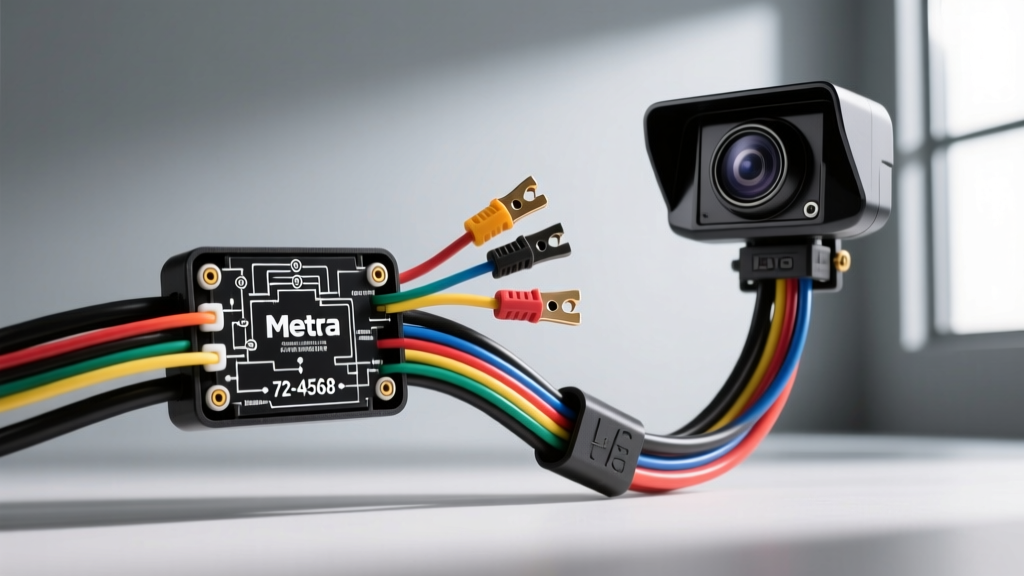
The Role of Speaker Harnesses in Backup Camera Integration
When integrating aftermarket backup cameras, dash cams with parking mode overlays, or digital signal processors (DSPs) into modern vehicles, accessing a clean 12V reverse trigger signal is a common hurdle. In many 2006-2013 Honda and Acura models, the reverse light circuit is controlled via a CAN-bus multiplex system or utilizes Pulse Width Modulation (PWM) for bulb-check diagnostics. Tapping directly into the reverse light wire often results in camera flickering, dashboard error codes, or insufficient amperage to trigger a standard camera relay.
To bypass this, professional installers use a Line Output Converter (LOC) tied to the rear speaker wires to generate a clean audio signal or a switched 12V trigger via a signal-sensing relay. This is where the Metra 72-4568 speaker wiring harness becomes an indispensable tool. Rather than slicing into the OEM wiring harness, the 72-4568 provides a plug-and-play bridge between the factory 4-pin speaker connector and your aftermarket LOC or camera trigger module. In this product comparison and selection guide, we evaluate the Metra 72-4568 against generic alternatives and outline the exact technical specifications required for a flawless camera tech installation.
Product Comparison: Metra 72-4568 vs. Generic Alternatives
Selecting the correct interface for your camera trigger or LOC integration dictates the long-term reliability of your electrical system. Below is a technical comparison of the primary methods used to access rear speaker signals in select Honda/Acura platforms.
1. Metra 72-4568 Speaker Wiring Harness (The OEM-Safe Choice)
The Metra 72-4568 is engineered specifically for select 2006-2013 Honda and Acura rear deck and door speaker applications. It features a factory-matched 4-pin Sumitomo-style connector on one end and four 18 AWG stranded copper leads on the other.
- Pros: Zero OEM wire splicing required; maintains factory warranty compliance; utilizes exact pin-to-pin locking tabs to prevent vibration-induced disconnects; 18 AWG wire matches SAE J1128 standards for low-voltage audio signal transmission.
- Cons: Higher upfront cost compared to generic bullet connectors; requires crimping or soldering to the LOC leads.
- Best For: Professional-grade backup camera installations where a signal-sensing relay or high-fidelity LOC is required to trigger a display without tapping the CAN-bus reverse circuit.
2. Generic T-Taps and Vampire Clips
Many DIY camera kits include generic T-taps intended for piercing the OEM speaker or reverse wire insulation.
- Pros: Extremely cheap; requires no wire stripping tools.
- Cons: Highly prone to corrosion and oxidation; pierces the protective wire jacket, exposing bare copper to moisture; causes micro-fractures in 18 AWG stranded wire leading to high-resistance connections; violates SAE J1128 wiring standards for automotive electrical integrity.
- Best For: Temporary diagnostics only. Never recommended for permanent camera or LOC integration.
3. Scosche and Universal Bullet Harnesses
Universal harnesses often rely on generic bullet connectors that claim to fit 'most Asian vehicles.'
- Pros: Widely available; inexpensive.
- Cons: Pin spacing and locking tab geometry rarely match Honda's proprietary Sumitomo connectors perfectly. This leads to a loose physical connection that can arc or disconnect when the vehicle encounters road vibrations, causing the backup camera display to randomly drop out.
- Best For: Quick test bench setups, but inadequate for daily-driven vehicle camera systems.
Technical Specifications & Pinout Reference
To properly wire your LOC or signal-sensing relay to the Metra 72-4568, you must match the harness wire colors to the OEM Honda/Acura rear speaker pinout. According to Honda OEM Service Documentation, the standard 4-pin rear speaker connector utilizes the following configuration. Always verify with a digital multimeter (DMM) before finalizing your camera trigger connections.
| Pin Number | Function | OEM Wire Color | Metra 72-4568 Wire Color | AWG Rating |
|---|---|---|---|---|
| Pin 1 | Left Rear Positive (+) | Blue/White Stripe | Blue/White | 18 AWG |
| Pin 2 | Left Rear Negative (-) | Yellow/White Stripe | Yellow/White | 18 AWG |
| Pin 3 | Right Rear Positive (+) | Pink or Red/White | Pink | 18 AWG |
| Pin 4 | Right Rear Negative (-) | Blue/Black Stripe | Blue/Black | 18 AWG |
Note: Wire colors on the Metra 72-4568 may occasionally vary slightly by production batch. Always perform a continuity test from the Metra harness plug to the pigtail leads using a DMM to confirm pin mapping before splicing to your LOC.
Step-by-Step: Integrating the 72-4568 with an LOC for Camera Triggers
When installing a backup camera that requires a 12V trigger, and the vehicle's reverse light circuit is unsuitable due to PWM signaling, you can use a signal-sensing relay (such as the PAC TR-4) paired with an LOC. The LOC detects the audio signal from the rear speakers the moment the vehicle is shifted into reverse (assuming the head unit outputs a chime or parking sensor audio through the rear channels) or simply uses the LOC's internal circuitry to generate a remote turn-on signal.
- Disconnect the Battery: Always isolate the negative battery terminal to prevent shorting the OEM audio amplifier or head unit outputs.
- Access the Rear Speaker: Remove the rear deck trim panel or door card to expose the factory 4-pin speaker connector. Depress the locking tab and disconnect the OEM plug.
- Install the Metra 72-4568: Plug the factory vehicle harness into the female receptacle of the Metra 72-4568. Then, plug the male Metra connector into the OEM speaker. You have now created a safe, non-destructive T-junction.
- Prepare the LOC Leads: Strip 1/4 inch of insulation from the Metra 72-4568 pigtail wires and your LOC input wires.
- Crimp and Seal: Use adhesive-lined heat shrink butt connectors (16-14 AWG stepped down to 18 AWG). Crimp using a ratcheting crimper to ensure a gas-tight connection compliant with Metra's installation guidelines. Apply heat until the adhesive sealant extrudes from the ends.
- Wire the Signal-Sensing Relay: Connect the LOC's remote turn-on output to the trigger input of your signal-sensing relay. Wire the relay's switched 12V output to the backup camera's red trigger wire and the camera display's reverse input.
- Grounding: Ensure the LOC and relay are grounded to a clean, unpainted chassis point using a self-tapping grounding screw and a ring terminal. A poor ground is the primary cause of camera display flickering.
Common Failure Modes & Troubleshooting
Even with the correct harness, camera and LOC integrations can present unique electrical challenges. Use this diagnostic tree to resolve common issues:
Symptom: Backup Camera Display Flickers or Cuts Out
- Cause: Voltage drop on the trigger line or PWM interference from the OEM reverse circuit.
- Fix: If you are still tapping the reverse light wire for the camera's main power, stop. Use the Metra 72-4568 and LOC setup to trigger a relay that pulls steady 12V power directly from the vehicle's rear accessory fuse box or a fused battery line. This bypasses the CAN-bus PWM diagnostics entirely.
Symptom: High-Pitched Alternator Whine in Camera Audio Overlay
- Cause: Ground loop introduced between the LOC ground and the camera module ground.
- Fix: Ensure the LOC is grounded to the exact same chassis bolt as the signal-sensing relay and the camera's main power ground. Do not ground the LOC to a seatbelt bolt or thin sheet metal, as these lack the amperage capacity to drain induced AC noise.
Symptom: Camera Trigger Does Not Activate in Reverse
- Cause: The LOC's sensitivity threshold is set too high, or the head unit fades audio to the front speakers when shifted into reverse (a common factory safety feature in some Honda models).
- Fix: Adjust the LOC's internal gain potentiometer. If the head unit mutes rear audio in reverse, you must reconfigure the head unit's settings to maintain rear fade, or switch to a CAN-bus reverse signal interface module instead of an audio-triggered LOC.
Conclusion
For professional and DIY installers working on 2006-2013 Honda and Acura platforms, the Metra 72-4568 speaker wiring harness is the definitive solution for integrating LOCs and signal-sensing camera triggers. By avoiding destructive T-taps and respecting OEM wiring architectures, you ensure that your backup camera and dash cam technologies operate reliably for the life of the vehicle. Always prioritize gas-tight crimps, proper adhesive heat shrink, and verified pinout testing to achieve a factory-grade installation.