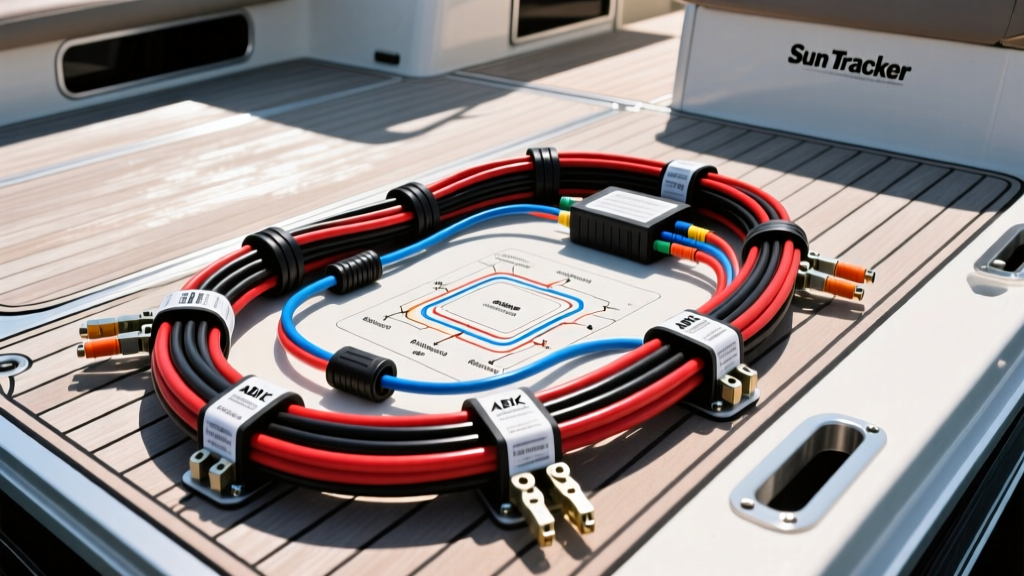
Introduction to Sun Tracker Electrical Architecture
When maintaining or upgrading a Sun Tracker pontoon, understanding the underlying electrical architecture is critical. Built by the Tracker Marine Group (White River Marine Group), these vessels utilize a centralized helm module that routes the main wiring harness through the port-side pontoon log or beneath the deck via corrugated split loom. While the factory Sun Tracker pontoon wiring diagram provides a solid baseline, owners frequently face issues related to voltage drop, harness chafing, and galvanic corrosion. Upgrading or repairing this system requires a strict adherence to marine-grade standards. This guide provides a comprehensive cost and tool requirements analysis to help you budget and equip your shop for a professional-grade marine electrical overhaul.
Mandatory Tool Requirements for Marine-Grade Rewiring
Automotive tools are insufficient for the harsh, high-vibration, and moisture-rich environment of a pontoon boat. To ensure connections meet ABYC E-11 standards, you must invest in specialized marine electrical tools. Below is the required tooling checklist for a proper Sun Tracker rewiring project.
- Ratcheting Marine Wire Crimper: Standard automotive crimpers often pierce the heat-shrink insulation or fail to compress the wire barrel adequately. A ratcheting crimper designed specifically for insulated marine terminals (such as the Ancor 200000 series or Ideal 33-806) ensures a gas-tight connection that withstands engine vibration.
- Dual-Temperature Heat Gun: Adhesive-lined marine heat shrink requires precise heat application to melt the inner polyamide sealant without scorching the outer polyolefin tubing. A heat gun with a 250°F (120°C) low setting and a 500°F (260°C) high setting is mandatory.
- Precision Wire Strippers: Tinned marine copper is more brittle than bare automotive copper. Use stepped, self-adjusting wire strippers (like the Klein Tools 11063W) calibrated for 22-8 AWG to avoid nicking the individual wire strands, which creates a failure point for corrosion.
- Digital Multimeter (DMM) with Marine Probes: A True-RMS multimeter (e.g., Fluke 87V) with piercing, waterproof silicone test leads is required to test voltage drop across the 20-to-24-foot harness runs typical of Sun Tracker pontoons.
- Corrosion Inhibitor & Dielectric Grease: Products like Boeshield T-9 or Marine Grease are required for coating busbar studs and battery terminals post-crimping.
Cost Analysis: Automotive vs. Marine-Grade Components
The most common mistake DIY pontoon owners make is sourcing wire and terminals from local automotive parts stores. While the upfront cost is lower, the lifespan of these components in a marine environment is drastically reduced. Tinned copper wire resists the capillary action of water that causes black wire rot in untinned automotive wire. Below is a cost comparison for a standard 10 AWG bilge and livewell pump rewiring project on a 22-foot Sun Tracker.
| Component | Automotive-Grade Cost | Marine-Grade Cost (UL 1426) | Lifespan & Failure Risk |
|---|---|---|---|
| 10 AWG Wire (100 ft spool) | $35.00 (Untinned) | $95.00 (Tinned Copper) | Auto: 2-3 years (high corrosion). Marine: 15+ years. |
| Ring Terminals (50 pk, 10 AWG) | $8.50 (Vinyl insulated) | $28.00 (Adhesive Heat Shrink) | Auto: High vibration failure. Marine: Waterproof seal. |
| 100A Busbar (6 stud) | $14.00 (Brass/Nickel) | $45.00 (Tin-Plated Copper) | Auto: Galvanic corrosion. Marine: Excellent conductivity. |
| Split Loom & Zip Ties | $12.00 (Standard Nylon) | $35.00 (UV & Salt Resistant) | Auto: Brittle in 1 season. Marine: UV stabilized. |
| Total Estimated Material Cost | $69.50 | $203.00 | Marine upgrade prevents stranded weekends and fires. |
Decoding the Sun Tracker Pontoon Wiring Diagram
To accurately trace faults or install new accessories, you must understand the ABYC color codes utilized in the Tracker Marine Group harnesses. The main harness typically connects to the helm dash via a 14-pin or 16-pin sealed Deutsch or Molex connector. When referencing your specific factory manual, cross-reference the pinout with the standard ABYC E-11 color codes below.
Main Helm Connector Pinout Reference
| Pin Number | Wire Color | Function / Circuit | Typical AWG Size |
|---|---|---|---|
| Pin 1 | Red | 12V+ Unprotected Battery Feed | 8 or 10 AWG |
| Pin 2 | Yellow | DC Ground (Return to Battery) | 8 or 10 AWG |
| Pin 3 | Purple | Ignition Switched 12V+ (Accessories) | 14 AWG |
| Pin 4 | Blue | Navigation / Anchor Lights | 16 AWG |
| Pin 5 | Brown | Bilge Pump (Float Switch Direct) | 14 or 16 AWG |
| Pin 6 | Green | Blower Motor | 14 AWG |
| Pin 7 | White | Courtesy / Deck Lighting | 16 AWG |
| Pin 8 | Black | AC Ground / Shield (if equipped) | N/A |
Note: Never use Black wire for DC Ground on a marine vessel. ABYC strictly designates Yellow for DC Ground to prevent fatal confusion with AC shore power grounding systems.
Hidden Costs: Voltage Drop and Harness Routing
When analyzing the cost of a Sun Tracker pontoon wiring diagram upgrade, the hidden cost of voltage drop is frequently overlooked. Pontoons require exceptionally long wire runs. A 24-foot Sun Tracker Party Barge requires a minimum of 48 feet of total wire (positive and negative) to reach a component at the stern from the bow-mounted battery bank.
According to Ancor Marine Wire specifications, a 10 AWG wire has a resistance of approximately 1.0 ohm per 1,000 feet. If you are running a 5-amp livewell pump on a 48-foot round trip using 14 AWG wire (resistance ~2.5 ohms/1000ft), the voltage drop will exceed the 3% ABYC maximum limit for critical navigation and pumping circuits. This results in a weak pump motor that burns out prematurely.
The Fix: Upgrading stern-bound circuits (bilge, livewell, stern nav light) from 14 AWG to 10 AWG or 8 AWG. This increases your material cost by roughly $40 but saves the $150 cost of replacing burnt-out pumps and the catastrophic cost of a sinking vessel.
Routing and Chafing Prevention
The corrugated split loom used in older Sun Tracker models often traps water against the wire insulation, accelerating degradation. Furthermore, where the harness passes through the aluminum cross-members, vibration acts like a saw. Budget an additional $35 for marine-grade nylon braided sleeving and heavy-duty rubber grommets to protect the harness where it penetrates the aluminum deck and pontoon logs.
Return on Investment (ROI) and Longevity
Is the 300% price premium for marine-grade tinned wire, adhesive heat shrink, and ratcheting crimpers worth it? Absolutely. Automotive wire relies on a thin enamel coating on the copper strands. In a humid pontoon environment, capillary action draws moisture under the wire jacket, oxidizing the copper from the inside out. This increases resistance, generates excess heat, and ultimately causes electrical fires or dead batteries while on the water.
By investing approximately $250 in premium materials and $150 in the correct ratcheting crimpers and heat guns, you effectively future-proof your Sun Tracker's electrical system for the next 15 to 20 years. More importantly, you ensure that your bilge pumps and navigation lights operate at 100% efficiency, keeping your vessel safe, compliant with Coast Guard regulations, and reliable for every outing.