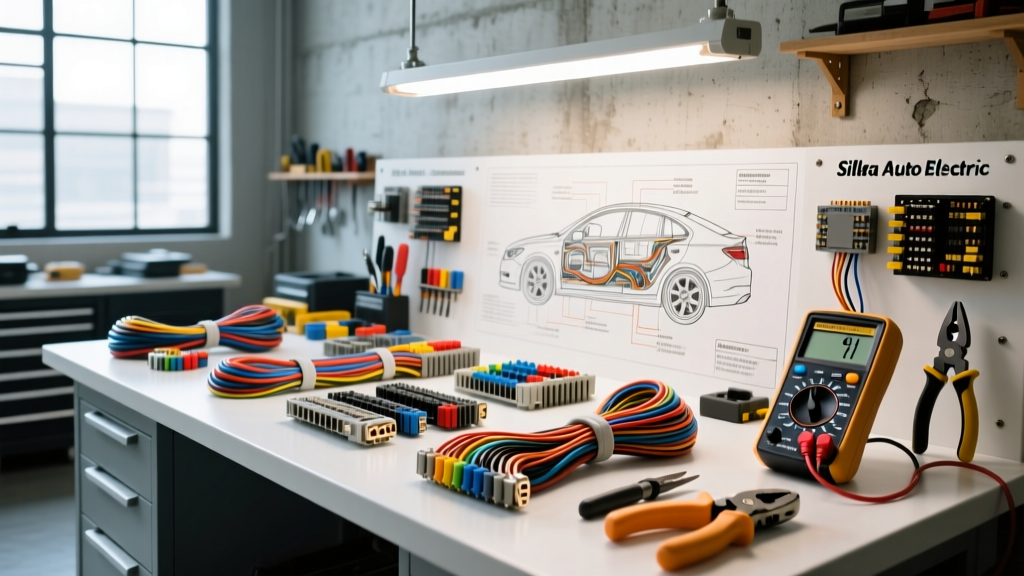
The "Silva Auto Electric" Standard in Modern Diagnostics
When benchmarking against the operational model of a premier facility like Silva Auto Electric, independent technicians and shop owners quickly realize that modern automotive electrical repair extends far beyond swapping alternators and testing batteries. Today's vehicles rely on complex multiplexed networks, high-voltage architectures, and sensitive ECU modules. To diagnose a parasitic draw on a late-model European sedan or fabricate a custom engine harness for a retrofit, a shop must invest in professional-grade diagnostic hardware, precision crimping tooling, and comprehensive wire inventories.
This cost and tool requirements analysis breaks down the exact capital expenditure needed to build a high-end auto electrical diagnostic bay. We will examine the specific oscilloscopes, terminal crimpers, CAN bus breakout tools, and wire gauges required to operate at an elite level, ensuring repairs meet OEM and SAE/USCAR-21 crimp validation standards.
Tier 1: Advanced Signal & Network Diagnostics
The cornerstone of any top-tier electrical shop is the automotive oscilloscope. Digital Multimeters (DMMs) are insufficient for analyzing fast-acting PWM (Pulse Width Modulation) signals or decoding network faults. A facility operating at the Silva Auto Electric benchmark relies on 4-channel scopes to capture simultaneous sensor and actuator waveforms.
Oscilloscopes and CAN Bus Breakout Tools
The industry standard is the PicoScope 4425A or 4823. These units offer up to 200 MHz bandwidth and deep memory buffers, allowing technicians to capture a CAN bus network fault that only occurs once every 45 minutes. To properly interface with the vehicle's network without piercing wires—which compromises the TXL wire insulation and invites corrosion—shops must invest in OBD-II breakout boxes and back-probes.
- CAN Bus Topology: Standard J1962 OBD-II Pin 6 (CAN-High) and Pin 14 (CAN-Low). CAN-H typically idles at 2.5V and drives to 3.5V, while CAN-L idles at 2.5V and drives to 1.5V. The termination resistance across the network must measure exactly 60 ohms (two 120-ohm resistors in parallel at the network ends).
- Current Clamps: A 600A DC/AC current clamp (like the Pico TA018) is mandatory for analyzing starter motor inrush current and alternator ripple AC voltage. A failing alternator diode bridge will show excessive AC ripple (above 50mV AC on a 14V DC charging system), which can corrupt CAN bus data.
According to Pico Technology, capturing the exact voltage drop across a fuel injector solenoid while simultaneously measuring the current ramp allows a technician to verify both the electrical integrity of the coil and the mechanical seating of the injector pintle, saving hours of unnecessary parts swapping.
Tier 2: Harness Fabrication & Terminal Tooling
A major differentiator for an elite auto electrician is the ability to repair and fabricate harnesses rather than replacing entire multi-thousand-dollar OEM wiring assemblies. This requires a deep inventory of automotive-grade wire and precision crimping dies.
Crimping Standards and Wire Inventories
Standard PVC wire has no place under the hood. Professional shops stock TXL (Thin Cross-Linked), GXL, and SXL wire, which feature cross-linked polyethylene insulation capable of withstanding continuous temperatures up to 125°C (257°F) and resisting battery acid, oil, and abrasion.
| Equipment Category | Specific Tool / Inventory | Est. Cost (USD) | Technical Justification |
|---|---|---|---|
| Diagnostics | PicoScope 4823 (8-Channel) w/ Probes | $4,500 | Simultaneous capture of CAM, CRANK, and Injector waveforms for timing correlation. |
| Terminal Crimping | Rennsteig/Asta Ratcheting Crimpers (Deutsch, TE, Molex) | $1,200 | Ratcheting mechanism ensures exact crimp height; mandatory for USCAR-21 pull-test compliance. |
| Wire Inventory | TXL Wire Spools (8, 10, 12, 14, 16, 18 AWG) | $650 | High-temp cross-linked insulation; matches OEM harness flexibility and current capacity. |
| Connectors | Deutsch DT, TE AMPSEAL, Molex MX150 Kits | $1,800 | Weatherproof (IP67/IP69K) connections for under-hood and chassis routing. |
| Thermal | FLIR ONE Pro or Seek Thermal CompactPRO | $500 | Identifies high-resistance grounds and shorted voltage regulator diodes via heat signatures. |
| Soldering | Hakko FX-888D w/ Marine Grade Heat Shrink | $250 | Adhesive-lined polyolefin heat shrink prevents capillary action of water into wire strands. |
When crimping terminals, the shop must adhere to strict die selections. For example, crimping a Deutsch Size 16 contact for a 16 AWG wire requires a specific die cavity that compresses the wire barrel without cutting the strands. The SAE/USCAR-21 standard dictates that a proper crimp must pass a specific pull-force test (e.g., a 16 AWG wire must withstand a minimum pull force of 50 lbs before the wire breaks, and the wire must break before the crimp fails).
Tier 3: Parasitic Draw & High-Current Load Testing
Parasitic draw testing on modern vehicles with dozens of CAN-linked modules requires extreme care. Disconnecting the battery to insert a DMM in series often wakes up the vehicle's modules, masking the fault. The Silva Auto Electric methodology relies on voltage drop testing across fuses.
The Millivolt Drop Method
By measuring the millivolt (mV) drop across the metal test points on the top of a standard Mini or ATO fuse, a technician can calculate the exact amperage flowing through the circuit without breaking the connection. Using the Littelfuse Fuse Selection and Voltage Drop Charts, a technician can cross-reference the mV reading to the specific fuse size.
- Example: A 10A Mini Fuse showing a 1.2 mV drop correlates to approximately 0.15A (150mA) of continuous draw. If the vehicle's acceptable sleep-state draw is 50mA, the technician knows this specific circuit is the culprit.
- High-Current Feeds: For alternator and starter diagnostics, 4 AWG and 8 AWG TXL wire is standard. Voltage drop across these heavy cables should never exceed 0.1V (100mV) per cable under full load. A reading of 0.5V on the starter positive feed indicates severe terminal corrosion or undersized aftermarket wiring.
Summary: ROI of Professional Electrical Tooling
Replicating a high-end diagnostic environment requires an initial capital investment of roughly $8,000 to $12,000 in specialized electrical tooling. However, the ROI is realized in the ability to accurately diagnose complex network faults, repair proprietary harnesses, and eliminate the "parts cannon" approach to electrical repair. By utilizing proper TXL wiring, OEM-style sealed connectors, and advanced oscilloscope diagnostics, an independent shop can confidently tackle the most stubborn electrical gremlins on the market, providing a level of service that rivals or exceeds dealership capabilities.