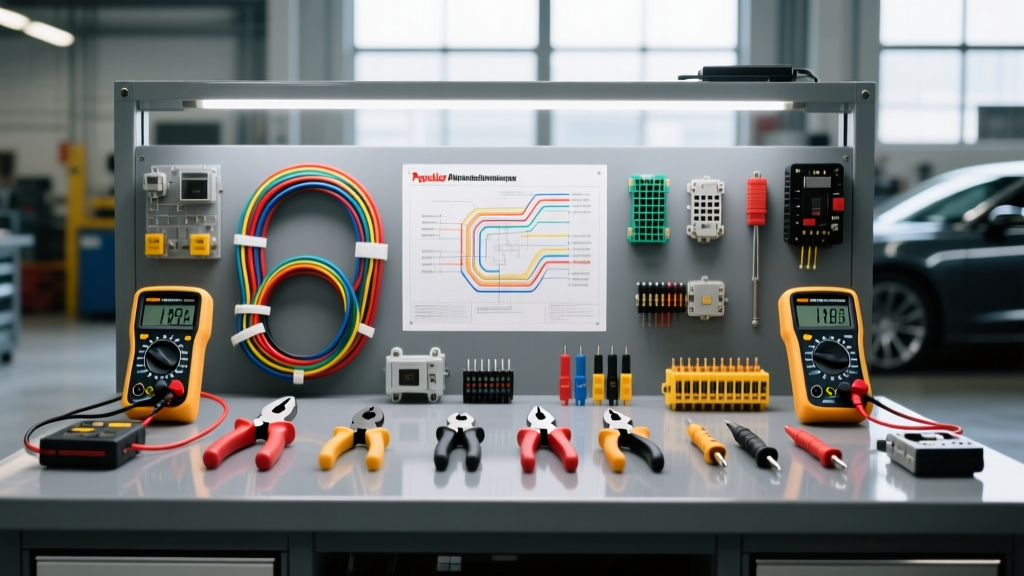
Benchmarking Elite Auto Electrical Diagnostics
When benchmarking against elite diagnostic facilities like Master Tech Auto Electric Inc, it becomes immediately clear that modern automotive electrical repair is no longer about simple continuity testing or swapping relays. Today's vehicles feature complex multiplexed networks, high-voltage EV architectures, and pulse-width modulated (PWM) sensor circuits that require laboratory-grade diagnostic equipment. Transitioning from a general mechanic to a master-level electrical diagnostician requires a significant capital expenditure (CapEx) in specialized tooling, software, and infrastructure. This analysis breaks down the exact tool requirements, technical specifications, and associated costs required to build an auto electrical diagnostic bench that meets the rigorous standards of top-tier facilities.
The Diagnostic Backbone: Oscilloscopes and Multimeters
The foundation of any Master Tech-level electrical bay is the digital storage oscilloscope (DSO). While a Digital Multimeter (DMM) is sufficient for measuring static voltage, resistance, and basic continuity, it is entirely blind to the microsecond-level signal drops and data bus corruption that plague modern CAN (Controller Area Network) and LIN (Local Interconnect Network) systems.
Oscilloscope Specifications for Modern Networks
Standard high-speed CAN bus operates at 500 kbps, but newer CAN-FD (Flexible Data-Rate) networks push data rates up to 8 Mbps. To accurately capture the rising and falling edges of a CAN-FD signal without aliasing or missing intermittent glitches, your scope must meet strict hardware thresholds. According to Pico Technology's automotive training standards, a minimum sampling rate of 1 GS/s (gigasample per second) and a bandwidth of 100 MHz are mandatory for advanced network diagnostics. A 4-channel scope is the bare minimum, allowing technicians to simultaneously monitor CAN-H, CAN-L, the sensor 5V reference, and the module ground to identify voltage offset issues.
DMM and Safety Ratings
For static measurements, a high-impedance DMM is required. However, safety is paramount when working near hybrid/EV DC-DC converters or high-output alternators. Technicians must use meters rated for CAT III 1000V or CAT IV 600V to withstand transient voltage spikes. The Fluke CAT rating guidelines emphasize that using an under-rated meter on vehicle power distribution circuits can result in catastrophic arc flash incidents.
| Equipment | Required Specification | Est. Cost | Primary Application |
|---|---|---|---|
| 4-Channel DSO | 100 MHz Bandwidth, 1 GS/s, 200mV/div resolution | $2,200 | CAN-FD, PWM injector, cam/crank correlation |
| Automotive DMM | CAT III 1000V, 10MΩ impedance, Min/Max recording | $550 | Battery load, static voltage drop, resistance |
| Hall-Effect Clamp | 0-60A DC/AC, 1mV/10mA resolution | $400 | Parasitic draw, starter inrush, alternator ripple |
| Power Probe | Circuit breaker protected, 12V/24V auto-detect | $350 | Rapid relay testing, ground integrity verification |
Parasitic Draw and Sleep Cycle Analysis
One of the most common misdiagnoses in general repair shops involves parasitic battery draws. A novice technician will often pull a fuse, wait for the vehicle to sleep, and then insert a shunt-based DMM in series with the battery terminal. This is a critical error. The moment a control module wakes up and draws more than the DMM's 10A fuse limit, the fuse blows. More importantly, the voltage drop across the DMM's internal shunt can cause sensitive modules to reset, artificially extending the sleep cycle and leading to false high-draw readings.
A Master Tech Auto Electric Inc setup mandates the use of a Hall-effect current clamp paired with an oscilloscope or high-resolution DMM. By clamping over the negative battery cable, the technician introduces zero resistance into the circuit. The vehicle is allowed to enter its natural sleep state (which can take up to 45 minutes on late-model European platforms), and the scope records the exact millisecond a module wakes up, allowing the technician to correlate the draw spike with specific network traffic or thermal expansion events.
Wiring Standards, Crimping, and Terminal Tooling
Electrical repairs are only as reliable as the physical connection. Twisting wires and covering them with electrical tape is strictly prohibited in professional environments. All repairs must adhere to SAE J1128 standards for low-tension primary cables, utilizing Cross-Linked Polyethylene (XLPE) insulated wires such as GXL, TXL, or SXL. These insulations withstand under-hood temperatures up to 150°C, unlike standard PVC wire which becomes brittle and melts.
Wire Gauge and Application Matrix
- 18 AWG (0.8mm²): Standard for CAN-H/CAN-L networks, 5V sensor references, and low-current module grounds.
- 14 AWG (2.0mm²): Used for high-current sensors, heated oxygen sensor (HO2S) heater circuits, and fuel injector power feeds.
- 10 AWG (5.0mm²): Reserved for alternator B+ sense circuits, main ECU power feeds, and high-draw cooling fan relays.
Precision Crimping Infrastructure
Open-barrel terminals (like the AMP Superseal 1.5 series or Deutsch DT connectors) require specialized ratcheting crimpers. A proper crimp must achieve a specific compression ratio to ensure a gas-tight connection, preventing oxidation and micro-arcing. For 18 AWG to 20 AWG wires, the wire strip length must be exactly 4.5mm. The insulation crimp must grip the XLPE jacket without piercing it, while the conductor crimp must deform the terminal ears inward, creating a cold-weld effect. Investing in OEM-equivalent ratcheting crimpers (such as those from TE Connectivity or Hozan) costs upwards of $800 but prevents the intermittent high-resistance faults that cause endless diagnostic headaches.
Multiplex Network Topology and Breakout Testing
Diagnosing communication faults (U-codes) requires an intimate understanding of the OBD-II Data Link Connector (DLC) J1962 pinout and network topology. The standard high-speed CAN bus relies on a 120-ohm terminating resistor network. By measuring resistance across Pin 6 (CAN-H) and Pin 14 (CAN-L) with the vehicle powered down, a technician should read exactly 60 ohms (two 120-ohm resistors in parallel). If the reading is 120 ohms, one terminating module is missing or disconnected; if it reads near 0 ohms, the network is shorted together.
To test these circuits under load without back-probing and damaging the delicate terminal tension, Master Tech facilities utilize DLC breakout boxes. These boxes allow technicians to monitor the CAN-H and CAN-L voltages simultaneously. In a healthy dormant state, CAN-H sits at roughly 2.6V and CAN-L at 2.4V. When active, CAN-H spikes toward 3.5V and CAN-L drops toward 1.5V. A breakout box with integrated LED indicators and switchable termination resistors ($250) is an absolute necessity for isolating bus-down conditions without risking a short circuit with multimeter probes.
Total Capital Expenditure (CapEx) Summary
Building a diagnostic bay capable of handling everything from parasitic draw sleep-cycle analysis to CAN-FD waveform decoding requires a strategic investment. Below is the estimated CapEx required to outfit a single bay to Master Tech Auto Electric Inc specifications.
| Category | Item Description | Estimated Investment |
|---|---|---|
| Diagnostic Hardware | 4-Channel Scope, DMM, Current Clamps, Power Probe | $3,500 |
| Network Testing | DLC Breakout Boxes, OEM-specific adapter cables | $600 |
| Terminal & Wiring | Ratcheting Crimpers, Pin Extraction Sets, GXL Wire Spools | $1,200 |
| Consumables | Deutsch/AMP Terminals, Heat Shrink, Solder Sleeves | $800 |
| Software & Data | Alldata/Mitchell1, OEM Techstream Subscriptions (Annual) | $2,500 |
| Total Estimated Bay Setup Cost | $8,600 | |
Conclusion
The transition to elite-level automotive electrical diagnostics is not cheap, but it is entirely necessary in an era where a single corroded 18 AWG ground wire or a 50-millivolt drop on a CAN bus can disable a vehicle's advanced driver-assistance systems (ADAS). By investing in laboratory-grade oscilloscopes, SAE-compliant crimping tooling, and rigorous network testing protocols, technicians can eliminate guesswork, reduce comebacks to near zero, and command premium diagnostic labor rates that quickly offset the initial tooling investment.