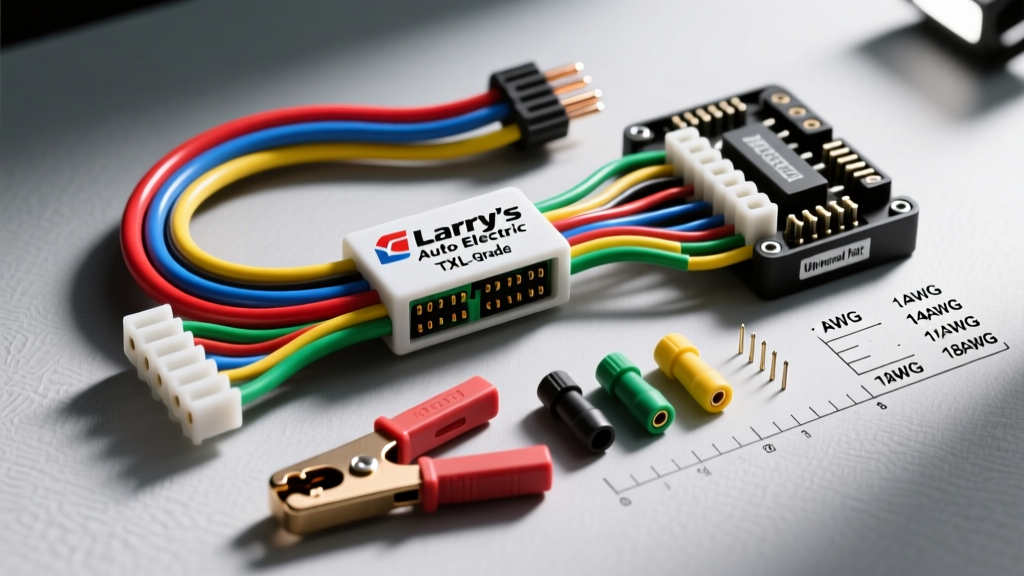
The Core Debate: Custom Shop vs. Universal Aftermarket Kits
When wiring a restomod, classic truck, or custom hot rod, the electrical architecture dictates the vehicle's long-term reliability and safety. Modern upgrades like electronic fuel injection (EFI), high-amperage electric cooling fans, and vintage air conditioning systems drastically increase the electrical load compared to factory-original setups. Enthusiasts generally face a critical crossroads: purchase an off-the-shelf universal 21-circuit aftermarket kit, or commission a bespoke harness from a specialized builder like Larry's Auto Electric. This selection guide breaks down the technical differences in wire specifications, connector ecosystems, circuit routing, and fusing strategies to help you choose the right electrical foundation for your build.
Wire Insulation & Conductor Specifications
The most significant differentiator between a universal budget kit and a premium custom harness is the wire jacket material. Most entry-level universal kits utilize standard PVC (Polyvinyl Chloride) or basic GXL wire. While adequate for low-draw circuits, PVC becomes brittle over time when exposed to the extreme under-hood temperatures generated by modern LS or Coyote V8 swaps. Furthermore, PVC insulation is notoriously thick, making harness wrapping and routing through tight firewall grommets a frustrating endeavor.
Conversely, boutique electrical shops and premium harness builders adhere strictly to SAE J1128 standards, favoring TXL (Thin-wall Cross-Linked Polyolefin) wire. TXL features a cross-linked molecular structure that withstands continuous temperatures up to 125°C (257°F) and intermittent spikes up to 150°C. The thin-wall design reduces the overall diameter of the wire without sacrificing the copper conductor's cross-sectional area, resulting in a harness that is up to 30% lighter and significantly more flexible than PVC equivalents.
SAE Wire Standard Comparison Chart
| Wire Type | Insulation Material | Max Continuous Temp | Wall Thickness (12 AWG) | Best Application |
|---|---|---|---|---|
| PVC | Polyvinyl Chloride | 105°C (221°F) | 0.58 mm | Interior, low-heat trunk circuits |
| GXL | Cross-Linked PVC | 125°C (257°F) | 0.48 mm | General chassis routing |
| TXL | Cross-Linked Polyolefin | 125°C (257°F) | 0.41 mm | Engine bays, tight firewall bends |
| SXL | Cross-Linked Polyolefin | 125°C (257°F) | 0.55 mm | Heavy abrasion zones, chassis rails |
Connector Ecosystem: Weather-Pack vs. Metri-Pack 2.8
Universal kits almost exclusively rely on the legacy Weather-Pack connector series. Originally designed by Packard Electric in the 1970s, Weather-Pack connectors are robust and feature a silicone ribbed seal. However, their massive physical footprint makes them impractical for modern, densely packed engine bays, and their pin retention mechanism can fail under high-vibration conditions if not properly crimped.
High-end custom builders, including the methodologies championed by Larry's Auto Electric, have migrated to the OEM-standard Aptiv (formerly Delphi) Metri-Pack 2.8 sealed series. The '2.8' refers to the 2.8mm width of the male blade terminal. Metri-Pack connectors offer a vastly superior power-to-size ratio, allowing for multi-pin configurations (up to 6 or 8 ways) in a fraction of the space required by Weather-Pack. Furthermore, Metri-Pack utilizes a positive lock terminal retention system (PLT) that prevents the terminal from backing out of the housing when the wire is pulled, a common failure mode in poorly assembled universal kits.
For extreme environments, such as transmission-mounted speed sensors or fuel pump modules submerged in the tank, custom builders will upgrade to Deutsch DT or Amphenol ATP series connectors, which utilize a secondary wedge lock and fluorosilicone seals rated for continuous fluid immersion.
Circuit Architecture: Relay Integration & Fusing
The hallmark of a professional-grade harness is the implementation of relay-driven high-current circuits. A common flaw in budget universal kits is routing high-amperage loads (like headlights or radiator fans) directly through the dashboard switches. This causes severe voltage drop and premature switch failure due to arcing.
Custom harnesses utilize Bosch-style ISO mini relays (DIN 72552 standard) to isolate the high-current load from the low-current trigger switch. Let's examine a properly engineered headlight circuit using Hella's DIN 72552 relay pinout standards:
- Pin 30 (Common): 10 AWG TXL wire directly from the main fuse block (fed by a 30A Maxi fuse).
- Pin 87 (Normally Open): 10 AWG TXL wire routing to the headlamp connector.
- Pin 86 (Coil +): 18 AWG wire receiving 12V ignition-switched power.
- Pin 85 (Coil -): 18 AWG wire routing to the dashboard headlight switch, which completes the circuit to ground.
By keeping the high-current 10 AWG runs extremely short (mounting the relay bank near the battery or front core support), voltage drop is virtually eliminated.
The Voltage Drop Mathematics
Why does wire gauge and routing length matter? Consider a 130W headlight pair drawing roughly 10 Amps. If a universal kit uses 14 AWG wire (4,110 Circular Mils) for a 15-foot run (30 feet total circuit length including ground), the voltage drop is calculated as: VD = (12.9 x 10A x 30ft) / 4110 = 0.94 Volts. If your alternator is outputting 14.2V, the headlights only see 13.26V, resulting in a noticeable dimming and a shift in halogen color temperature.
If a custom harness uses 10 AWG wire (10,380 Circular Mils) and mounts the relay just 5 feet from the lamps (10 feet total circuit length), the drop is: VD = (12.9 x 10A x 10ft) / 10380 = 0.12 Volts. The lamps receive 14.08V, maximizing lumen output and extending bulb life. This level of engineering is rarely found in flat-rate universal boxes.
Grounding Architecture: Star vs. Daisy Chain
Electrical current only flows when it has a complete path back to the source (the battery/alternator). Universal kits often provide generic 'daisy-chain' ground wires, expecting the builder to daisy-chain multiple sensors and accessories to a single chassis bolt. This creates ground loops, electromagnetic interference (EMI), and erratic ECU behavior.
Professional auto electricians employ a Star Grounding topology. A central ground bus bar (typically constructed from 1/4-inch thick copper busbar) is bolted directly to the engine block or chassis using a minimum of 4 AWG braided copper strap. From this single, verified zero-resistance node, individual 14 AWG or 12 AWG ground wires radiate outward to each specific component. Every ring terminal is crimped using a closed-barrel hex crimp tool, sealed with adhesive-lined 3:1 shrink tubing, and coated in dielectric grease before being torqued to the manufacturer's specification.
Final Selection Matrix: Which Route Should You Take?
Choosing between a universal kit and a custom-built solution from a specialist like Larry's Auto Electric ultimately depends on your budget, timeline, and the complexity of your build.
Choose a Universal Aftermarket Kit If:
- You are restoring a stock vehicle with minimal electrical upgrades (e.g., standard alternator, carbureted engine, no AC).
- You are on a strict sub-$500 budget for the entire wiring system.
- You possess the patience to label, trace, and modify generic circuits to fit your specific chassis dimensions.
- The vehicle will be a weekend cruiser with low annual mileage.
Choose a Custom Auto Electrical Builder If:
- Your build features modern CAN-bus systems, standalone EFI (Haltech, Holley Terminator X), or digital dash clusters that require shielded twisted-pair wiring.
- You demand OEM-level aesthetics, utilizing factory-style split-loom, Tesa tape, and molded firewall bulkheads.
- The vehicle is a high-vibration track car or daily driver where connector retention and TXL heat resistance are non-negotiable.
- You want a 'plug-and-play' experience where every connector is pre-mated, labeled, and routed to exact chassis measurements, saving dozens of hours in the garage.
While universal kits serve a purpose in the budget restoration market, the long-term reliability, superior materials, and precise circuit engineering provided by dedicated auto electrical specialists ensure that your vehicle's nervous system will perform flawlessly for decades.